
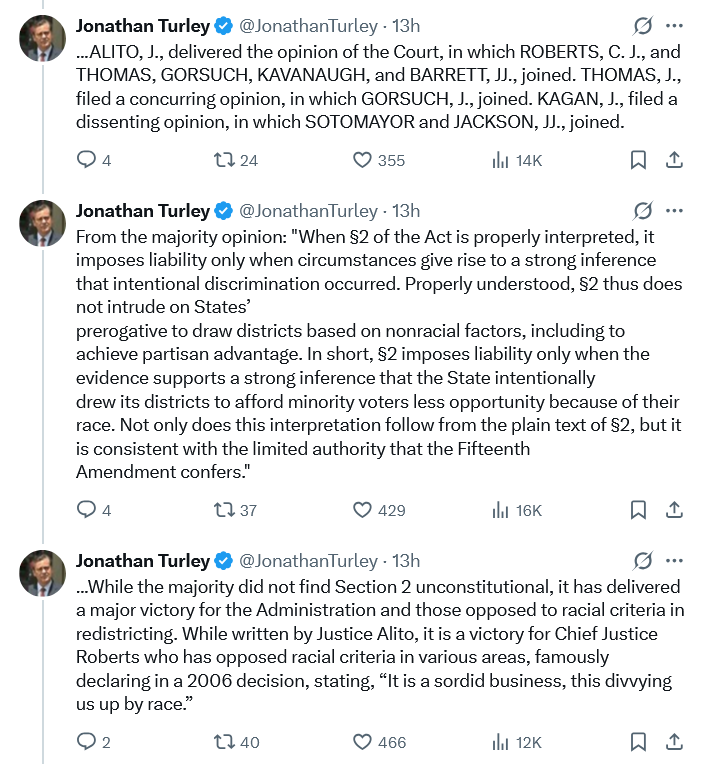
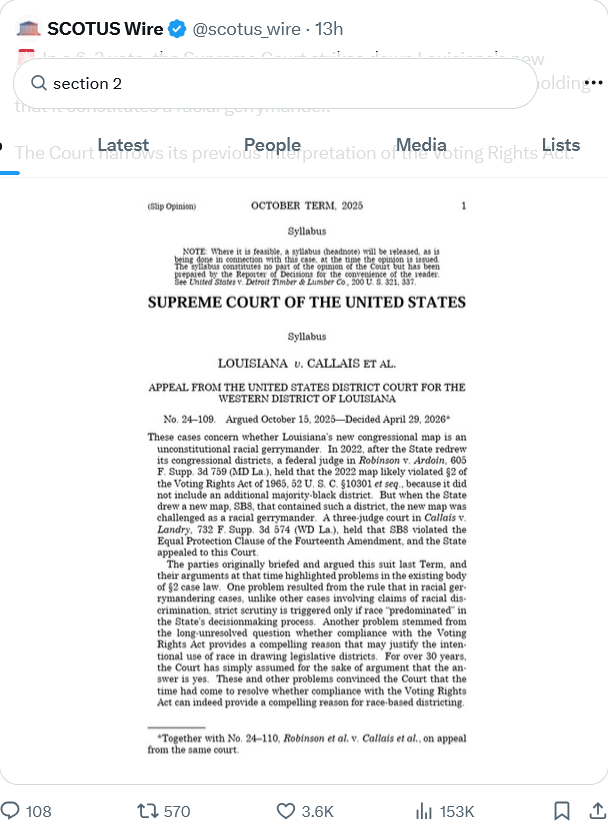
What we are left with now is that gerrymandering for race is unconstitutional while gerrymandering for partisan advantage is constitutional. The Supreme Court got into this morass in the sixties, and now it has gotten the Federal courts out of the business of the policing of electoral districts in the states. This is all to the good, as the racial spoils system instituted in the sixties was always grossly unconstitutional. The days are long gone when blacks could not run for elective office solely due to their skin color. Our divisions when it comes to politics are partisan and not racial. A good day for the Constitution. Go here to read the text of the decision. Justice Thomas is majestic in his brief concurring opinion:
JUSTICE THOMAS, with whom JUSTICE GORSUCH joins,
concurring.
I join the Court’s opinion in full. This Court should never
have interpreted §2 of the Voting Rights Act of 1965 to ef-
fectively give racial groups “an entitlement to roughly pro-
portional representation.” Thornburg v. Gingles, 478 U. S.
30, 93 (1986) (O’Connor, J., concurring in judgment); see
ante, at 23–24. By doing so, the Court led legislatures and
courts to “systematically divid[e] the country into electoral
districts along racial lines.” Holder v. Hall, 512 U. S. 874,
905 (1994) (THOMAS, J., concurring in judgment). “Blacks
[we]re drawn into ‘black districts’ and given ‘black repre-
sentatives’; Hispanics [we]re drawn into Hispanic districts
and given ‘Hispanic representatives’; and so on.” Ibid. That
interpretation rendered §2 “repugnant to any nation that
strives for the ideal of a color-blind Constitution.” Id., at
905–906. Today’s decision should largely put an end to this
“disastrous misadventure” in voting-rights jurisprudence.
As I explained more than 30 years ago, I would go further
and hold that §2 of the Voting Rights Act does not regulate
districting at all. See id., at 922–923. The relevant text
prohibits States from imposing or applying a “voting quali-
fication,” “prerequisite to voting,” or “standard, practice, or
procedure,” in a manner that results in a denial or abridge-
ment of the right to vote based on race. 52 U. S. C.
§10301(a). How States draw district lines does not fall
within any of those three categories. Holder, 512 U. S., at
922–923 (opinion of THOMAS, J.); Allen v. Milligan, 599
U. S. 1, 46 (2023) (THOMAS, J., dissenting). The words in §2
instead “reach only ‘enactments that regulate citizens’ ac-
cess to the ballot or the processes for counting a ballot’; they
‘do not include a State’s . . . choice of one districting scheme
over another.’ ” Ibid. (quoting Holder, 512 U. S., at 945
(opinion of THOMAS, J.)). Therefore, no §2 challenge to districting should ever succeed.


It’s been a while since I looked into this, but the majority-minority district may hurt the Democrats by packing their strongest supporters together. So this decision could increase the number of Democrats in Congress. But right is right, so good for the Court.
IANAL, but it seems to me the significance of this will be to reduce the quantum of lawfare which is appended to the redistricting process and the opportunities for Democratic operatives in robes to invalidate Republican maps while sustaining Democratic maps.
==
It’s not difficult to design a redistricting process which makes use of minimal discretion and distributes the discretion you have to exercise to local boards made up of judges or elections commissioners. You do have to accept, though, that the population of districts will vary some (by a range of about 2:1 in re the case of lower houses of state legislatures – i.e. between 0.62 x and 1.25x the average population of a district).
==
Much more concerned about birthright citizenship. That practice is gangrene.
t’s been a while since I looked into this, but the majority-minority district may hurt the Democrats by packing their strongest supporters together. So this decision could increase the number of Democrats in Congress.
==
That was the claim made by The New Republic contra Wm. Bradford Reynolds litigation during the Reagan Administration.(And that it was helpful to a certain sort of black Democratic pol and injurious to every other sort of pol). The thing is, white Democrats representing districts in Southern states tend to be from non-Southern subregions in Southern states (the corridor running from NoVa to the Philadelphia suburbs, peninsular Florida, and the El Paso / Rio Grande / Desert portion of Texas) or to represent quite peripheral areas (greater Louisville), or to be the odd white man representing a minority district (the guy from Memphis). Packing the districts and contrivances like ballot harvesting are the options they actually have in the South. Outside the South, blacks tend to be heavily concentrated in core city neighborhoods, so you don’t have to resort to contrivances to generate them and it’s not possible to generate them outside of core city areas.
It’s about time.
The amount of BS we leave unchallenged is maddening.
The most important thing this court has done is to get themselves back in their proper lane. We don’t need courts reviewing every single thing that the elected representatives decide. I’d almost rather be ruled by an imperial presidency than an imperial Judiciary appointed for life although neither is ideal.
And to prove Don’s point about our decisions being made primarily on politics rather than race, I’d vote for Clarence Thomas for any elective office over Mitch McConnell. 100 times out of 100.
This is fantastic. I hope ours are redrawn soon and a certain someone loses his seat