
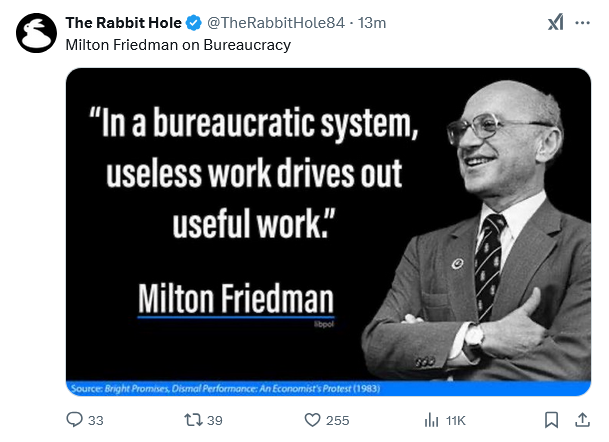
The corollary to this is the Iron Law of Bureaucracy:
in any bureaucracy, there are two types of workers in the bureaucracy: those who work to further the purported goals of the bureaucracy, and those who work for the bureaucracy itself to sustain it as an organization, with the latter group typically having more influence and control over the bureaucracy despite not being focused on achieving the purported goals for which the bureaucracy was created in the first place. Eventually the existence of the bureaucracy becomes an end unto itself, and the foremost goal, if unstated, of the bureaucracy.



Even those not primarily employed by the bureaucracy may see their work as tied to the unnecessary regulations the bureaucracy mandates to sustain itself.
Regulatory agencies can generate welfare losses in the larger society, but they generally do not employ that many people and have modest budgets. In recent years, the EPA and the FCC have been the agencies with the largest budgets. During the Obama years, about 10% of the budget of the EPA went to formulating and enforcing regulations. The rest went to patronage distribution to state and local governments and what you might call ‘environmental works projects’. Be amusing to see what the DOGE boys have to say about those projects. As for the FCC, in the mid-Obama years, > 85% of its budget went to financing telecom subsidies.
[…] Analysis, Punditry, and News:IVF Won’t MAGA – Nathanael Blake at The Federalist. . .Those Who Work for the Bureaucracy Itself to Sustain It as an Organization – The Am CatholicWhere Is America Headed, to Chaos or a Counter-Order – J Horvat at […]
Dr. Jerry Pournelle’s iron Law of Bureaucracy! You all know I am going to post this! 😉 From pro-nuclear blogger James Hopf on Twitter / X; the time for the US NRC’s comeuppance may be at hand.
—–
The White House has released an executive order that gives the president more oversight of “independent” regulatory agencies. It would subject all significant regulatory actions to presidential review. Link to executive order in reply.
The FTC, FCC, and SEC were specifically named in an also-released fact sheet (also linked in a reply), but it’s likely that the rules will apply to the NRC as well.
I actually agree with the principles discussed in Section 1 of the executive order. It initially seemed blasphemous, but I’ve come to the conclusion that agencies which have a narrow focus and are independent, are a bad thing. My reasons are those stated in the executive order. Such agencies are unaccountable to society at large.
Having groups that only look at part of an issue be in charge of policy causes problems. An example would be how health experts/scientists were largely calling the shots in terms of COVID response policy. Predictably, their entire focus was doing everything they could to reduce transmission risks and deaths, that being their wheelhouse. They gave little consideration to other factors like economic and societal costs, as well as the effect on child education.
The consensus now, looking back, is that this resulted in sub-optimal policies and decisions. That happened even though they were not strictly in charge. Actual decision makers just listened to them to various extents (some leaders overruled their advice and went with less strict policies in order to minimize economic, social and education impacts).
NRC (which is an actual independent, non-overrule-able agency) is a poster child example of this as well. I had long complained that NRC did not weigh nuclear’s benefits vs. its risks. Instead, their regulations’ goal was to minimize nuclear risks (specifically) at almost any cost. They didn’t care about the fact that such strict requirements were actually increasing public health and climate risks, by reducing nuclear use and increasing use of (orders of magnitude more harmful) fossil generation in its place.
In reply, NRC defenders would argue that “it’s not NRC’s job” to consider the impacts of energy sources that would take nuclear’s place, or to weigh nuclear’s benefits. It’s not their job to look at the big picture. An obvious response to that ridiculous view is to ask “who’s job is it then?” Their answer to that question appears to be “no one”. An absurd position.
If an agency has a narrow focus or mandate, such as NRC which only covers nuclear safety (vs. overall risks from energy production), its decisions must be subject to approval by a higher authority that is tasked with looking at the big picture, and is accountable to the public. Yes, the president would be an (or the) example, given that the NRC is part of the executive branch. As Truman said, “the buck stops here.”
The situation at NRC has improved with the passage of the ADVANCE Act. The law (and its authors, etc..) agrees that NRC should be required to consider the benefits of nuclear, and weigh them vs. its risks, when making regulatory decisions. After resisting initially, NRC appears to be willing to move in that direction.
But will it be enough to make a real difference? I’m rather skeptical. They may take some steps to streamline and quicken the licensing process. But I’m not confident that they will revise the terms of the licenses, i.e., the regulatory requirements and QA standards that are the main source of nuclear’s high costs.
If NRC were to truly embrace the notion of considering both benefits and risks, it would aim for a set or requirements that minimizes overall impacts from US power production. Both new and existing regulations would be subject to revision to achieve that goal. The simplest way to do that would be to require nuclear’s public health risks (deaths/kW-hr) to be equal to or better than those of gas generation, which is the primary, and accepted, alternative to nuclear. Stricter standards may be OK if they don’t significantly increase nuclear’s cost, or cause nuclear to be uncompetitive vs. fossil alternatives. The humble goal being not having regulations that actually increase public health risk by increasing fossil fuel use.
As shown in the chart linked in the 3rd reply, nuclear is ~100 times safer than gas, based on its past history, but much of the risk is due to Chernobyl, an unrepresentative case. The current fleet of US reactors is probably more like 1000 times better than gas. New large reactors like the AP1000 are at least another order of magnitude safer (10,000 times). SMRs (esp. the smaller ones) would be safer still by another order of magnitude or two.
It’s pretty clear that removing most existing NRC regulations, and allowing the use of standard industrial (non-nuclear-grade) QA programs, would not increase nuclear’s risks by a factor of 10,000. It’s not clear if nuclear is even capable of being as risky as gas. All indications are that it’s inherently safer than gas. This would be especially clear for small SMRs. Thus, if NRC truly embraced looking at the big picture, they would eliminate most of the regulatory burdens, both new and existing.
It doesn’t seem likely that NRC will ever go that far. Thus, it may be that a heavier, external hand will be required in order to achieve the fundamental regulatory reform that is necessary to reduce nuclear’s costs (and build times) to what they need to be.
https://www.whitehouse.gov/presidential-actions/2025/02/ensuring-accountability-for-all-agencies/
https://www.whitehouse.gov/fact-sheets/2025/02/fact-sheet-president-donald-j-trump-reins-in-independent-agencies-to-restore-a-government-that-answers-to-the-american-people/
Oh, BTW, I forgot to add the attached screen capture to my comment about US NRC bureaucracy not considering the total gamut of health risks from each energy source, and the adverse safety consequences from regulatory stragulation of new nuclear that results in using energy sources with a higher mortality rate per tera-watt-hour of electrical generation. I do note that the graph has solar lower than nuclear, but solar doesn’t work at night, on cloudy days, or when the sun is low on the horizon in morning and evening hours, so its capacity factor is ~30% at best compared to nuclear’s 92+ % capacity factor. You want a stable electric grid and almost zero pollution with low mortality rate? Well, the bureaucracy of the US NRC doesn’t prioritize that. Why don’t they? Because for years Democrat Administrations stacked the US NRC with anti-nuclear zealots and Republican Administrations were too stupid to reverse the damage done. Now that Democrats are afraid of climate change (as afraid as they once were of radiation – oh, the irony!), they want you to believe that suddenly they are pro-nuclear, but it’s all a shell game: they raised regulatory strangulation that requires nuclear developers to spend more money, then they use US DOE funding (from you and me the taxpayers) to provide such funding. Thus the bureaucracy keeps itself alive, and you and I get impoverished with excessive taxation. See how that works? Meanwhile, we use energy sources with far higher rates of mortality per tera-watt hour and the bureaucracy gives not a damn about the increased number of deaths. As I think Stalin said, “A single death is a tragedy, a million deaths are a statistic.”
LQC-
The percentages on your chart only add up to 96% of the world’s energy production.
I know YOU are an honest guy, but I wonder where the other 4% is coming from🤔
@The Bruised Optimist –> there are other forms of niche energy production not included in the graphs like geothermal (which Iceland uses), tidal power (which Japan is experimenting with), etc. I sadly don’t have good statistics on those niche sources.
IRS Leaker Didn’t Expose 8,000 Tax Files; It Was 400,000 – HotAir
==
Has anyone at Pro Publica been prosecuted?