
The Little Lexicon invokes the 2020 letter from the DDF, Samaritanus bonus, which also addressed end-of-life issues.
That document reaffirms the Church’s longstanding teaching that, as long as one is not aiming at death, it can be morally legitimate to remove or forego extraordinary, disproportionate, or “aggressive” medical treatment.
However, the DDF text limited such cases of legitimately removing or forgoing these treatments to situations “when death is imminent.” The doctrinal dicastery also insisted that “it is not lawful to suspend treatments that are required to maintain essential physiological functions, as long as the body can benefit from them,” and gives examples that include hydration and nutrition.
“The suspension of futile treatments,” the DDF teaches, “must not involve the withdrawal of therapeutic care.” This teaching was also reaffirmed, nearly word-for-word, in the declaration Dignitas Infinita earlier this year.
In contrast, the pontifical academy’s new text appears to suggest that, because the food and hydration given to disabled, so-called “vegetative” patients is prepared in a laboratory and administered through technology, offering them to such patients does not amount to “simple care procedures.”
It could therefore be thought of as a medical treatment which could, in principle, be withdrawn, rather than the kind of basic care which can never be withheld.
From a bioethical perspective, this would strike many ethicists as an odd framing of the issue, to say the least.
The nutrition given to such disabled human beings is no more made in a laboratory than a protein shake powder. And feeding tubes are extremely simple devices that don’t require any machine or other special technology.
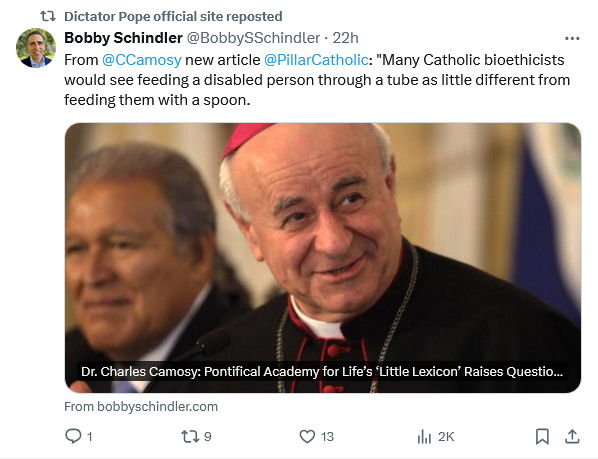
Many Catholic bioethicists would see feeding a disabled person through a tube as little different from feeding them with a spoon. Both are “technology” in a strict sense, but both are examples of basic Christian care for the needy (“feeding the hungry”), not medical treatment.
Go here to read the rest. And the work of the current gang at the Vatican to stand traditional Catholic teaching on its head continues apace


It could therefore be thought of as a medical treatment which could, in principle, be withdrawn, rather than the kind of basic care which can never be withheld.
Their “principles” are flattering to the likes of the deceased Dr Kevorkian. Terri Schiavo could breathe on her own and responded to family when they were at her bedside. It broke my heart watching her parents and Bobby loose to a so-called husband who had already moved into a new relationship while his wife laid prey to the whims of the hospital and judge.
The parents would pay for and feed their daughter but no.
And now this?
Where is the Catholic Church and what have you done with her? (Addressed to Pope Francis.)
Lord, save us from these ravening wolves in shepherd’s clothing.
When Cardinal Perv Mural was appointed to that Pontifical Academy, he said “no one will be more pro-life than me.”
He’s made good on that threat ever since.
Pope St. JP II
https://www.vatican.va/content/john-paul-ii/en/speeches/2004/march/documents/hf_jp-ii_spe_20040320_congress-fiamc.html
The sick person in a vegetative state, awaiting recovery or a natural end, still has the right to basic health care (nutrition, hydration, cleanliness, warmth, etc.), and to the prevention of complications related to his confinement to bed. He also has the right to appropriate rehabilitative care and to be monitored for clinical signs of eventual recovery.
I should like particularly to underline how the administration of water and food, even when provided by artificial means, always represents a natural means of preserving life, not a medical act. Its use, furthermore, should be considered, in principle, ordinary and proportionate, and as such morally obligatory, insofar as and until it is seen to have attained its proper finality, which in the present case consists in providing nourishment to the patient and alleviation of his suffering.
The obligation to provide the “normal care due to the sick in such cases” (Congregation for the Doctrine of the Faith, Iura et Bona, p. IV) includes, in fact, the use of nutrition and hydration (cf. Pontifical Council “Cor Unum”, Dans le Cadre, 2, 4, 4; Pontifical Council for Pastoral Assistance to Health Care Workers, Charter of Health Care Workers, n. 120). The evaluation of probabilities, founded on waning hopes for recovery when the vegetative state is prolonged beyond a year, cannot ethically justify the cessation or interruption of minimal care for the patient, including nutrition and hydration. Death by starvation or dehydration is, in fact, the only possible outcome as a result of their withdrawal. In this sense it ends up becoming, if done knowingly and willingly, true and proper euthanasia by omission.
More in Evaneglium Vitae
https://www.vatican.va/content/john-paul-ii/en/encyclicals/documents/hf_jp-ii_enc_25031995_evangelium-vitae.html