Donald R. McClarey
Cradle Catholic. Active in the pro-life movement since 1973. Father of three, one in Heaven, and happily married for 43 years. Small town lawyer and amateur historian. Former president of the board of directors of the local crisis pregnancy center for a decade.



I think since the overturning of Roe, the abortion issue has become largely irrelevant to the presidency. Abortion is homicide and homicides are adjudicated at the state level.
Abortion is homicide.
…..but they say it’s healthcare.
Reproductive healthcare.
Wordsmiths have a special place in the lake of fire.
One issue I am VERY concerned about is the manner in which liberal Democrats not only fight tooth and nail against any restrictions on abortion, but also try to quash pro-life activity/advocacy by branding it as “fraud”, “discrimination” or even “domestic terrorism”.
Personally I would like to see Trump and the GOP emphasize that regardless of what restrictions, or lack thereof, particular states have on abortion, the rights of those who do not want to participate in abortion (conscience protections) or who want to speak out against abortion and/or offer alternatives (crisis pregnancy centers) MUST be respected. In fact I think this should be a higher priority than enacting abortion “bans”. Suburban women in blue states may insist that abortion be available for any reason or no reason, but they don’t have to also insist that anyone who speaks out against it or tries to persuade women to consider other choices be thrown in jail or sued into bankruptcy.
I know many pro-lifers are disappointed that Trump doesn’t support a national abortion ban and wants to leave it up to the states. While that is a far from morally perfect position, it is far better than the Biden administration’s assertion that abortion is a sacred and inalienable “right” and that anyone who thinks otherwise is un-American if not a potential terrorist.
I know many pro-lifers are disappointed that Trump doesn’t support a national abortion ban
Something that would be impossible to get through the Senate or the House. Returning the issue to the States was a big step forward and we in the pro-life forces should concentrate our efforts on the States.
NB, in regard to certain neuralgic issues, Republican appointees to the Court were given to siding with the preferences of law faculties and the har-de-har public interest bar. The frequency with which they did so and the issues on which they did so varied. Some of these issues should have been decided 9-0 had professionalism and integrity been guiding the Court and their juvenile clerks. The chronic defectors included Harry Blackmun, John Paul Stevens, and David Souter. The episodic defectors included Warren Burger, Lewis Powell, Sandra Day O’Connor, and Anthony Kennedy. (In Burger’s case, some of it was his gaming to be the one to assign the Court’s opinion). Have a gander at John Dean’s account of how the Nixon Administration vetted court appointments. While the recalcitrance of the main body of Senate Democrats (and the usual pansies in the Republican caucus) was tremendously important, the Nixon people were doing everything with the left hand.
At the federal level, the efforts should be to prohibit abortion in federal facilities, to end federal financing of abortions, and to restrict the franchise to enter into agreements to perform abortions between providers and customers domiciled in different states. Banning the interstate traffic in body parts ought to be another item to pursue.
One other problem: the Senate Republican caucus. From 1913 to 2001 five Democratic nominees to the Court met with some resistance from the Senate Republican caucus.
A. Lewis Brandeis (1914)
B. Hugo Black (1937)
C. Sherman Minton (1949)
D. Abe Fortas / Homer Thornberry (1968)
About 1/4 of the Republican caucus objected to Minton, whose nomination was also subject to complaints by editorial boards which commonly favored the Democrats. (The complaint was that Truman was using court appointments to reward cronies; there was nothing facially wrong with Minton’s preparation).
About 40% of the residue of Republicans in the Senate objected to Black. Black was a member of Congress and a loyal soldier of Roosevelt’s at a time when the constitutionality of policy initiatives was at issue and when the President had attempted to pack the Court. Black’s experience on the bench was limited to a brief run as a local justice of the peace.
The bulk of Republicans objected to Brandeis and his nomination was sufficiently controversial that confirmation hearings were held, something previously atypical. Brandeis had never held a judicial position. He was a prominent figure in the efforts to pursue social policy through lawsuits.
Large blocks of the Republican and Democratic caucus objected to the Fortas / Thornberry two-step. Fortas place on the Court was inappropriate to begin with (he was a crony of Johnson’s with no judicial experience), but Republicans let it slide. By 1968, his conduct on the Court had offended a critical mass of people in Congress and there was sub rosa knowledge of sketchy conduct on his part and on his wife’s part.
The whole scheme was instigated by Earl Warren, who had submitted a legally dubious contingent resignation letter. Congress should have refused to consider any nominees on the grounds that there was no vacancy. Warren’s object was to arrange for Johnson to pick his replacement, or, failing that, to have Hubert Humphrey pick his replacement, or, failing that, to have Richard Nixon stuck with him. The scheme collapsed in 1969 when Fortas was compelled to resign from the Court in lieu of facing impeachment proceedings and a possible criminal prosecution of his wife.
IOW, Republicans objected when Democrats nominated people with dubious preparation, nominated people with irregular procedures, and nominated people who had been political partisans. They were remarkably slovenly when Democrats nominated people with passable black letter qualifications (Ruth Bader Ginsburg and Stephen Breyer being blatant examples).
Throughout this time, Democrats in the Senate successfully blocked Republican nominees in 1931, 1969, 1970, and 1987 (2x). They ran a vicious defamation campaign in 1991 against a nominee they could not block. Nearly half the Democratic caucus objected to a Republican nominee in 2005 and all but an odd minority did to another nominee in 2006. On the other hand, street-level Democrats were enraged when the Republican Senate would not hold hearings on an Obama nominee in 2016. Merrick Garland was otherwise left alone. We now know he’s a viciously abusive character who deserves disbarment. At the elite level and at street-level, Democrats fancy the courts are their property, and are enraged when anyone thwarts them. It was not until 2009 you began to see pushback from Republicans.
Since homicides are adjudicated at the state level, how does a national abortion ban pass constitutional muster?
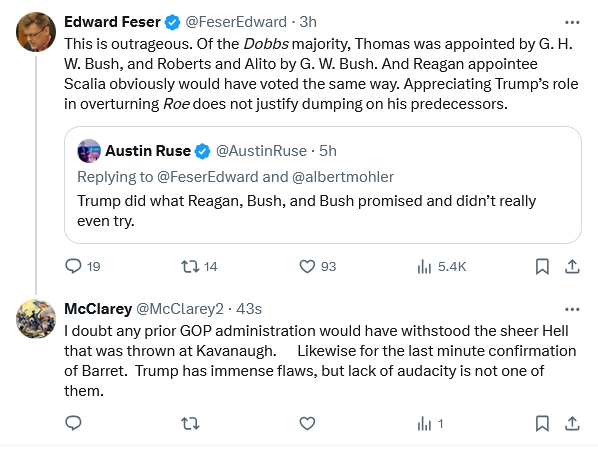
I will agree with Feser insofar as the Bushes deserve credit too. They did put Alito and Thomas, the two real leaders with regards to Dobbs, on the Court. I was disappointed George W. Bush made no public statement on the overturning of Roe. At least not to my knowledge. He could have even taken a deserved bow on the issue.
Kavanaugh was no sure vote by any means. In fact, I was a bit surprised at his going along with the majority on that decision.
I was disappointed George W. Bush made no public statement on the overturning of Roe. At least not to my knowledge. He could have even taken a deserved bow on the issue.
==
His only public statement on a contentious issue in the last 15 years was a dishonest slam of the much abused J6 protesters.
I think George W Bush was a much better president than he has been an ex-president. I think he’s been absolutely disgraceful as to the latter.