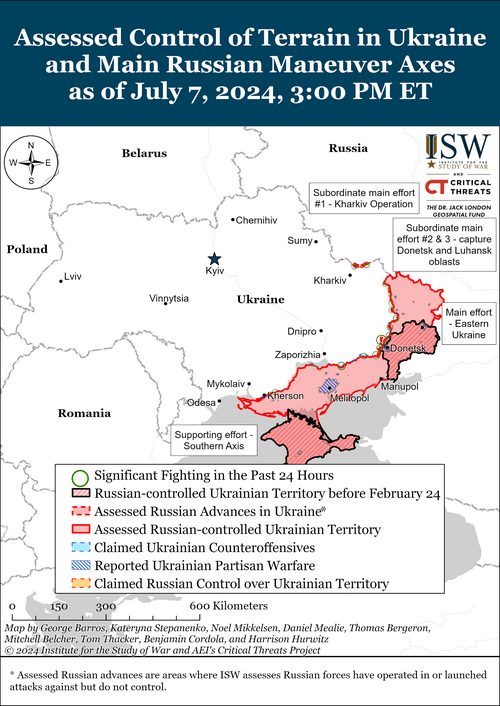
From The Institute for the Study of War:
Russian Offensive Campaign Assessment, July 7, 2024
Christina Harward, Riley Bailey, Nicole Wolkov, Grace Mappes, and George Barros
July 7, 2024, 5:25pm ET
Click here to see ISW’s interactive map of the Russian invasion of Ukraine. This map is updated daily alongside the static maps present in this report.
Click here to see ISW’s 3D control of terrain topographic map of Ukraine. Use of a computer (not a mobile device) is strongly recommended for using this data-heavy tool.
Click here to access ISW’s archive of interactive time-lapse maps of the Russian invasion of Ukraine. These maps complement the static control-of-terrain map that ISW produces daily by showing a dynamic frontline. ISW will update this time-lapse map archive monthly.
Note: The data cut-off for this product was 12:00pm ET on July 7. ISW will cover subsequent reports in the July 8 Russian Offensive Campaign Assessment.
Ukrainian forces conducted a drone strike against a Russian ammunition depot in Sergeevka, Voronezh Oblast on the night of July 6 to 7. Ukrainian outlet Suspilne reported that its sources stated that the Ukrainian Security Service (SBU) conducted the strike and reported that the ammunition depot contained surface-to-surface missiles, surface-to-air missiles, ammunition for tanks and artillery, and small arms rounds.[1] Geolocated footage published on July 7 taken near Morozovka, Voronezh Oblast (just northeast of Sergeevka along the M2 highway) shows a smoke plume and explosions with visible secondary detonations in the distance.[2] Voronezh Oblast Governor Alexander Gusev claimed on July 7 that Russian air defense systems destroyed several Ukrainian drones over Voronezh Oblast and that drone debris fell on a warehouse in Podgorensky Raion, causing a fire and secondary explosions.[3] NASA Fire Information for Resource Management (FIRMS) data from July 7 detected anomalous heat signatures near Sergeevka.[4]
Satellite imagery confirms that the Ukrainian Air Force conducted a successful strike against a reported Russian regimental command post in Belgorod Oblast in late June 2024, likely with Western-provided weapons – further demonstrating how Ukraine could disrupt Russian offensive operations should the West continue to lift restrictions on Ukraine’s use of Western-provided weapons to strike military targets in Russia. The Ukrainian General Staff reported on June 23 that the Ukrainian Air Force struck the command post of an unspecified Russian motorized rifle regiment in Nekhoteevka, Belgorod Oblast on an unspecified date.[5] Geolocated footage of the strike shows that the command post was less than one kilometer from the Russian-Ukrainian border.[6] Satellite imagery collected on April 1 and June 28 shows significant damage to the building that reportedly housed the command post in Nekhoteevka.[7] Ukrainian forces likely used a French-made Armement Air-Sol Modulaire Hammer precision-guided bomb.[8] The command post’s location close to the frontline in northern Kharkiv Oblast suggests that it was involved with ongoing Russian offensive operations north of Kharkiv City.[9] The Nekhoteevka strike demonstrates Ukraine’s ability to conduct successful strikes on Russian military targets within Russia using Western-provided weapons to degrade Russian forces’ ability to conduct offensive operations in Ukraine. ISW continues to assess that Ukraine should be able to use Western-provided weapons, including ATACMS missiles, to strike Russian military targets within Russia’s operational rear and deep rear areas to substantially disrupt Russian operations at scale.[10]
Ukrainian drone operators appear to be improving their capabilities to interdict longer-range Russian drones in mid-air, and these technological innovations may allow Ukrainian forces to ease pressures on short-range and medium-range air defense assets if successfully fielded at scale. Footage posted on June 1 shows Ukrainian forces using first-person view (FPV) drones to strike a Russian tactical Zala reconnaissance drone and a medium-range Orlan-10 reconnaissance drone in mid-flight in the Velyka Novosilka area.[11] The Ukrainian Kharkiv Group of Forces posted footage on June 29 showing a Ukrainian FPV drone intercepting a Russian Lancet loitering munition in mid-air in the Kharkiv direction.[12] Both Ukrainian and Russian forces appear to be improving their capability to use FPV drones to intercept other FPV drones at the tactical level, but ISW has yet to observe confirmation of Russian forces using FPV drones to strike Ukrainian loitering munitions or longer-range reconnaissance drones in mid-air.[13] Russian forces leveraged constraints on Ukrainian air defense assets in recent months to more freely operate fixed-wing reconnaissance drones in Ukraine, including in deep Ukrainian rear areas, which likely allowed Russian forces to improve their reconnaissance fire and reconnaissance strike complexes (RFC/RSC).[14] A robust Ukrainian capability to use cheap and widely-available drones to interdict more expensive Russian reconnaissance drones at scale would likely allow Ukrainian forces to degrade Russia’s RFC/RSC while conserving expensive and scarce short- and medium-range air defense interceptors for more expensive and significant Russian air targets. ISW has yet to observe Ukrainian forces using FPV drones to strike conventional Russian reconnaissance drones at scale, however. Russian and Ukrainian forces are currently engaged in a technological offense-defense race, and Ukraine’s capability to field technological innovations at scale ahead of Russian adaptations is crucial for Ukraine’s ability to offset Russia’s current materiel advantages.[15]
Chechen “Akhmat” Spetsnaz forces likely coerced a Russian milblogger to issue a public apology after he criticized “Akhmat” forces – an illustrative example of unprofessionalism in the Russian military. An often-critical Russian milblogger claimed on June 5 that “TikTokers” are “standing behind” conscripts in Belgorod Oblast, insinuating that Chechen “Akhmat” forces are not contributing to ongoing Russian offensive operations in the Kharkiv direction.[16] The milblogger later published an apology video on July 7 in which the milblogger is sitting with a soldier from the “Akhmat” Spetsnaz “Aida” Detachment and acknowledged that he was referring to “Akhmat” forces as “TikTokers.[17] The milblogger claimed on July 7 that he met with “Akhmat” Spetsnaz Commander Apty Alaudinov and that Akhmat forces are actually fighting on the frontline in the Kharkiv direction. The milblogger notably pointedly criticized the Russian military command for Russia’s lack of progress and significant losses in the Vovchansk direction in the July 5 video but only focused his July 7 apology on his comments about “Akhmat” forces.[18] Russian milbloggers have previously criticized “Akhmat” forces for not contributing to Russian military operations and only visiting frontline areas for propaganda purposes, and Chechen officials have tried to publicly restore “Akhmat’s” reputation.[19] The Kremlin has recently undertaken measures that have successfully limited criticisms of the Russian military in the Russian information space, and Alaudinov’s immediate involvement in the issue after the milblogger’s July 5 video demonstrates the extreme measures that select members of the Russian military command are able to take to suppress critical voices.[20] The “Akhmat” forces’ response to the milblogger’s video also demonstrates the widespread unprofessionalism that is pervasive throughout the Russian military, since it appears that the “Akhmat” forces took matters affecting their reputations into their own hands.
Key Takeaways:
- Ukrainian forces conducted a drone strike against a Russian ammunition depot in Sergeevka, Voronezh Oblast on the night of July 6 to 7.
- Satellite imagery confirms that the Ukrainian Air Force conducted a successful strike against a reported Russian regimental command post in Belgorod Oblast in late June 2024, likely with Western-provided weapons – further demonstrating how Ukraine could disrupt Russian offensive operations should the West continue to lift restrictions on Ukraine’s use of Western-provided weapons to strike military targets in Russia.
- Ukrainian drone operators appear to be improving their capabilities to interdict longer-range Russian drones in mid-air, and these technological innovations may allow Ukrainian forces to ease pressures on short-range and medium-range air defense assets if successfully fielded at scale.
- Chechen “Akhmat” Spetsnaz forces likely coerced a Russian milblogger to issue a public apology after he criticized “Akhmat” forces – an illustrative example of unprofessionalism in the Russian military.
- Russian forces recently made confirmed advances near Chasiv Yar and Toretsk, and Ukrainian forces recently advanced north of Kharkiv City.
- Open-source researchers analyzed satellite imagery and assessed that Russia has removed roughly 42 percent of Russian tanks from pre-war open-air storage since the start of the full-scale invasion.
Go here to read the rest. The mold has been set for this year: main focus on air war, with the ground war consisting of meaningless micro advances.