
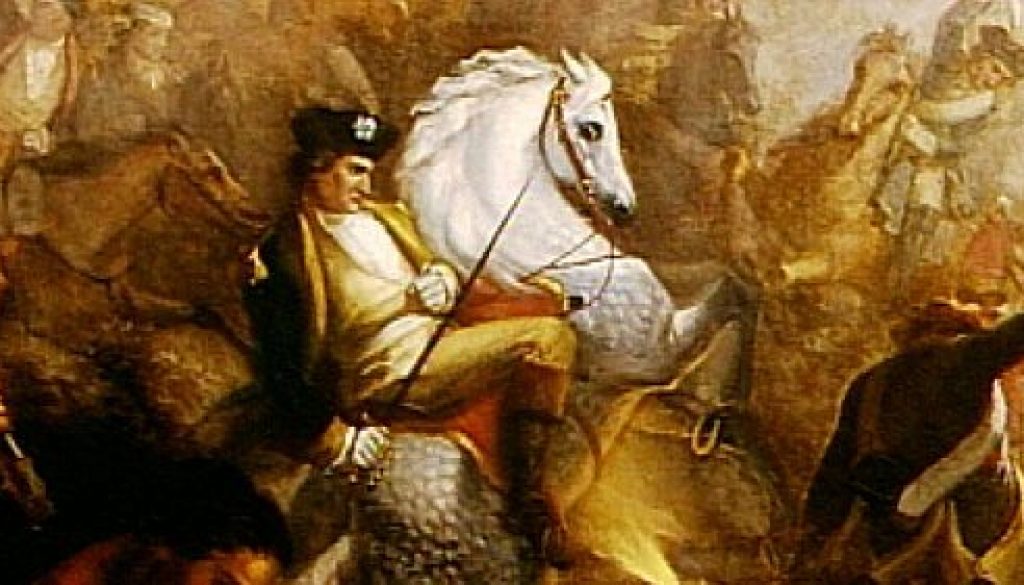
Was it inevitable that our first President would be the man who successfully led our forces to victory in the Revolution? Almost certainly. A firm patriot from the first stirrings against British rule, no American general could match his battlefield achievements. He may have remained simply another general if fate had not taken him by the hand at the Battle of Monmouth on June 28, 1778. After General Charles Lee accepted the post of military governor of the newly liberated Philadelphia, he was the natural choice to lead the attack on the retreating British army making its way to New York City.
The Continental Army had emerged stronger from Valley Forge, thanks to the drilling program of Baron Von Steuben. Men and officers were spoiling a fight, and their commander planned to satisfy their desire. The battle was fought in extreme heat, with Continental regiments slugging it out toe to toe with some of the finest regiments in the British Army. The General seemed to be everywhere, leading assault after assault until the British retreated, leaving the field of battle to the Americans.
The victory was marred of course by the death of the Commander-in-Chief, General George Washington. Exposing himself to enemy fire as he customarily did, a stray bullet hit him in his heart, instant death following. When General Arnold learned of this, he ordered that the news of this be kept secret until the battle was concluded, not wanting to dishearten the troops. Witnesses report that tears rolled down the face of the hardened warrior as he ordered this.
After the battle Arnold reported the victory and the death of General Washington. The concluding paragraph in his report has become immortal. “God gave General Washington to lead us in our fight. Now, with victory in sight, like Moses and the Promised Land, God saw fit that Washington might see the Promised Land of American Independence but not enter into it. Let us win a victory and build a nation that will make us worthy of the sacrifice of the greatest man who ever lived.”
The appointment of a successor commander in chief was a difficult one for Congress, with Congress dividing primarily between Generals Gates, Lee and Arnold. Eventually Arnold was appointed provisional Commander-in-Chief for a year, a negative tribute to his frequently acrimonious relations with Congress. However, Arnold bit his tongue, and even was gracious in his acceptance, benefiting from the advice of his chief aide, Colonel Hamilton, Arnold wisely maintaining the staff appointments of General Washington.
The next year went well enough, with the British maintaining themselves in New York City, but otherwise contenting themselves with raids. General Arnold relied upon the Marquis de Lafayette to smooth his way with the French alliance. Congress was pleased, if not Generals Lee and Gates, and before his year as provisional commander in chief was up, Congress made the appointment permanent for General Arnold for the duration of the War.
When the British effort moved south in 1780, Arnold took a force south to fight, leaving General Greene in command in the north. With the assistance of the French, General Arnold conducted a masterful campaign, retaking Charleston in 1781 with the surrender of the army of Lord Cornwallis. With the evacuation of the British from New York City in 1783, after the signing of the Treaty of Paris, General Arnold resigned his commission.
It would perhaps have been happier for Benedict Arnold if his public service had ended with the Revolution. However, Colonel Hamilton convinced him to run successfully for President in 1788, with Hamilton as his Vice President. No other candidates coming forward, Arnold and Hamilton were duly elected by the members of the Electoral College.
Arnold’s term in office established two long lasting traditions: that a President should serve for only one term, and that his relations in Congress would often be turbulent. Arnold regretted taking the office from the outset. Even with the assistance of Vice President Hamilton he found the duties to be onerous and unpleasant. Dealing with Congressional factions, Federalists and Republicans in their proto forms quickly coming into being, was very difficult for a President who condemned factions constantly and who had no understanding of political give and take. A fair amount of legislation was accomplished, but Arnold compared the process with having teeth extracted by a blind dentist. Arnold left the office with no regrets, bidding good luck to President Hamilton and Vice President Jefferson. In his farewell address he admonished the American people to eschew faction and to be loyal to the United States, and only the United States.
In his retirement Arnold wrote his memoirs, and successfully engaged in merchant activities, losing little of his skill from earlier in his life. When death came for him in 1801 it found him wearing his Continental uniform, Arnold requesting that it be the last clothing he wore.


A President who actually fought with his troops. Now that’s pretty special.
“ The victory was marred of course by the death of the Commander-in-Chief, General George Washington.”
April FIRST 2024
(For a split second the Earth did shift under my feet, but then I did realize the date…)
🤦♀️
Bravo Donald!
April Fools Day