
From The Institute for the Study of War:
Russian Offensive Campaign Assessment, March 14, 2024
Karolina Hird, Riley Bailey, Grace Mappes, and Frederick W. Kagan
March 14, 2024, 8:15pm ET
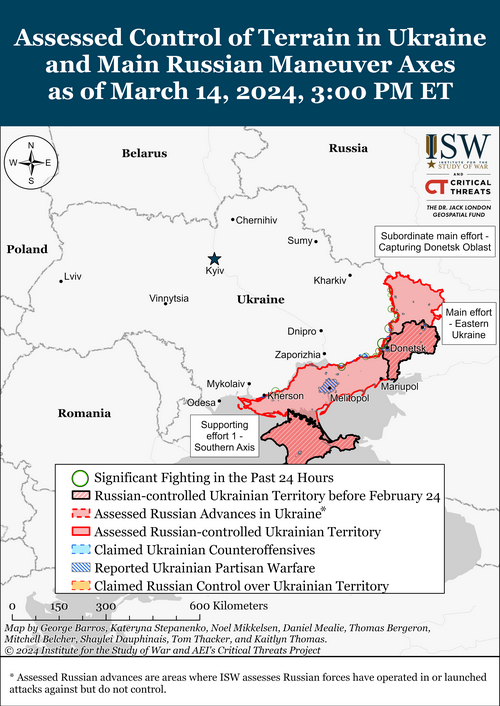
Click here to see ISW’s interactive map of the Russian invasion of Ukraine. This map is updated daily alongside the static maps present in this report.
Click here to see ISW’s 3D control of terrain topographic map of Ukraine. Use of a computer (not a mobile device) is strongly recommended for using this data-heavy tool.
Click here to access ISW’s archive of interactive time-lapse maps of the Russian invasion of Ukraine. These maps complement the static control-of-terrain map that ISW produces daily by showing a dynamic frontline. ISW will update this time-lapse map archive monthly.
Note: The data cut-off for this product was 2:00pm ET on March 14. ISW will cover subsequent reports in the March 15 Russian Offensive Campaign Assessment.
Russian Security Council Deputy Chairperson Dmitry Medvedev posted a detailed call for the total elimination of the Ukrainian state and its absorption into the Russian Federation under what he euphemistically called a “peace formula.”[1] Medvedev’s demands are not novel but rather represent the Kremlin’s actual intentions for Ukraine — intentions that leave no room for negotiations for purposes other than setting the precise terms of Ukraine’s complete capitulation. Medvedev begins the “peace plan” by rhetorically stripping Ukraine of its sovereignty, referring to it as a “former” country and placing the name Ukraine in quotation marks. Medvedev laid out the seven points of his “peace formula,” which he sardonically described as “calm,” “realistic,” “humane,” and “soft.”[2] The seven points include: Ukraine’s recognition of its military defeat, complete and unconditional Ukrainian surrender, and full “demilitarization”; recognition by the entire international community of Ukraine’s “Nazi character” and the “denazification” of Ukraine’s government; a United Nations (UN) statement stripping Ukraine of its status as a sovereign state under international law, and a declaration that any successor states to Ukraine will be forbidden to join any military alliances without Russian consent; the resignation of all Ukrainian authorities and immediate provisional parliamentary elections; Ukrainian reparations to be paid to Russia; official recognition by the interim parliament to be elected following the resignation of Ukraine’s current government that all Ukrainian territory is part of Russia and the adoption of a “reunification” act bringing Ukrainian territory into the Russian Federation; and finally the dissolution of this provisional parliament and UN acceptance of Ukraine’s “reunification” with Russia.[3]
The tone of Medvedev’s post is deliberately sardonic, and the calls he is making appear extreme, but every one of the seven points in Medvedev’s “peace formula” are real and central pieces of the Kremlin’s ideology and stated war aims and justifications — Medvedev just simplified and synthesized them into a single brutal Telegram post. The first two of the seven points call for the complete military defeat, disarmament, “demilitarization,” and “denazification” of Ukraine. Russian President Vladimir Putin identified the full “demilitarization” (stripping Ukraine of all its military and self-defense capabilities) and “denazification” (complete regime change) as Russia’s main goals in Ukraine when initially announcing the invasion on February 24, 2022. Putin and other Kremlin officials have frequently re-emphasized these goals in the subsequent two years of the war.[4] Medvedev’s calls for the resignation of all Ukrainian authorities and the creation of a new provisional government are calls for regime change simply made with more specificity about the methods. The demand that any successor state to Ukraine be forbidden to join military alliances without Russian permission is a call for Ukraine’s permanent neutrality, a demand that Putin and other Kremlin officials reiterate regularly.[5]
Putin established the principles that align the Kremlin’s objectives in Ukraine with Medvedev’s seven points in Putin’s 2021 essay “On the Historical Unity of Russians and Ukrainians.” Putin claimed in that article that Ukrainians and Russians are historically one united people who were violently and unjustly separated by external nefarious forces.[6] Putin used this essay to undermine Ukraine’s sovereignty and claims over its own political, social, historical, linguistic, and cultural development — all suggestions that underpin Medvedev’s calls to dissolve Ukraine as a legal entity and fully absorb it into the Russian Federation. Putin and other Russian officials have long set informational conditions to define Ukraine as an integral and inseparable part of Russian territory and set Russia’s goal in Ukraine as “reuniting” Ukrainian territories with their supposed historic motherland.[7] Medvedev’s “peace formula” makes explicit and brutal what Putin and the Kremlin have long demanded in somewhat more euphemistic phrases: that peace for Russia means the end of Ukraine as a sovereign and independent state of any sort with any borders. Those advocating for pressing Ukraine to enter negotiations with Russia would do well to reckon with this constantly reiterated Russian position.
Ukrainian Commander-in-Chief Colonel General Oleksandr Syrskyi stated on March 14 that unspecified Ukrainian units that have been deployed to the frontline for a long time have started rotations.[8] Syrskyi stated that these unit rotations, during which deployed units will be replaced at the front with fresher units, will help stabilize the operational situation but did not specify where along the frontline Ukrainian forces were conducting the rotations in order to preserve Ukrainian operational security.[9] Ukrainian forces would likely be unable to conduct significant rotations in areas where the Ukrainian command assesses the situation is difficult or at risk of a Russian breakthrough. The reported beginning of Ukrainian rotations suggests that the Ukrainian command believes that the situation on whatever unspecified sector(s) of the frontline where the rotations will occur has stabilized sufficiently for Ukrainian troops to rotate.
Russian forces may be currently committing tactical and operational reserves to fighting in eastern Ukraine in an effort to maintain and potentially intensify the tempo of ongoing Russian offensive operations. Ukrainian military observer Kostyantyn Mashovets stated on March 14 that the Russian military command is committing tactical and operational reserves to Russian offensive efforts in the Lyman direction, near Bakhmut, and west and southwest of Donetsk Oblast to prevent Ukrainian forces from further stabilizing the frontline in these areas.[10] Mashovets stated that many of these reserves were meant to exploit an envisioned Russian breakthrough of Ukrainian defenses, not necessarily to support current Russian offensive operations against stabilizing Ukrainian defensive positions.[11] Mashovets stated that Russian forces recently committed additional elements of the 3rd Army Corps (AC) to fighting southwest of Bakhmut; an unspecified reserve regiment of the 20th Motorized Rifle Division (8th Combined Arms Army [CAA], Southern Military District [SMD]) and the 10th Tank Regiment (1st Donetsk People’s Republic [DNR] AC) to fighting southwest of Donetsk City; and elements of the 272nd Motorized Rifle Regiment (47th Tank Division, 1st Guards Tank Army [GTA]) to the Lyman direction.[12] Mashovets added that Russian forces still possess appropriate reserves to further intensify offensive operations but that these reserves would likely be inadequate to permit the Russian military to collapse Ukrainian defenses.[13] Russian forces have previously struggled to achieve more than gradual marginal tactical gains in Ukraine since mid-2022, and the introduction of tactical or even limited operational reserves in itself does not change Russian prospects for operationally significant gains because Russian forces have not yet demonstrated the capability to conduct sound mechanized maneuvers to take large swaths of territory rapidly.[14]
The Russian ability to make significant gains is still dependent on the level of Western support for Ukraine, however, and continued delays in Western security assistance will increase the risk of operationally significant Russian gains in the long run. Ukrainian materiel shortages resulting from delays in Western security assistance may be making the current Ukrainian frontline more fragile than the relatively slow Russian advances in various sectors would indicate.[15] Well-provisioned Ukrainian forces have proven that they can prevent Russian forces from making even marginal gains during large-scale Russian offensive efforts, and there is no reason to doubt that Ukrainian forces with sufficient Western security assistance would be able to stabilize the current frontline.[16] Difficult weather and terrain conditions in spring 2024 will likely constrain effective mechanized maneuver on both sides of the line and further limit Russian capabilities to make significant tactical advances while the ground is still muddy.[17] Russian forces are likely committing tactical and operational reserves to sustain the tempo of their offensive operations to press current advantages against ill-provisioned Ukrainian forces before ground conditions slow the overall operational tempo in Ukraine. Russian forces may also seek to maintain the tempo of their offensive operations through spring 2024 regardless of difficult weather and terrain conditions in an effort to exploit Ukrainian materiel shortages before promised Western security assistance arrives in Ukraine. Russian forces are reportedly preparing for a new offensive effort in late May or summer 2024, and Western security assistance to Ukraine will likely play a significant role in determining the prospects of that effort.[18]
Reported Russian transfers of tactical reserves to new areas of the frontline demonstrate Russia’s likely ability to dynamically balance and reweight its offensive efforts. Mashovets’ reporting about the transfer of elements of the DNR’s 10th Tank Regiment to southwest of Donetsk City and elements of the 1st Guards Tank Army’s (GTA) 272nd Motorized Rifle Regiment to the Lyman direction are notable as these elements were likely reserves in other directions where Russian forces are conducting offensive operations.[19] Elements of the 10thTank Regiment participated in the seizure of Avdiivka in mid-February and appear to have rested and likely partially reconstituted in the past month, and the commitment of these elements southwest of Donetsk City instead of west of Avdiivka suggests that the Russian command does not want to intensify the tempo of offensive operations near Avdiivka at the expense of a decreased operational tempo southwest of Donetsk City. Russian forces apparently reconstituting in the Avdiivka area can likely allow Russian forces to intensify efforts to push further west of Avdiivka at a moment of the Russian military’s choosing, and the Russian military command may have decided that this potential reserve is sufficient without the elements of the 10th Tank Regiment.[20]Elements of the 1st GTA have been responsible for Russian offensive operations northwest of Svatove since the start of the Russian winter-spring 2024 offensive effort on the Kharkiv-Luhansk axis in January 2024, and the 272nd Motorized Rifle Regiment was likely meant as a reserve to support those offensive operations.[21] The transfer of the elements of the 272nd Motorized Rifle Regiment to the Lyman direction may suggest that Russian forces are currently prioritizing advances in the Lyman direction over advances elsewhere along the Kupyansk-Svatove-Kreminna line. These tactical transfers are relatively minor but are examples of the way in which the Russian military command can choose to increase or decrease commitment to operations anywhere along the line at will due to the operational flexibility offered by Russia’s possession of the theater-wide initiative.[22]
British outlet The Times reported on March 14 that the British government believes that Russia deliberately jammed the satellite signal on a plane carrying British Defense Secretary Grant Shapps back to the UK from Poland.[23] The Times reported that British officials believed that Russian jammed the satellite signal of a Royal Air Force (RAF) Dassault 900LX Falcon jet transporting Shapps, his staff, and select journalists back to the UK after Shapps observed NATO Steadfast Defender exercises in Poland. The signal jamming reportedly impacted GPS signals for about 30 minutes as the jet flew near Kaliningrad, also preventing passengers from accessing the internet on their mobile phones. Data from the GPSJAM GPS interference tracking site show that much of northern and central Poland and the Baltic Sea region experienced high levels of GPS jamming on March 13.[24] ISW previously reported that widespread GPS disruptions across the Baltic region and much of Poland in late December 2023 and early January 2024 may have been linked to Russian electronic warfare (EW) activity in Kaliningrad.[25] It is unclear if Russian forces deliberately targeted Shapps’ plane, but considering the recent rates of GPS interference in this region that have been likely linked to Russian EW activity, Russia could well have targeted the RAF jet for informational and political effects. Russia may have been reacting to Shapps’ recent announcement extending the deployment of British Sky Saber air defense systems in Poland through the end of the year, which pro-Kremlin milbloggers amplified likely as part of the information operation to portray the West as threatening Russia.[26]
Continued limited raids from Ukrainian territory into Russian border regions will likely force the Kremlin to choose between paying a reputational or resource cost in responding to the incursions. Russian sources, including the Russian Ministry of Defense (MoD), continued to claim that likely elements of the all-Russian pro-Ukrainian Russian Volunteer Corps (RDK) and Freedom of Russia Legion (LSR) continued attacks on Russian border settlements, primarily Tetkino, Kursk Oblast and Kozinka and Spordaryushino, Belgorod Oblast on March 14, but that Russian border guards repelled the attacks.[27] The milbloggers claimed that these likely RDK and LSR forces conducted a low-altitude helicopter landing near Kozinka in the evening and that Russian forces continued defending against the incursion.[28] A prominent Russian milblogger criticized the Russian military command because Russian border regions cannot “breathe free” in the third year of the war and claimed that “someone” committed a “strategic miscalculation” by deciding to withdraw Russian forces all the way back to the Russian border when withdrawing from northern Ukraine in the first months of the war, making the border the frontline.[29] The milblogger called for the Russian military to implement “corrective measures” that would somehow push the frontline at least 40 kilometers from the Russian border and into Ukraine. Another milblogger criticized Russian forces for not establishing barricades in certain border settlements to prevent attacks from Ukrainian territory.[30] These criticisms highlight the Kremlin’s current dilemma in light of such cross-border incursions. The Kremlin must balance between the reputational cost of accepting that pro-Ukrainian forces will sometimes be able to conduct minimally effective cross-border raids into Russia while conserving its military resources for use in Ukraine and the resource cost of allocating additional forces and means to border security to reassure the Russian populace at the expense of its military operations against Ukraine. Russia previously allocated Rosgvardia and some Chechen “Akhmat” Spetsnaz elements to border security following May 2023 cross-border incursions without meaningfully impacting its military operations in Ukraine and could feasibly chose to make the same choice now.[31]
The Kremlin must choose a balance between acceptable reputational and resource costs, but the Kremlin may not suffer as high a reputational cost in 2024 as it did in 2023 due to ongoing censorship efforts. The Russian military command’s failure to protect Russian border regions from Ukrainian and pro-Ukrainian attacks has become a point of neuralgia for the Russian information space, and this neuralgia reached a boiling point resulting from RDK and LSR raids into Belgorod Oblast in late May and early June 2023.[32] Russian ultranationalists heavily criticized the Russian Ministry of Defense’s (MoD) failure to protect Russians within Russia, including criticizing Defense Minister Sergei Shoigu and Chief of the General Staff Army General Valery Gerasimov by name.[33] This throughline is notably similar to that of Wagner Group financier Yevgeny Prigozhin and his supporters when Prigozhin launched his armed rebellion and march on Moscow soon after these raids on June 24, 2023, intending to unseat Shoigu and Gerasimov for continued military failures that traded Russian lives and military competency for personal gain.[34] The Kremlin has since cracked down on the Russian information space’s complaints against the MoD, actively censoring certain fringe and extreme milbloggers through arrests or other measures, encouraging self-censorship and compliance among the remaining milbloggers, and disbanding the Wagner Group following the rebellion.[35] The Russian milblogger response to the March 2024 border raid thus far is relatively neutral compared to its response to previous border raids, indicating that the Kremlin’s efforts to directly and indirectly censor the ultranationalist community has tempered milbloggers’ willingness to respond publicly to military failures. The milbloggers who criticized the Russian response on March 12–14 did not place blame directly on the MoD, Shoigu, Gerasimov, or other prominent military figures by name, title, or epithet, instead writing in the passive voice or blaming a vague “someone.”[36] The majority of the Russian milblogger responses criticized Ukraine and the RDK and LSR rather than the Russian military command and praised the Russian forces defending against the attacks.[37]
Key Takeaways:
- Russian Security Council Deputy Chairperson Dmitry Medvedev posted a detailed call for the total elimination of the Ukrainian state and its absorption into the Russian Federation under what he euphemistically called a “peace formula.” Medvedev’s demands are not novel but rather represent the Kremlin’s actual intentions for Ukraine—intentions that leave no room for negotiations for purposes other than setting the precise terms of Ukraine’s complete capitulation.
- Ukrainian Commander-in-Chief Colonel General Oleksandr Syrskyi stated on March 14 that unspecified Ukrainian units that have been deployed to frontline for a long time have started rotations.
- Russian forces may be currently committing tactical and operational reserves to fighting in eastern Ukraine in an effort to maintain and potentially intensify the tempo of ongoing Russian offensive operations.
- The Russian ability to make significant gains is still dependent on the level of Western support for Ukraine, however, and continued delays in Western security assistance will increase the risk of operationally significant Russian gains in the long run.
- Reported Russian transfers of tactical reserves to new areas of the frontline demonstrate Russia’s likely ability to dynamically balance and reweight their offensive efforts.
- British outlet The Times reported on March 14 that the British government believes that Russia deliberately jammed the satellite signal on a plane carrying British Defense Secretary Grant Shapps back to the UK from Poland.
- Continued limited raids from Ukrainian territory into Russian border regions will likely force the Kremlin to choose between paying a reputational or resource cost in responding to the incursions.
- The Kremlin must choose a balance between acceptable reputational and resource costs, but the Kremlin may not suffer as high a reputational cost in 2024 as it did in 2023 due to ongoing censorship efforts.
- Russian forces advanced west of Avdiivka and in western Zaporizhia Oblast amid continued positional engagements across the theater on March 14.
- Russian regional governments have reportedly increased economic incentives for Russian volunteers to sign contracts for military service.
Go here to read the rest. The Russian election results will be announced on Sunday. The farce will conclude with Fearless Leader having a fifth term as President and then we will soon see what Putin will attempt to do in Russia this year.


For a moment I thought I was reading Hitler’s demands to Chamberlain and later Benes. If the West does not stand up now to Russia and demonstrate that aggression comes with a price, we can look forward to similar from Iran and China in short order.