
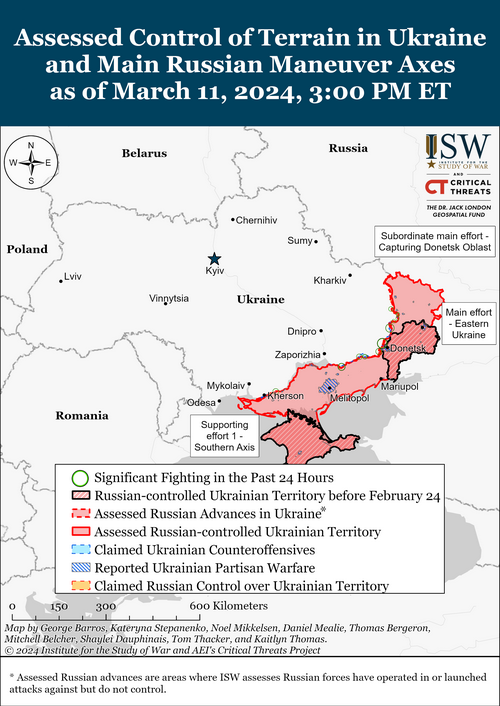
From The Institute for the Study of War:
Russian Offensive Campaign Assessment, March 11, 2024
Nicole Wolkov, Angelica Evans, Christina Harward, Karolina Hird, Grace Mappes, and Frederick W. Kagan
March 11, 2024, 6:15pm ET
Click here to see ISW’s interactive map of the Russian invasion of Ukraine. This map is updated daily alongside the static maps present in this report.
Click here to see ISW’s 3D control of terrain topographic map of Ukraine. Use of a computer (not a mobile device) is strongly recommended for using this data-heavy tool.
Click here to access ISW’s archive of interactive time-lapse maps of the Russian invasion of Ukraine. These maps complement the static control-of-terrain map that ISW produces daily by showing a dynamic frontline. ISW will update this time-lapse map archive monthly.
Note: The data cut-off for this product was 12:30 pm ET on March 11. ISW will cover subsequent reports in the March 12 Russian Offensive Campaign Assessment.
A Ukrainian military observer offered assessments of Russian force generation and defense industrial base (DIB) capacities that are consistent with ISW’s previous assessments. Ukrainian military observer Kostyantyn Mashovets stated that the Russian military command is aiming to create a “strategic reserve” for offensive operations in spring–summer 2024 but is not planning to equip these newly formed units and formations with the doctrinally required quantities of weapons and equipment due to current Russian DIB production constraints.[1] Mashovets stated that the Russian military command only plans to equip the 27th Motorized Rifle Division — which Russia is reportedly in the process of standing up on the basis of the Central Military District’s existing 21st Motorized Rifle Brigade — with up to 87 percent of its doctrinally required amounts of weapons and equipment by the second and fourth quarters of 2024 and implied that the Russian military command has a similar goal for other new formations and units. Mashovets assessed that it is unlikely that Russian forces will be able to meet this equipment goal by the fourth quarter of 2024 given that many Russian regiments, brigades, and divisions currently operating in Ukraine only have about 30 percent of the doctrinally required amounts of weapons and equipment. Several Western and Ukrainian military officials and analysts noted that Russia’s reported tank production numbers largely reflect restored and modern tanks drawn from storage rather than new production.[2]
Mashovets’ assessment is consistent with ISW’s assessment that the Russian DIB is capable of sustaining Russia’s current tempo of operations, although not likely able to fully support a potential operational or strategic-level offensive operation using a strategic reserve of manpower 2024.[3] Reports that the Russian military is prioritizing creating new underequipped units and formations are consistent with ISW‘s assessment that Russia is prioritizing the quantity of manpower and materiel over the quality of its forces.[4] ISW continues to assess that Russia would have the opportunity to expand its DIB and amass resources if it maintains the theater-wide initiative throughout 2024, thus allowing Russia to set conditions for a future offensive operation using a larger reserve of manpower and equipment.[5]
Mashovets stated that the Russian military command intends to form the bulk of the 27th Motorized Rifle Division from the newly formed 433rd Motorized Rifle Regiment (reportedly staffed by degraded elements of the 21st Separate Motorized Rifle Regiment), 506th Motorized Rifle Regiment, and 589th Motorized Rifle Regiment.[6] Mashovets stated that Russia is currently forming its 433rd, 506th, and 589th motorized rifle regiments at the Totskoye training ground in Orenburg Oblast and the “Trekhizbenovsky“ training ground in occupied Luhansk Oblast and plans to have these units ready for combat by late spring or early summer 2024.[7] These newly formed regiments are likely meant to rapidly deploy to Ukraine to offset frontline losses and are unlikely to be staffed with high-quality recruits or operating at doctrinal end strength.[8] Although Russia likely does not have the capacity to staff and equip these new units near their intended end strength in the near term, the Russian military command almost certainly has long-term intentions to fully equip these and similar units. Mashovets noted that the Russian military command has already been forced to reconsider the formation of a number of units due to “discrepanc[ies]“ between Russia’s force-generation ambitions and realities and that Russia’s ability to deploy its strategic reserves in practice are likely limited “to a certain point.”[9] The Russian military command appears to be prioritizing short-term benefits, such as limited territorial gains, over long-term sustainability and large-scale operationally meaningful undertakings in Ukraine amid ongoing Russian reformation and reconstitution efforts. ISW continues to assess that the Russian military command’s use of ongoing force structure changes to rush newly created and understrength formations into combat in Ukraine will likely constrain the immediate efficacy of these units on the battlefield but is enough to maintain the current pace of operations.[10] The major variable likely to determine the rate at which such partially replenished Russian forces can advance this summer is the availability of materiel to Ukraine, which in turn depends heavily on the continued provision of US military assistance.
Russia’s increased defense industrial base (DIB) production is likely not sustainable in the medium- and long-term as it will likely suffer from labor shortages, decreased weapons and equipment stockpiles, and an inability to completely compensate for military and dual-use items it can no longer acquire due to sanctions. The Wall Street Journal (WSJ) reported on March 11 that a senior NATO official stated that Russia can likely sustain its current war effort for two to five more years.[11] WSJ noted that some Russian production figures, such as those for military vehicles, do not differentiate between newly produced items and refurbished ones brought out of storage, such as older, lower quality T-62 and T-54/-55 tanks. ISW has observed that reports of Russia’s reported tank “production” numbers in recent years largely reflect restored and modernized tanks drawn from storage rather than new production.[12] Open-source researchers recently analyzed satellite imagery and assessed that Russia has reportedly removed 25 to 40 percent of its tank strategic reserves, depending on the model, from open-air storage facilities since 2022.[13] Carnegie Endowment for International Peace’s Russia and Eurasia Program Senior Fellow Dara Massicot assessed on March 8 that Russia’s “remaining inventory will dwindle in the next couple of years” if Russia continues its current tempo of operations.[14] WSJ reported that the Bank of Finland concluded that Russia may not be able to sustain its increased DIB production as the DIB takes personnel and material resources away from other sectors of the Russian economy.[15] WSJ reported that Kremlin official statements suggest that the Russian DIB is suffering from a personnel shortage of about 20 percent and that some DIB enterprise employees have recently complained about the lack of training and tools. ISW has previously assessed that Russia’s labor shortage, which is partially a result of its war in Ukraine and partially a symptom of Russia’s ongoing demographic crisis, will likely continue to complicate Kremlin efforts to balance increasing Russian economic capacity and force generation while catering to select members of the Russian ultranationalist community by disincentivizing migrant workers from working in Russia.[16] The Bank of Finland also reportedly found that Russia’s increased DIB production has focused on low-tech products, such as fabricated steel, and that Russia is still reliant on foreign suppliers for higher-tech items such as semiconductors.[17] WSJ stated that while Russia has successfully evaded sanctions and imported some products, Russia is struggling to source some necessary specialized items, such as tank optics, from third countries.
The Royal United Services Institute (RUSI) reported that Russia currently has about three million rounds of old artillery ammunition in its stockpiles, but that much of it is in poor condition.[18] WSJ reported that RUSI and other Western analysts have assessed that Russia’s current domestic ammunition production is not sufficient for its war in Ukraine, so Russia will likely continue relying on supplies from partners.[19] CNN reported on March 11 that NATO intelligence estimates that Russia is producing about 250,000 artillery munitions of unspecified caliber per month totaling about three million shells per year.[20] A senior European intelligence official reportedly told CNN the US and Europe can collectively produce only about 1.2 million shells of unspecified calibers per year for Ukraine. CNN stated that the US military set a goal to produce 100,000 shells per month by the end of 2025 and noted that this is less than half of Russia’s current monthly production, but US Assistant Secretary of the Army for Acquisition, Logistics, and Technology Doug Bush stated on February 5 that this goal of 100,000 shells per month by 2025 only refers to 155mm artillery shells and does not include shells of other calibers that the US produces and that Ukrainian forces use.[21] NATO intelligence estimates of Russian artillery munition production cited by CNN likely include various calibers of munitions, not just 152mm shells that are the analogue to Western 155mm shells, and is likely not a direct comparison to the West’s goals for the production of 155mm shells.
Transfers of North Korean weapons to Russia by sea have apparently resumed after a pause since mid-February 2024. North Korea–focused outlet NK Pro reported on March 11 that satellite imagery indicates that a ship resembling the Russian Lady R cargo ship arrived at North Korea’s Rajin Port on March 10 and appears to be loaded with containers that crews will likely fill with arms for delivery back to Russia.[22] NK Pro stated that objects, likely delivered to the port by train from inside North Korea, appeared at the pier at Rajin Port where ships are usually loaded before departing to Russia. The Lady R ship reportedly delivered cargo from North Korea to Russia twice in October 2023 and once in February 2024. NK Pro reported on February 29 that satellite imagery indicated that Russian ships involved in the maritime transport of North Korean ammunition and weaponry to Russia had not docked at the Rajin Port since February 12.[23]
A Ukrainian military source noted that Russian forces are increasingly using grenades equipped with chemical substances in the Zaporizhia direction, in potential violation of the Chemical Weapons Convention (CWC) to which Russia is a signatory. Ukrainian Tavriisk Group of Forces Spokesperson Captain Dmytro Lykhovyi stated on March 11 that Russian forces used at least 60 grenades equipped with a suffocating and tear-inducing substance on Ukrainian positions in the Tavriisk direction (Avdiivka through western Zaporizhia Oblast) between March 4 to March 10 alone, noting that most of these attacks occurred in the Zaporizhia direction.[24] Lykhovyi suggested that Russian forces are most likely equipping grenades with chloropicrin (PS) or a similar substance. PS is a lung-damaging riot control agent (RCA) that shares the characteristics of tear gas — it is not necessarily lethal but can have extremely irritating and harmful impacts when inhaled.[25] The CWC prohibits the use of PS and other RCAs in warfare, and Russia has been a signatory to the CWC since 1997.[26]
The Moldovan Ministry of Foreign Affairs (MFA) has summoned Russian Ambassador to Moldova Oleg Vasnetsov in response to claims that Russia will operate polling stations in pro-Russian Moldovan breakaway region Transnistria during the Russian presidential election. The Moldovan MFA summoned Vasnetsov to appear on March 12 in response to Moldova’s “disapproval” of claims that Russia will operate polling stations in Transnistria.[27] Regional outlet Transnistrian News claimed on March 11 that Russian citizens will be able to vote in the Russian presidential election at six polling stations in Transnistria on March 17 despite previous Moldovan rulings that Russia can only operate one polling station at the Russian embassy in Chisinau.[28] Russian Embassy Press Secretary Anatoly Loshakov appeared to deny Transnistrian News’ claim, stating that the embassy is only organizing voting at the polling station at the embassy.[29] These claims may be part of the Kremlin’s efforts to use Transnistria and pro-Russian Moldovan autonomous region Gagauzia in information operations to support hybrid operations aimed at sabotaging Moldova’s EU accession process and keeping Moldova within Russia’s sphere of influence.[30]
Russia, China, and Iran will hold the joint Maritime Security Belt – 2024 naval exercise in the Gulf of Oman between March 11–15.[31] Kremlin-affiliated outlet Izvestia reported on March 11 that a detachment ships of Russia’s Pacific Fleet, including the Varyag Slava-class cruiser, arrived at Iran’s Chabahar Port to participate in Maritime Security Belt-2024 alongside Iranian and Chinese naval detachments.[32] The exercise, which was first held in 2019, is intended to practice safe joint naval maneuvers to ensure safe maritime economic activity.[33] The Russian Marshal Shaposhnikov Udaloy-class destroyer; the Chinese Ürümqi destroyer, Linyi frigate, Dongpinghu replenishment ship; and 10 unnamed Iranian ships, boats, and supply vessels and three naval helicopters are taking part in the exercise.[34] Representatives of Pakistan, Kazakhstan, Azerbaijan, Oman, India, and South Africa will observe the exercise.
The Russian Ministry of Foreign Affairs (MFA) claimed that the West intends to use Armenia as a tool against Russia, a notable escalation in its information operations criticizing Armenian efforts to distance itself from security relations with Russia. UK Minister of State for the Armed Forces James Heappey stated on March 10 that the UK recognizes Armenia’s decision to “essentially” freeze its participation in the Russia-led Collective Security Treaty Organization (CSTO) “in the face of threats of relation from Russia,” while acknowledging that Armenia is not officially leaving the CSTO.[35] The Russian MFA claimed that Heappey’s statement was “direct confirmation” of the West’s intent to “turn Armenia into a tool against Moscow” and its wider “anti-Russian” efforts in the post-Soviet space and the South Caucasus.[36] The Russian MFA called on Armenian officials to “think seriously.” Senior Russian government officials have acknowledged and criticized Armenia’s lack of participation in the CSTO since Armenian President Nikol Pashinyan’s February 22 announcement that Armenia “essentially” froze its participation in the CSTO.[37] The Kremlin is likely preparing a harsher and more concerted response as Armenia continues to take measures to distance itself from Russia and signal interest in strengthening relations with the West.
Russian President Vladimir Putin signed a bill on March 11 that allows Russian authorities to further restrict actors it deems “foreign agents” to consolidate control over the Russian information space ahead of the presidential election. Putin signed a bill that bans Russians from advertising the content of individuals and organizations legally designated as “foreign agents” and from advertising their own content on platforms that “foreign agents” own.[38] ISW previously assessed that this law will impact Russian opposition media’s ability to operate and report reliably in Russia and reported that at least one Russian opposition journalist has already suspended their work in Russia due to the new advertising ban.[39] ISW recently observed reports that large Russian advertising agencies have already included unilateral termination clauses in their advertising contracts in case the Kremlin designates a client as a foreign agent during the term of their contract.[40] The Russian Cabinet of Ministers also announced its support for a draft bill that would allow the Russian government to designate foreign organizations whose founders or participants are allegedly affiliated with foreign governments as “undesirable” and fine or imprison individuals found guilty of participating in their events.[41]
France is reportedly prepared to build a coalition of countries that are open to potentially sending Western military personnel to Ukraine.[42] French Foreign Minister Stéphane Séjourné announced on March 9 during a meeting with Baltic and Ukrainian officials that Ukraine could use foreign troops for operations such as demining or similar efforts and that Western personnel in Ukraine would not necessarily fight.[43] Séjourné emphasized that “it is not for Russia to tell us how we [the West] should help Ukraine in the coming months or years,” noting that Russia should not be able to control how the West responds to Russia by setting arbitrary “red lines.” Polish Foreign Minister Radosław Sikorski similarly stated on March 8 that the “presence of NATO forces in Ukraine is not unthinkable.”[44] Séjourné reiterated on March 11 that France seeks to “send strong signals” to Russia and speak to the Kremlin in the “language of balance of power.”[45]
Key Takeaways:
- A Ukrainian military observer offered assessments of Russian force generation and defense industrial base (DIB) capacities that are consistent with ISW’s previous assessments.
- Russia’s increased defense industrial base (DIB) production is likely not sustainable in the medium and long-term as it will likely suffer from labor shortages, decreased weapons and equipment stockpiles, and an inability to completely compensate for military and dual-use items it can no longer acquire due to sanctions.
- Transfers of North Korean weapons to Russia by sea have apparently resumed after a pause since mid-February 2024.
- A Ukrainian military source noted that Russian forces are increasingly using grenades equipped with chemical substances in the Zaporizhia direction, in potential violation of the Chemical Weapons Convention (CWC) to which Russia is a signatory.
- The Moldovan Ministry of Foreign Affairs (MFA) has summoned Russian Ambassador to Moldova Oleg Vasnetsov in response to claims that Russia will operate polling stations in pro-Russian Moldovan breakaway region Transnistria during the Russian presidential election.
- Russia, China, and Iran will hold the joint Maritime Security Belt – 2024 naval exercise in the Gulf of Oman between March 11–15.
- The Russian Ministry of Foreign Affairs (MFA) claimed that the West intends to use Armenia as a tool against Russia, a notable escalation in its information operations criticizing Armenian efforts to distance itself from security relations with Russia.
- Russian President Vladimir Putin signed a bill on March 11 that allows Russian authorities to further restrict actors it deems “foreign agents” to consolidate control over the Russian information space ahead of the presidential election.
- France is reportedly prepared to build a coalition of countries that are open to potentially sending Western military personnel to Ukraine.
- Russian forces recently made confirmed advances near Kreminna, Bakhmut, and Donetsk City.
- Russian President Vladimir Putin continues efforts to cater to Russian servicemembers and their families with the promise of various social benefits.
Go here to read the rest. Sweden joined NATO last Thursday. Putin’s Ukraine adventure has breathed new life into the old alliance.


Sems Putin and his sycophants are letting their paranoia rule their judgement. Not a good sign for anyone.