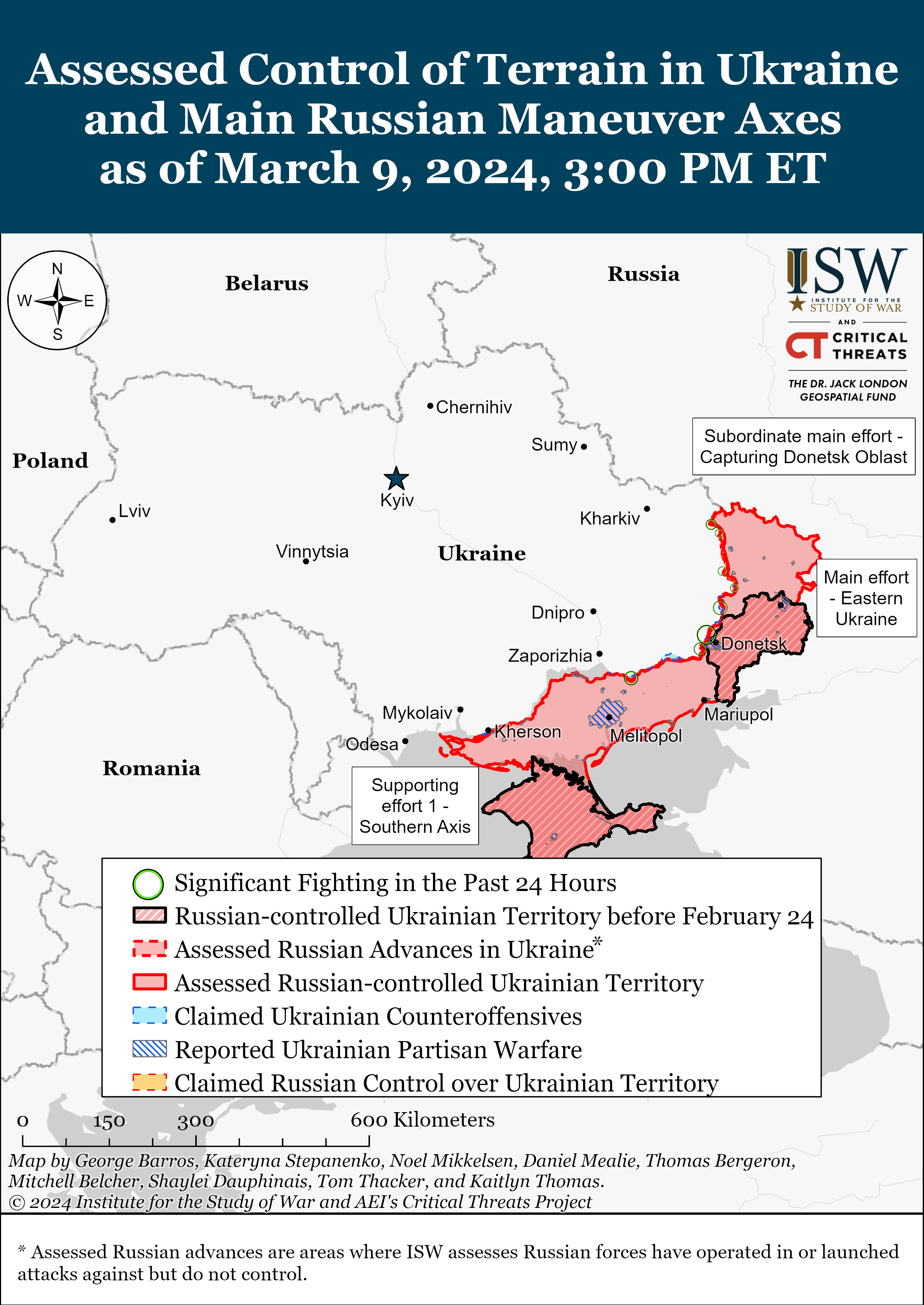
From The Institute for the Study of War:
Russian Offensive Campaign Assessment, March 9, 2024
Christina Haward, Grace Mappes, Nicole Wolkov, Riley Bailey, and George Barros
March 9, 2024, 5:55pm ET
Click here to see ISW’s interactive map of the Russian invasion of Ukraine. This map is updated daily alongside the static maps present in this report.
Click here to see ISW’s 3D control of terrain topographic map of Ukraine. Use of a computer (not a mobile device) is strongly recommended for using this data-heavy tool.
Click here to access ISW’s archive of interactive time-lapse maps of the Russian invasion of Ukraine. These maps complement the static control-of-terrain map that ISW produces daily by showing a dynamic frontline. ISW will update this time-lapse map archive monthly.
Note: The data cut-off for this product was 12:40 pm ET on March 9. ISW will cover subsequent reports in the March 10 Russian Offensive Campaign Assessment.
Ukrainian forces reportedly conducted drone strikes targeting Rostov Oblast overnight on March 8-9 and may have struck a Russian aircraft plant refurbishing and modernizing Russian A-50 long range radar detection aircraft. The Russian Ministry of Defense (MoD) claimed that Russian forces intercepted 41 Ukrainian drones overnight over Rostov Oblast, and eyewitnesses reportedly stated that the strike caused at least five explosions.[1] Geolocated footage of a strike shows an explosion at the Beriev Aircraft Plant in Taganrog, Rostov Oblast.[2] The Beriev Aircraft Plant in Taganrog is reportedly refurbishing and modernizing Russian A-50 aircraft for use in Ukraine, and Russian sources claimed that the plant was repairing an A-50 damaged in a previous drone strike (possibly referring to the attack on a Russian A-50 at the Machulishchi Air Base in Minsk, Belarus, in February 2023).[3] Radio Free Europe/Radio Liberty published satellite imagery dated February 29 indicating that the geolocated explosion occurred roughly 900 meters from a Russian A-50 aircraft that previously had been present at the Beriev Aircraft Plant, although it is unclear whether the A-50 was in the same location at the time of the strike.[4] Senior Ukrainian officials have not commented on the strike at the time of this publication. ISW is unable to confirm that the reported strike damaged any Russian A-50 aircraft, facilities repairing or refurbishing aircraft, or other Russian military infrastructure in the area.
Russian sources widely circulated footage of a Russian strike on March 9 to claim that Russian forces destroyed a Patriot air defense system in eastern Ukraine, although there has yet to be any confirmation of these claims. The Russian Ministry of Defense (MoD) published footage on March 9 purportedly of Russian forces striking a Ukrainian S-300 air defense missile launcher with Iskander missiles near Pokrovsk, Donetsk Oblast.[5] Russian sources amplified additional footage of the strike’s aftermath purportedly showing destroyed German MAN KAT1 trucks, which can be used as a base for Patriot air defense missile launchers.[6] Russian sources used this footage to claim that Russian forces destroyed a MIM-104 Patriot air defense system, although the Russian MoD has yet to revise its earlier claim about destroying a Ukrainian S-300 system.[7] Russian state media outlet RIA Novosti reported that a source in Russian law enforcement stated that the Russian Iskander strike destroyed two Patriot air defense systems.[8] Several OSINT social media accounts concluded that the strike likely destroyed a Ukrainian Patriot air defense system, although another OSINT account noted that Ukrainian forces also use the MAN KAT1 trucks as logistics vehicles.[9] ISW has not yet observed evidence confirming that Russian forces destroyed a Patriot air defense system.
US officials reportedly told CNN that Russia considered using “tactical or battlefield” nuclear weapons in Ukraine in 2022 – during the same time Russia conducted an intense information operation aimed at the West about Russia potentially using a nuclear weapon against Ukraine to deter Western support for Ukraine. CNN reported on March 9 that two senior Biden administration officials stated that the United States began “preparing rigorously” for a potential Russian “tactical or battlefield” nuclear strike in late 2022 after collecting intelligence indicating that Kremlin officials at various levels were discussing this possibility.[10] The United States reportedly contacted multiple high-level Kremlin officials, discussed the issue with US allies, and asked China and India to discourage Russia. CNN reported that one US official assessed that Chinese and Indian public statements were a “helpful, persuasive factor” that showed Russia the costs of their potential decision. The sources reportedly stated that the United States believed that significant Russian territorial or personnel losses in Ukraine could have been a “potential trigger” for a Russian tactical nuclear strike as the Kremlin viewed areas of occupied Ukraine, such as Kherson City, as Russian territory and potentially viewed the loss of such territories as a direct threat to the Kremlin or the Russian state – one scenario in which Russia would contemplate using nuclear weapons. CNN reported that US officials believed that the Kremlin may have tried to use claims that Ukraine intended to use a “dirty bomb,” which Russian Defense Minister Sergei Shoigu and other Kremlin officials were reportedly promoting in conversations with Western military and political officials at the time, as “cover” for a Russian tactical nuclear strike. Shoigu and other Kremlin officials routinely publicly promoted claims about a Ukrainian “dirty bomb” in October 2022 as part of an information designed to deter Western security assistance to Ukraine following Ukrainian forces’ rout of Russian forces in Kharkiv Oblast in September 2022.[11] Ukrainian forces have transgressed Russia’s nuclear “red lines” several times over the course of the war with no Russian nuclear strike, indicating that many of Russia’s “red lines” are most likely information operations designed to deter Ukrainian and Western action to defeat Russia’s invasion of Ukraine. Ukraine’s liberation of Russian-occupied territories during counteroffensives in eastern and southern Ukraine in fall 2022 and subsequent Ukrainian strikes against occupied Ukraine violated Russia’s ”red lines.”[12] Sweden’s and Finland’s NATO accession also violated Russia’s so-called red lines. ISW continues to assess that Russian nuclear use in Ukraine remains highly unlikely.[13]
Senior Armenian officials stated that Armenia is considering seeking membership in the European Union (EU), against the backdrop of deteriorating Russian-Armenian relations. Armenian Foreign Minister Ararat Mirzoyan stated in a March 9 interview with Turkish TV channel TRT World that Armenia is considering new opportunities “taking into account the challenges [Armenia] has faced in the last three to four years” including “the idea of joining the EU.”[14] Armenian Parliament Speaker Alen Simonyan stated on February 29 that ”[Armenia] should think about [seeking EU candidate status].”[15] Russian officials have not responded to Armenian officials’ statements as of this publication. ISW continues to assess that Russian Foreign Minister Sergei Lavrov’s acknowledgement and criticism of Armenia’s lack of participation in the Russia-led Collective Security Treaty Organization (CSTO) indicates that the Kremlin may be preparing a more concerted response to its deteriorating relations with Armenia.[16] The Kremlin has conducted hybrid wars against former Soviet states that have sought EU accession.
Ukrainian President Volodymyr Zelensky stated that Ukraine would be open to negotiations with Russia only after Ukraine and its partners develop a peace plan and as Turkey continues to promote its own negotiation platform for the war in Ukraine. Zelensky stated that Ukraine would invite representatives of Russia to a peace summit only after Ukraine and other countries have developed a peace plan at a first peace summit.[17] Ukraine plans to hold the first Ukrainian Peace Formula Summit in Switzerland in 2024.[18] Turkish President Recep Tayyip Erdoğan stated on March 8 that Turkey is ready to host a peace summit between Ukraine and Russia.[19] ISW continues to assess that Russia is not interested in good faith negotiations with Ukraine and has no interest in ending the war on anything but Russia’s articulated maximalist terms of destroying Ukraine’s sovereignty and eradicating the notion of a unique Ukrainian national identity.[20]
Key Takeaways:
- Ukrainian forces reportedly conducted drone strikes targeting Rostov Oblast overnight on March 8-9 and may have struck a Russian aircraft plant refurbishing and modernizing Russian A-50 long range radar detection aircraft.
- Russian sources widely circulated footage of a Russian strike on March 9 to claim that Russian forces destroyed a Patriot air defense system in eastern Ukraine, although there has yet to be any confirmation of these claims.
- US officials reportedly told CNN that Russia considered using “tactical or battlefield” nuclear weapons in Ukraine in 2022 – during the same time Russia conducted an intense information operation aimed at the West about Russia potentially using a nuclear weapon against Ukraine to deter Western support for Ukraine.
- Senior Armenian officials stated that Armenia is considering seeking membership in the European Union (EU), against the backdrop of deteriorating Russian-Armenian relations.
- Ukrainian President Volodymyr Zelensky stated that Ukraine would be open to negotiations with Russia only after Ukraine and its partners develop a peace plan and as Turkey continues to promote its own negotiation platform for the war in Ukraine.
- Russian forces recently made confirmed advances near Kreminna and Avdiivka amid continued positional fighting along the entire frontline on March 9.
- Open-source researchers analyzed satellite imagery and assessed that Russia has reportedly removed 25 to 40 percent of its tank strategic reserves, depending on the model, from open-air storage facilities, although ISW cannot independently verify this report.
Go here to read the rest. The Russians have a new ally, apparently:
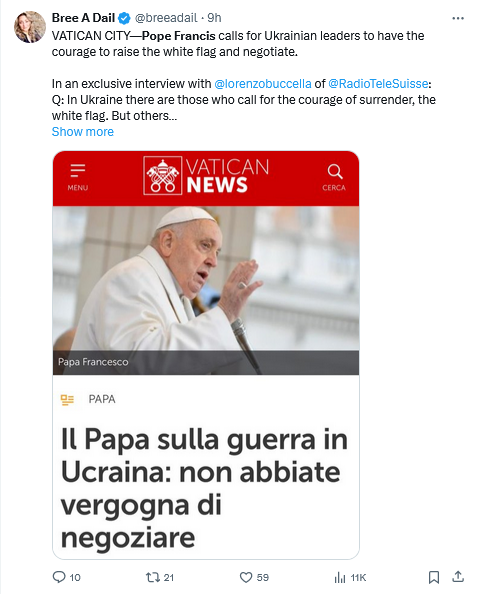
If a power is sufficiently anti-American, this Pope will sooner or later be of service to them.