
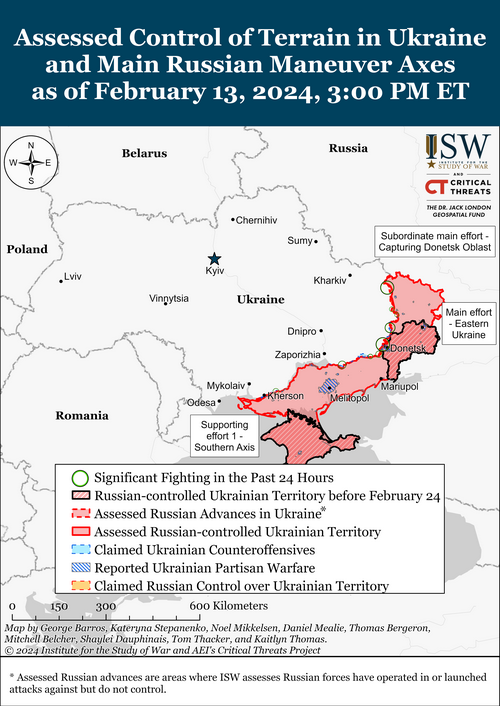
From The Institute for the Study of War:
Russian Offensive Campaign Assessment, February 13, 2024
Grace Mappes, Christina Harward, Riley Bailey, Nicole Wolkov, George Barros, and Frederick W. Kagan
February 13, 2024, 7:10pm ET
Click here to see ISW’s interactive map of the Russian invasion of Ukraine. This map is updated daily alongside the static maps present in this report.
Click here to see ISW’s 3D control of terrain topographic map of Ukraine. Use of a computer (not a mobile device) is strongly recommended for using this data-heavy tool.
Click here to access ISW’s archive of interactive time-lapse maps of the Russian invasion of Ukraine. These maps complement the static control-of-terrain map that ISW produces daily by showing a dynamic frontline. ISW will update this time-lapse map archive monthly.
Note: The data cut-off for this product was 1:00pm ET on February 13. ISW will cover subsequent reports in the February 14 Russian Offensive Campaign Assessment.
The US Senate passed a supplemental appropriations bill that would provide roughly $60 billion of security assistance to Ukraine, the vast majority of which would go to US companies and personnel. The Senate passed a $95.3 billion aid package for assistance to Ukraine, Israel, and Taiwan, $60.6 billion of which is for Ukraine, by a 70-29 vote on February 13.[1] Roughly 16 percent of the Ukraine-related appropriations in the bill would go directly to support the Ukrainian government and economy whereas the remaining 84 percent of the appropriations are specifically marked for US manufacturers and US or allied government entities supporting Ukraine.[2]
Ukrainian military observer Kostyantyn Mashovets reported that Russian forces are attempting to restore maneuver to the battlefield through Soviet deep battle theory but are struggling with implementing Soviet deep battle so far due to current Ukrainian capabilities. Mashovets stated that Russian forces are attempting to implement Soviet deep battle theory for operational planning to rapidly break through Ukrainian defenses but are failing to achieve the effects of Soviet deep battle operations.[3] Deep battle theory is a product of Soviet operational art developed in the 1920s and 1930s that was designed to restore maneuver to battlefield after World War I by engaging the enemy on multiple fronts and in depth at the tactical and operational levels by attacking enemy assets at all echelons with artillery, airstrikes, and attacks against the enemy’s rear in concert with frontal attacks to penetrate the enemy’s defensive lines.[4] Deep battle theory also posits that successful operational design includes sequenced plans for successive operations to prevent the defender from re-establishing coherent defensive positions following a penetration and its exploitation.[5] Deep battle theory’s key operational tenets are still valid in modern war, and the Russian military could restore maneuver to the battlefield and overcome Ukrainian defenses if it could successfully plan and execute operationally sound campaigns using deep battle theory. Ukrainian forces could also use deep battle theory to restore maneuver to the battlefield to their advantage if their Western supporters properly resourced them.
Mashovets, however, noted that Russian forces’ current limited capabilities, specifically in conducting effective counterbattery fire, striking targets at operational depth, concealing force concentrations from the enemy, and combating Ukrainian technological parity, are preventing Russian forces from achieving the operational level surprise necessary to break through Ukrainian lines and conduct deep battle operations.[6] Mashovets stated that the Russian military command is failing to implement certain technological innovations into operational planning, including remote mine laying; large scale drone operations; command-and-control; and communications using modern technology.[7]
The current Ukrainian battlefield capabilities that are denying Russian forces the ability to restore maneuver to the battlefield on Russian terms largely depend on the provision of Western military assistance in key systems, many of which only the US can provide at scale. Ukrainian forces currently have advantages in counterbattery technology and medium-to-long-range strike capabilities due to Western-provided military assistance.[8] Western states have provided NATO 155mm artillery systems and ammunition capable of striking targets at longer ranges than Soviet equipment, and superior counterbattery radar systems that have provided Ukrainian forces with targeting advantages.[9] Western-provided medium- and long-range systems including HIMARS, ATACMS, and Storm Shadow/SCALP missiles have enabled Ukrainian forces to achieve the significant impacts of liberating west bank Kherson Oblast and severely degrading the Russian Black Sea Fleet, among others.[10] Western provided air defense systems have denied Russian forces the air superiority necessary to safely operate aircraft to support Russian offensive operations, including hypothetical deep battle operations.[11]
Ukrainian forces will not be able to retain these advantages and deny Russian forces the ability to restore maneuver to the battlefield on Russian terms without further assistance from the United States and its partner countries in the near and medium term. Russian President Vladimir Putin and other senior Russian officials have previously touted their hopes of outlasting Western security assistance to Ukraine on the battlefield, and Russian forces are attempting to develop technology to adapt to current Ukrainian capabilities.[12] Mashovets noted that the Russian military command is learning and currently demonstrating greater operational flexibility than earlier in the war, including by establishing new artillery batteries to increase fire capabilities, bolstering intelligence capabilities, using disinformation to feed false intelligence on Russian force movements, and fragmenting the movements of its larger formations.[13] Mashovets stated that Russian forces are also actively developing their own technology to counter Ukrainian capabilities and develop their own capabilities, including electronic warfare (EW) systems, sea drones, combat control systems.[14] Ukraine will lose its current battlefield advantages if Western states, particularly the United States, prematurely cease security assistance to Ukraine before Ukraine’s ongoing defense industrial base (DIB) revitalization efforts render its DIB largely self-sufficient.[15] If the US cuts off military aid now Russian forces may regain battlefield capabilities necessary to restore maneuver to the battlefield on Russian terms and would place Russia in a much better position militarily in the medium to long term.
Russian sources are purposefully exaggerating Ukrainian casualties in a Russian strike near Selydove, Donetsk Oblast on February 13.[16] Other Russian sources claimed that the strike caused far fewer casualties and published footage purportedly of a Russian strike against Tsukuryne (just south of Selydove) that is not consistent with the high number of casualties that other Russian sources claimed.[17] Ukrainian military officials reported on February 13 that Russian sources began purposefully spreading disinformation about Ukrainian losses after the Russian strike near Selydove and stated that Russian forces conducted a multiple rocket launch system (MLRS) strike against Tsukuryne, Donetsk Oblast on February 13 that damaged civilian infrastructure but did not cause any casualties.[18] Kremlin newswire TASS amplified a claim from an alleged unofficial Telegram channel of a Ukrainian brigade confirming Ukrainian personnel losses in the strike.[19] This unofficial Telegram channel later denied its initial claim.[20] The official Ukrainian brigade’s Facebook page has not published anything regarding the purported strike at the time of this publication.[21] The Ukrainian Center for Countering Disinformation reported in December 2023 that Russian actors planned to promote information operations aimed at degrading Ukrainian morale through a network of fake Telegram channels disguised as official accounts of Ukrainian regional officials and military brigades.[22]
The Kremlin appears to be asserting the right to enforce Russian Federation law on officials of governments in NATO member states over actions taken in the performance of their official duties within the territories of their own countries. The Russian Ministry of Internal Affairs (MVD) has put dozens of government officials from NATO countries on Russia’s wanted list because of alleged violations of Russian federal law committed outside the jurisdiction of the Russian Federation. Russian opposition outlet Mediazona stated on February 13 that it gained access to the MVD’s wanted list and that the Russian MVD put Estonian Prime Minister Kaja Kallas, Estonian Secretary of State Taimar Peterkop, Latvian Justice Minister Inese Libina-Egnere, Latvian Finance Minister Arvils Aseradens, Latvian Agricultural Minister Armands Krauze, and former Latvian Interior Minister Marija Golubeva on the wanted list for allegedly destroying Soviet monuments in Estonia and Latvia — which Kremlin newswire TASS confirmed.[23] Mediazona stated that 59 Lithuanian Seimas deputies, 15 Riga municipal deputies, Lithuanian Mayor of Klaipeda Arvydas Vaitkus, Vaitkus’s deputy, 13 members of the Klaipeda city council, six deputies of the Vilnius city council, Polish Mayor of Walbrzych Roman Szelemey, and Polish Deputy Minister of State Assets Karol Rabenda also appear on the Russian MVD’s wanted list in connection with the destruction of Soviet monuments in the Baltic states and Poland.[24] Kremlin Spokesperson Dmitri Peskov stated the Baltic officials are wanted for “hostile actions against historical memory and Russia.”[25] Russian Ministry of Foreign Affairs (MFA) Spokesperson Maria Zakharova claimed that Kallas is “actively pursuing a policy of demolishing monuments and mocking the memory of Soviet soldiers” and that she must be held accountable for “blasphemy.”[26] Zakharova called on Russian law enforcement agencies to conduct investigations “within the framework of their powers and responsibilities in accordance with the legislation of Russia.” Zakharova claimed that the officials must “answer for their crimes” and that “this is just the beginning.”[27]
Article 243 of the Russian Criminal Code states that the destruction or damage of cultural heritage sites and monuments is punishable by up to six years in prison.[28] Russia, however, does not have the legal authority to prosecute foreign citizens for allegedly violating Russian laws in foreign states. Russia has notably used the issue of Soviet monuments to justify hybrid warfare tactics against NATO countries in the past when Russia launched large-scale cyberattacks against Estonia in 2007 after Estonia moved a Soviet World War II war memorial and the remains of Soviet soldiers from central Tallinn to the Tallinn Defense Cemetery.[29] Although it is unclear if the Russian government had planned to publicize its inclusion of the European officials on the list before Mediazona disclosed this information, this may be part of ongoing Russian effort to set informational conditions justifying possible Russian escalations against NATO states in the future, as ISW has extensively reported.[30] The Kremlin has also invoked narratives related to the historical memory of World War II to justify and sustain its full-scale invasion of Ukraine.[31]
US sanctions are reportedly constraining Russian efforts to skirt the G7 oil cap amid continued indications that India may be rethinking its growing position as a customer of Russian oil. Bloomberg reported on February 13 that at least 21 of the 50 oil tankers that the US has sanctioned since October 2023 for carrying Russian crude oil priced above the G7’s $60 price cap have stopped transporting Russian oil and petroleum products.[32] Bloomberg also reported that in the past two months roughly half of 14 idling oil tankers carrying Russian oil to India have since turned around from their destination without unloading.[33] Indian government sources have recently reportedly stated that India wants to distance itself from Russia due to the war in Ukraine, limiting Russia’s ability to provide India with munitions.[34] Increased energy exports to Indo-pacific states, primarily India and China, and widespread Russian efforts to skirt the G7 price cap through a fleet of oil tankers with obscure ownership and insurance allowed Russia to significantly increase oil revenues in 2023.[35] Russia relied on oil revenues to buoy federal budgets amid increased spending on its war in Ukraine in 2023, and effective US sanctions and Indian reconsiderations of its trade relationship with Russia may complicate this effort in 2024.[36]
Key Takeaways:
- The US Senate passed a supplemental appropriations bill that would provide roughly $60 billion of security assistance to Ukraine, the vast majority of which would go to US companies and personnel.
- Ukrainian military observer Kostyantyn Mashovets reported that Russian forces are attempting to restore maneuver to the battlefield through Soviet deep battle theory but are struggling with implementing Soviet deep battle so far due to current Ukrainian capabilities.
- The current Ukrainian battlefield capabilities that are denying Russian forces the ability to restore maneuver to the battlefield on Russian terms largely depend on the provision of Western military assistance in key systems, many of which only the US can provide at scale.
- Ukrainian forces will not be able to retain these advantages and deny Russian forces the ability to restore maneuver to the battlefield on Russian terms without further assistance from the United States and its partner countries in the near and medium term.
- Russian sources are purposefully exaggerating Ukrainian casualties in a Russian strike near Selydove, Donetsk Oblast on February 13.
- The Kremlin appears to be asserting the right to enforce Russian Federation law on officials of governments in NATO member states over actions taken in the performance of their official duties within the territories of their own countries.
- US sanctions are reportedly constraining Russian efforts to skirt the G7 oil cap amid continued indications that India may be rethinking its growing position as a customer of Russian oil.
- Russian forces recently made confirmed advances near Kreminna and in western Zaporizhia Oblast amid continued positional engagements along the entire frontline.
- The British International Institute for Strategic Studies (IISS) think tank stated on February 12 that Russia is likely able to sustain its current rate of vehicle losses for at least two to three years by producing new vehicles and reactivating vehicles from storage.
- The Kremlin continues efforts to solidify control of occupied Ukraine through institutionalizing social benefits and services.
Go here to read the rest. The Ukrainians will likely receive the 60 billion in US aid, but after that the spigot flow will likely be greatly reduced, if not shut completely. The issue has become entangled in partisan US politics, fueled by the lack of success of the Ukrainian offensive last year. Victory by Putin in the Ukraine would be very bad for the US, but those who oversold the War in the US are now reaping the whirlwind of isolationism, never far beneath the surface in American domestic politics in reaction. If I were the Ukrainian commander in chief, I would stand on the defensive, defeat the inevitable Russian offensive and then counter punch.


this is the slowest war ever. Win somebody. Anybody. And be cheap about it.