
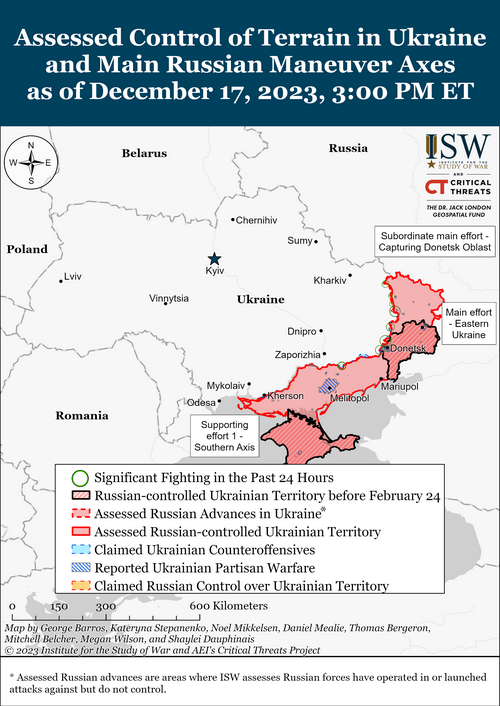
From The Institute for the Study of War:
Russian Offensive Campaign Assessment, December 17, 2023
Riley Bailey, Kateryna Stepanenko, Christina Harward, and Frederick W. Kagan
December 17, 2023, 9:15pm ET
Click here to see ISW’s interactive map of the Russian invasion of Ukraine. This map is updated daily alongside the static maps present in this report.
Click here to see ISW’s 3D control of terrain topographic map of Ukraine. Use of a computer (not a mobile device) is strongly recommended for using this data-heavy tool.
Click here to access ISW’s archive of interactive time-lapse maps of the Russian invasion of Ukraine. These maps complement the static control-of-terrain map that ISW produces daily by showing a dynamic frontline. ISW will update this time-lapse map archive monthly.
Note: The data cut-off for this product was 2pm ET on December 17. ISW will cover subsequent reports in the December 18 Russian Offensive Campaign Assessment.
Russian President Vladimir Putin threatened Finland and the wider NATO alliance in a statement ostensibly meant to dismiss concerns about the threat that Russia poses to NATO. Putin gave an extended interview with Russian state TV channel Rossiya 1 on December 17, wherein he attempted to deny US President Joe Biden’s December 6 warning that Russia would attack a NATO country in the future if it won the war in Ukraine.[1] Putin argued that Russia does not have any geopolitical, economic, military, or territorial reason to fight NATO and that Russia is interested in developing relations with NATO member states.[2] Putin followed this supposed reassurance with an accusation that NATO member states artificially created conflict between Russia and Finland and “dragged“ Finland into the NATO alliance.[3] Putin stated that “there will be problems” with Finland and that Finland’s NATO accession prompted Russian officials to start forming the Leningrad Military District (LMD) and concentrating military units in northwestern Russia.[4] The Russian military is currently redividing the Western Military District (WMD) to reform the LMD and the Moscow Military District (MMD) as part of a long-term restructuring and expansion effort that aims to prepare Russia for a potential future large-scale conventional war against NATO.[5] The WMD is responsible for the Russian border with NATO members Lithuania, Latvia, Estonia, and Finland but has largely been committed to the fight in Ukraine, where it has incurred significant losses.[6] The restoration of the LMD and MMD is likely intended to balance Russian operational requirements in Ukraine with Russian military posturing along the Russian border with NATO.[7] Putin’s justification for the formation of the LMD, which will be responsible for an area bordering Finland, Sweden, and the Arctic, suggests that he sees the LMD as a military response to the “problems” of current and future NATO members in Scandinavia.
Putin’s reassurances about his peaceful intentions toward NATO ring hollow in the context of the threats he and Kremlin pundits have recently been making against NATO member states. Putin threatened Poland on July 21, stating that Russia would respond “with all the means” at its disposal after Warsaw sent troops to the Belarusian-Polish border due to the redeployment of Wagner Group fighters to Belarus.[8] Deputy Chairman of the Russian Security Council Dmitry Medvedev threatened on August 29 that Russia had “an opportunity to act within the framework of jus ad bellum against everyone in NATO countries” when commenting on Western support of Ukrainian strikes on occupied Crimea.[9] Medvedev similarly threatened Poland in November when he stated that Russia deems Warsaw to be a “dangerous enemy” that could lose its “statehood.”[10] A Russian propagandist suggested on Russian state TV on December 2 that Baltic states would be Russia’s next military target and that they would fall shortly after Ukraine.[11] Russian propagandist Vladimir Solovyov, Medvedev, and other pundits consistently threaten to use nuclear weapons against the United States and other NATO countries.[12] These threats are part of long-standing Russian narratives about attacking NATO that predated Finland’s application and acceptance into the alliance on April 4.[13] The statements of Russian pundits do not pose a military threat to NATO countries, to be sure, but they are important context for Putin’s ostensible effort to calm the waters during his December 17 interview. Putin’s proclamation that Russia has no interest in invading NATO is also very similar to the Kremlin’s persistent claims in late 2021 and early 2022 — including right up to the eve of the invasion — that Russia did not intend to invade Ukraine.[14] The interview was likely a deliberate attempt to reamplify the Kremlin’s efforts to misrepresent the Russian military threat as an imaginary and artificial NATO invention.[15]
Putin has been seeking to curtail and weaken NATO for two decades and continually demands changes to the alliance that would amount to dismantling it Putin stated on December 17 that Russia does not have any “territorial disputes” with NATO countries in order to mask his actual long-standing objective to weaken Western unity and coerce NATO into abandoning its core principles, such as the “Open Door Policy,” which allows the alliance at its discretion to admit new members and is enshrined in the NATO Charter.[16] Putin has been consistently pursuing this goal throughout his regime and demonstrated his full commitment to it by ordering the Russian Foreign Ministry (MFA) to issue ultimatums to the US and NATO in December 2021 demanding “security guarantees” from NATO and commitments not to expand, among other things.[17]
Putin’s decades-long goal is to set conditions in which NATO would undermine its own global power, creating a structurally and ideologically defeated NATO that cannot resist Russia’s future objectives – which can include territorial conquests or the establishment of Russian suzerainty over states that Moscow deems to be in its proper sphere of control.[18] ISW has long assessed that growing friction between the United States and Europe and within NATO and other Western structures would weaken Western collective measures against the Kremlin’s aggressive behavior and allow Putin to develop a new web of coalitions to support Russia’s objectives.[19] Putin routinely reiterates his distaste for Western alliances, calling for the formation of a multipolar world order in which Russia has a veto over key global events.[20] Putin wants NATO to recognize Russia’s claims, demands, and perceived sphere of influence and has repeatedly indicated Russia’s intent to end “US hegemony.”[21] Putin had been largely using hybrid war efforts to weaken the West and its place in the world order before invading Ukraine in 2014 (apart from his 2008 invasion of Georgia), and his justifications for the full-scale invasion of 2022 did not rely on so-called territorial disputes.[22]
Putin’s interview indicated that he continues to perceive the West as weak, contrasting with his confidence in the growth of Russia’s power over the past two decades. Putin stated that he believes that the United States was interested in inflicting a “strategic defeat” on Russia 20 years ago but that this objective is not currently in the US national interest.[23] Putin responded to a journalist’s question about how Russia can find common ground with the United States, stating that the United States will need to be the one to find common ground as the United States will need to “reckon” with Russia, suggesting that Putin believes the US to be the weaker power and that Russia‘s perceived position of strength means that Russia has no need to find “common ground” or engage in serious diplomatic negotiations with the United States.[24] Both these statements can be perceived as thinly-veiled threats against the United States and NATO. Putin’s statements indicate that he continues to believe that the West has been weakening relative to Russia over the past two decades — a view Putin has been articulating since at least 2014.[25] ISW previously assessed that Putin launched the full-scale invasion of Ukraine in part because he believed that NATO was weak — not because the Kremlin felt militarily threatened by NATO.[26] ISW also assessed that Putin only respects military might, which he anticipated the United States and NATO would not use to defend Ukraine, and may be anticipating that Western support for Ukraine will collapse.[27] Putin’s perception of Russia’s increased relative power aligns with his statement on December 14 continuing to stand by his maximalist objectives in Ukraine — which are tantamount to full Ukrainian and Western surrender.[28] Kremlin officials have also recently made statements with expansionist rhetoric that emphasize the Kremlin’s confidence in its ability to fulfill its objectives in Ukraine with force.[29]
Putin is increasingly invoking a purposefully broad, vague, and pseudo-realist conception of Russian sovereignty in an effort to justify Russian goals to impose Putin’s will in Ukraine and beyond. Putin also addressed the United Russia Party Congress on December 17 in Moscow and argued that “being strong is a vital necessity for Russia” since Russia is either a sovereign, self-sufficient state or does not exist at all.[30] Putin made similar statements during his December 14 “Direct Line” Forum, where he stated that in his next term as Russian president, he would focus on protecting Russian external sovereignty, which he said encompasses Russia’s defense capacity and external security environment.[31] Putin has long employed an expansive definition of Russia’s sovereignty that frames any efforts to challenge Russian power or ambitions as infringements of Russian sovereignty.[32] Russian national security and foreign policy documents also provide for Russia’s right to “protect the rights of compatriots abroad,” and Russia has intentionally defined “compatriots” in broad terms as ethnic Russians and Russian speakers and not just those holding Russian citizenship.[33] The Kremlin has intentionally obscured the definition of “ethnic Russians” to falsely include Ukrainians and Belarusians and is promoting the notion of a wider ”Russian world” (Russkiy Mir) that includes other ethnic groups in Russia and the former territory of the Soviet Union and Russian empire.[34] The vague conception of external Russian sovereignty and who falls under its protections is meant to justify the forceful imposition of Russia’s strategic objectives upon other countries as a legitimate expression of the duties and rights of the Russian state in defense of its sovereignty. Putin and Russian officials have routinely invoked these conceptions of Russian sovereignty to justify Putin’s maximalist objectives in the full-scale invasion of Ukraine.[35]
Putin’s focus on the ties between strength and sovereignty frames Russian aggressive efforts to achieve Russia’s strategic objectives and diminish perceived Western power as defensive measures protecting Russian sovereignty. This framing allows Putin to claim that any measures that increase Russian power are in defense of the Russian people, which he has a duty to protect.[36] The focus on power suggests that he views states that are unable to unilaterally impose their will upon others as devoid of sovereignty. Putin and other Russian officials have routinely characterized Ukrainian partnerships with the West as nullifying Ukrainian sovereignty, for example.[37] This view of sovereignty allows Russian officials to justify any Russian action against any state that Putin deems to be not strong enough to protect itself and illustrates that legitimate appeals to the protections of sovereignty as customarily defined by international law will continue to mean very little to Putin.
Putin continues to express a world view in which Russia must impose its will without any compromise or face existential consequences. Putin stated in his interview with Rossiya 1 that he was naive in the 2000s and thought that the West understood that there was no basis for confrontation with Russia.[38] Putin accused the West of continuing to fight Russia as it had done with the Soviet Union because it had not rethought the Cold War era structures that the West had constructed.[39] Putin also accused some in the West of pursuing the full destruction and balkanization of Russia, framing Putin’s perceived geopolitical confrontation with the collective West in existential terms.[40] Putin has built a world view over two decades of rule in which dissatisfaction with the West has grown into a hardened zero-sum view of Russian and Western power.[41] Putin has increasingly expressed a narrative alleging that there is a concerted decades-long Western effort to diminish Russian power and inflict a permanent strategic defeat upon it, and he has grouped any geopolitical setback however minor into that narrative.[42] Putin’s worldview suggests that Putin regards anything less than full Western surrender to Russian grand strategic objectives as insufficient.[43]
This zero-sum world view of geopolitics is indicative of Putin’s personal philosophy, which prizes power above all else and frames any compromise as defeat. Putin implied in the Rossiya 1 interview that he did not apologize to his mother as a child (despite her punishments and numerous requests for an apology) but held firm until she finally wavered in punishing him.[44] This anecdote, bizarrely intruded into a conversation about Russian strategic objectives, may have been an indirect reference to Putin’s commitment to force those opposed to him to capitulate. This view is also clearly seen in the key thesis of Putin’s quasi-auto-biography First Person, which argues that Putin concluded that it was necessary to impose his will upon the world, first himself and then Russia’s survival.[45]
The Kremlin’s repeated rhetoric about its hostile intent towards NATO, coupled with Russia’s potential future military capabilities in the event of Russian victory in Ukraine, poses a credible — and costly — threat to Western security. If Russia were able to achieve its stated maximalist objective of full Ukrainian capitulation, likely leading to a Russian military occupation of Ukraine, Russia would be able to deploy forces right up to NATO’s border from the Black Sea to the Arctic Ocean.[46] ISW recently assessed that the sudden collapse of Western aid would likely lead sooner or later to the collapse of Ukraine’s ability to hold off the Russian military.[47] Given Russia’s demonstrated hostile intent towards NATO and its potential military capabilities along almost the entirety of NATO’s eastern border, the West would be obliged to prepare to defend against possible Russian action against NATO. The cost of these defensive measures would be astronomical and would likely be accompanied by a period of very high risk.[48] Support for Ukraine offers the West the best opportunity to avoid these costs and the expanded Russian threat.
Russian forces conducted a series of missile and drone strikes against Ukraine on the night of December 16 to 17. The Ukrainian Air Force reported that Russian forces launched a Kh-59 missile from occupied Crimea and Kherson Oblast and an Iskander-M missile.[49] The Ukrainian Air Force reported that Russian forces also launched 20 Shahed-136/131 drones from Primorsko-Akhtarsk, Krasnodar Krai as well as Cape Chauda, occupied Crimea.[50] Ukrainian officials reported that Ukrainian forces shot down the Kh-59 missile and all of the drones over Odesa, Kherson, Zaporizhia, and Khmelnytskyi oblasts.[51] Ukrainian Air Force Spokesperson Colonel Yuriy Ihnat stated on December 17 that Russian forces targeted Kherson City and Starokostyantyniv airfield in Khmelnytskyi Oblast.[52] Ukrainian President Volodymyr Zelensky stated on December 16 that Ukrainian forces have destroyed 104 out of 112 Russian Shahed drones launched at Ukraine in the past week.[53]
The Russian Ministry of Defense (MoD) claimed that Russian air defenses shot down 35 Ukrainian drones over Lipetsk, Rostov, and Volgograd oblasts on the night of December 16 to 17 and in the morning of December 17.[54] Rostov Oblast Governor Vasily Golubev claimed on December 17 that Russian forces shot down ”most” of the drones.[55] Russian and Ukrainian sources stated that a Ukrainian drone damaged at least one Russian aircraft at Morozovk airfield in Rostov Oblast.[56]
Key Takeaways:
- Russian President Vladimir Putin threatened Finland and the wider NATO alliance in a statement ostensibly meant to dismiss concerns about the threat Russia poses to NATO.
- Putin’s reassurances about his peaceful intentions toward NATO ring hollow in the context of the threats he and Kremlin pundits have recently been making against NATO member states.
- Putin has been seeking to curtail and weaken NATO for two decades and continually demands changes to the alliance that would amount to dismantling it.
- Putin’s interview indicated that he continues to perceive the West as weak, contrasting with his confidence in the growth of Russia’s power over the past two decades.
- Putin is increasingly invoking a purposefully broad, vague, and pseudo-realist conception of Russian sovereignty in an effort to justify Russian goals to impose Putin’s will in Ukraine and beyond.
- Putin continues to express a world view in which Russia must impose its will without any compromise or face existential consequences.
- The Kremlin’s repeated rhetoric about its hostile intent towards NATO, coupled with Russia’s potential future military capabilities in the event of Russian victory in Ukraine, poses a credible – and costly – threat to Western security.
- Russian forces conducted a series of missile and drone strikes against Ukraine on the night of December 16 to 17.
- Russian forces conducted offensive operations along the Kupyansk-Svatove-Kreminna line, near Bakhmut, near Avdiivka, west and southwest of Donetsk City, in the Donetsk-Zaporizhia Oblast border area, and in western Zaporizhia on December 17 and advanced in some areas.
- Relatives of Russian mobilized personnel continue to appeal directly to high-ranking Russian military and political officials about demobilization and the return of their relatives from Ukraine.
- The Kremlin continues attempts to expand political infrastructure in occupied Ukraine in an effort to further integrate occupied territories into Russia.
Go here to read the rest. I would rate the prospect of a NATO member being attacked by Russia as low, but Putin’s threatening language, uttered I assume for electoral purposes, does not inspire long term confidence in Russian restraint. Finland and the Baltic Republics are members of NATO and it wouldn’t take much for a border incident to lead to World War III.


We could hear such language in the 1980s, when Hackett wrote “August 1985” on a fictional Soviet invasion of West Germany. Then it all fell apart, faster than anyone could have figured. Putin barely has the bodies to throw into Ukraine, and even if he could seize territory in some westward surge, he couldn’t hold it. A nuclear throw? He’d lose and he knows it, even if he killed a lot of people, and even if he’s that suicidal, I doubt the folks around him are.
Yet on the other hand, the Japanese were mad to attack Pearl Harbor.