
INTRODUCTION
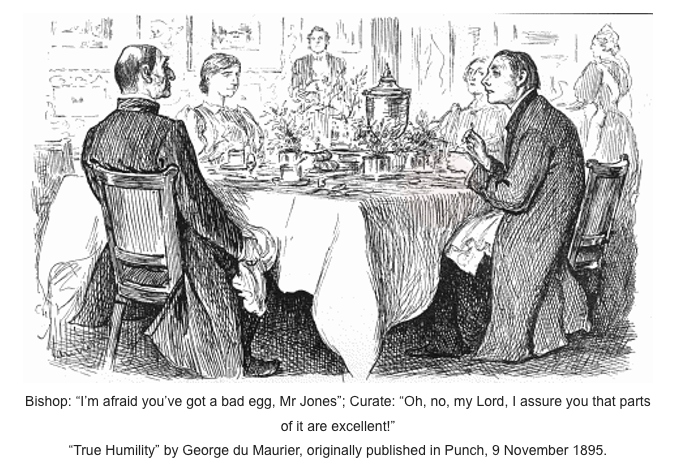
If ever one wanted an analogy to show that a flawed work had good parts, it would be the Curate’s Egg cartoon above. One hesitates to criticize anything a Pope says officially, yet an encyclical is not in itself a pronouncement ex cathedra—does not carry the charism of infallibility that attaches to formal dogmatic definitions. It should be regarded as authoritative teaching, deserving respectful engagement. But such respect entails honest evaluation. I’ve used this analogy once before, commenting on Pope Francis’s encyclical Laudato Si (see here).
THE “EXCELLENT” PARTS
As with the Curate’s Egg, parts of Magnifica Humanitas are excellent. The encyclical rightly affirms that AI is not a person and could never be; that AI lacks conscience, relational experience, and intrinsic moral agency — all of which must be supplied by programming, and the programmers are humans, not God. It is equally good that the encyclical insists principles of Catholic Social Teaching be embedded in the development and governance of AI systems — though again, this depends entirely on how particular AI agents are programmed, and by whom. And the encyclical is right to reject transhumanism and posthumanism as a new Gnosticism — a flight from embodiment that the Incarnation itself refutes.
CRITIQUE 1: EMPIRICAL OVERREACH
The Vatican, however, does not have the technical expertise to make scientific and technological judgments of the kind that appear in Magnifica Humanitas, nor does it appear to summon a sufficiently broad panel of scientific and engineering experts before making them. We saw this with Laudato Si’ and its pronouncements on anthropogenic global warming. Let us not do the Galileo thing again.
Two specific examples illustrate the problem — neither of which is mentioned in the encyclical, suggesting the advisory process was incomplete:
First, the global shortage of RAM and storage chips, driven precisely by the AI factory buildout the encyclical condemns, is already functioning as a natural market brake on runaway data center expansion — a self-correcting mechanism the encyclical ignores entirely.
Second, and more telling: Apple is pursuing a strategy of on-device local AI inference as a deliberate alternative to cloud-based processing [see here]. If this approach succeeds — and Apple’s 15 years of custom silicon investment suggests it may — the massive energy-hungry data center model the encyclical treats as the inevitable face of AI could be rendered obsolete, much as fuel-efficient wide-body jets made the supersonic Concorde economically untenable. The Vatican’s environmental indictment may be aimed at a target that is already in the sights of market forces and engineering ingenuity guns.
The encyclical’s treatment of AI and employment assumes that mass technological unemployment is essentially inevitable, demanding urgent political intervention. But this is a contested empirical claim, not settled science. Economic historians note that automation can certainly disrupt and lead to sectoral changes, but it has not historically led to mass loss of jobs — technology destroys jobs, but not work. The current picture is similarly mixed: while economists have predicted a “jobless boom” in 2026 as companies rely on AI to boost productivity without expanding payrolls, 67% of CEOs surveyed by Teneo expect AI to boost entry-level hiring, with companies stepping up hiring in engineering and AI-focused positions while existing roles are redesigned as routine tasks become automated. The encyclical presents one side of a genuinely open debate as if it were established fact. National Catholic RegisterThe Holy See
The encyclical’s prohibition on autonomous weapons is even more problematic in its reasoning. The moral principle — that non-combatant immunity is absolute and that human dignity cannot be subordinated to algorithmic efficiency — is sound Catholic teaching, fully consistent with the Catechism (§§2312–2313) and Gaudium et Spes (§80). The Church is entirely competent to state that principle. But the encyclical goes further, asserting as a universal that “no algorithm can make war morally acceptable” — smuggling in the empirical claim that no autonomous system could ever implement just war norms more reliably than human judgment under battlefield stress. Military ethicists and engineers actively dispute this. A fatigued soldier at 3 a.m. making a targeting decision under fire may be a far less reliable guardian of non-combatant immunity than a well-designed system with appropriate human oversight. Whether that is true is an empirical question — one the Vatican is not equipped to answer by fiat.
In each of these cases — data centers, employment, autonomous weapons — the pattern is the same: a moral intuition, often sound in itself, is attached to an empirical prediction the Church has no special competence to make. The result is that the moral authority of the genuine teaching is weakened by association with contestable claims. This is not a new problem. We saw it with Laudato Si’ and anthropogenic global warming. The Church would do well to remember that its credibility as a moral teacher depends in part on not overreaching into domains where it speaks without expertise. We need not revisit the Galileo affair to understand the cost of that error.
CRITIQUE 2: A FAILURE TO INSPIRE
As with many documents from the Vatican at all levels, Magnifica Humanitas is written as if it were an interoffice memo, in a style that makes one reach for the coffee to keep awake. This was not a problem with messages from former popes. Who can forget “Faith and reason are like two wings on which the human spirit rises to the contemplation of truth” (Pope St. John Paul II, Fides et Ratio) and “The Bible isn’t meant to be a manual of natural science. Instead it is meant to make understandable the authentic and deep truth of all things” (Pope Benedict XVI, General Audience, 6 February 2013)?
The Church has in Scripture and Patristic Writings powerful anti-transhumanist apologetics that would give a clear message, but these have been ignored by those who advise Pope Leo. I’ll list just a few examples.
- GENESIS 2:7: God breathes nisham chayyim ( נִשְׁמַת חַיִּים “Soul of Life”) into Adam’s nostrils; an algorithm can never receive the breath of God.
- JOHN 1:14: Et Verbum caro factum est—and the Word was made flesh; The Incarnation is the ultimate answer to transhumanism: God himself chose finitude, embodiment, suffering, and death rather than engineering them away. The Logos becoming sarx is not a problem to be solved but a mystery to be contemplated. The encyclical hints at this in the conclusion but never uses it as an argument.
- ST. AUGUSTINE, CONFESSIONS I.1: “our heart is restless until it rests in Thee.” In one sentence Augustine captures the teleological orientation of the human person toward God that no algorithm can share — because that orientation cannot be enabled by information processing; only a soul made for union with its Creator will have that yearning.
- ST. THOMAS AQUINAS, SUMMA THEOLOGICA I Q.79: the distinction between intellectus and ratio, the immateriality of the intellective act, the esse intentionale versus esse naturale distinction. These give a rigorous philosophical demonstration that AI cannot replicate human understanding — something the encyclical merely asserts without argument. Tradition has the philosophical tools; the encyclical does not use them.
FINAL THOUGHTS
The Curate’s Egg, then, is a fair verdict on Magnifica Humanitas. The encyclical’s core theological instincts are sound: AI is not a person, cannot be a person, and the authentic transcendence of the human person lies not in technological self-engineering but in the grace of God who made us, redeemed us in flesh, and calls us to union with Himself. On these matters Pope Leo XIV is right, and the Church is right to say so.
But the egg has bad parts. The encyclical overreaches into empirical territory where the Church has neither the expertise nor the mandate to pronounce with authority. And where the Church does have something irreplaceable to say — about the soul, the Incarnation, the restless heart that only God can fill — it says it in the language of a committee report rather than with the force of Scripture, Patristic wisdom, and philosophical demonstration that the moment demands.
The AI debate will not wait for a better document. It is happening now, in boardrooms, legislatures, universities, and — increasingly — in the minds of ordinary people who sense that something important about their humanity is at stake but cannot articulate what. The Church has the words. Genesis has the words. Augustine has the words. Aquinas has the argument. What is needed is a voice willing to speak them with the clarity and passion that the Fides et Ratio opening or Benedict’s February 2013 audience showed was still possible.
Perhaps that voice will come from theologians, philosophers, and scientists working together.


Perhaps it is remnants of Victorian white liying that lands us in this mess. We mayn’t disagree nor be uncivil for fear of… what?
Difficulty. Friction. Unpleasantness.
Tell the bishop the truth. Parts of his egg are simply inedible, and if he does not know it, he deserves the truth.
Bishops, particularly the Bishop of Rome, have been er.. coddled.. for far too long. We are reaping the logical rewards of our unmanly desire to avoid conflict at all costs.
“perhaps that voice will come from theologians, philosophers, and scientists working together.”
or summarized together, with a Large Language Model computer? :- )
@Bob Kurland, Ph.D. that is facetious i know… AI is a marketing term… it’s being used to inspire fear and the need for world government control.. that i rightly fear.. not the fantasy of a computer capable of actual artificial intelligence.
As the author of the AI Technology Control Plan at my company, which we will call by the pseudonym of Neutrons ‘R Us, I agree 100% with you, Dr. Kurland.
“Moral intuition, often sound in itself, is attached to an empirical prediction the Church has no special competence to make.
The result is that the moral authority of the genuine teaching is weakened by association with contestable claims.” -Dr. Kurland
A brilliant summary, Dr. Bob Kurland, in those two short sentences alone. P. Leo could mightily benefit from your contribution. Sadly, I doubt he would listen.
Even prior to this latest jaw-dropping P. Leo “thought experiment,” it is disturbing to try to grasp (1) P. Leo’s epistemology and his apparent satisfaction with his certitude of “knowing the known;” and (2) frankly, the shallowness of thought exhibited so far in this Pope’s pronouncements. (Maybe #1 = #2)
If everything now is conditioned by new circumstances, and therefore subject to perpetual change in our moral pronouncements (just war theory; capital punishment; employment; data centers), why should we pay any attention?
Soon they will change again.
“…that non-combatant immunity is absolute and that human dignity cannot be subordinated to algorithmic efficiency — is sound Catholic teaching,”
I don’ know if that’s true. From the CCC 2313 :
“Non-combatants, wounded soldiers, and prisoners must be respected and treated humanely.”
The wording does not necessarily imply an “absolute” immunity. In fact, an acceptance of collateral damage has always been recognized in Catholic moral teaching through the principle of Double Effect.
Noncombatant immunity is absolute.
Yeah, right.
If noncombatant immunity *was* absolute, most wars wouldn’t be waged at all. Most happen because one side is abusing noncombatants. If there ain’t no “just war” then who will prevent noncombatants being abused???
But aren’t we just so much betterer and cleverer than everybody who came before us! New Springtime! The Best of All Possible Worlds!
If it weren’t for the real Tradition of the Church, unassailable by fools, scoundrels, and the well intentioned, I would have bolted some time ago.