
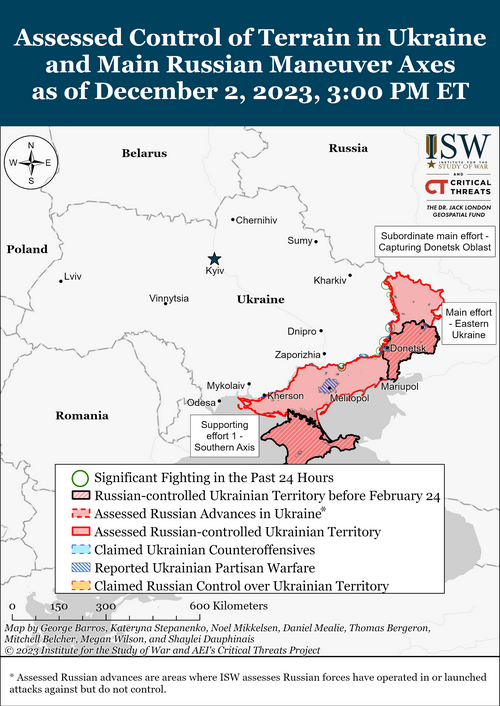
From The Institute For The Study of War:
Russian Offensive Campaign Assessment, December 2, 2023
Kateryna Stepanenko, Riley Bailey, Grace Mappes, Angelica Evans, and Frederick W. Kagan
December 2, 2023, 7:30pm ET
Click here to see ISW’s interactive map of the Russian invasion of Ukraine. This map is updated daily alongside the static maps present in this report.
Click here to see ISW’s 3D control of terrain topographic map of Ukraine. Use of a computer (not a mobile device) is strongly recommended for using this data-heavy tool.
Click here to access ISW’s archive of interactive time-lapse maps of the Russian invasion of Ukraine. These maps complement the static control-of-terrain map that ISW produces daily by showing a dynamic frontline. ISW will update this time-lapse map archive monthly.
Note: The data cut-off for this product was 1:45pm ET on December 2. ISW will cover subsequent reports in the December 3 Russian Offensive Campaign Assessment.
Poor weather conditions continue to slow the pace of Ukrainian and Russian combat operations across the entire frontline but have not completely halted them. Ukrainian Ground Forces Command Spokesperson Lieutenant Colonel Volodymyr Fityo stated that Russian forces actively use aviation in the Bakhmut direction when the weather permits it.[1] Fityo added that weather does not significantly affect Russian artillery fire in the Bakhmut direction. Russian milbloggers, claimed on December 1 that strong winds near Bakhmut and in western Zaporizhia Oblast prevented Russian forces from using drones and artillery over the past two days, however.[2] A Russian milblogger claimed that although light rain allows Russian forces to conduct aerial reconnaissance near Verbove (9km east of Robotyne) the muddy terrain makes it challenging for infantry and wheeled vehicles to advance in western Zaporizhia Oblast.[3] The milblogger added that Russian forces can only move on tracked vehicles and that Ukrainian forces continue intense artillery fire despite the poor weather conditions in western Zaporizhia Oblast. Zaporizhia Oblast occupation official Vladimir Rogov amplified footage on December 2 that shows muddy roads on the Robotyne-Novoprokopivka-Verbove line in western Zaporizhia Oblast and claimed that these conditions have practically immobilized Ukrainian wheeled vehicles, forcing Ukrainian troops to conduct infantry-only attacks.[4] Rogov amplified additional footage showing an infestation of rats and mice in a Ukrainian trench in Zaporizhia Oblast, which he claimed was the result of the cold weather in the region.[5]
Russian forces launched another series of Shahed 136/131 drone and missile strikes targeting southern Ukraine overnight on December 1-2. Ukrainian military officials reported that Russian forces launched 11 Shahed drones from Cape Chauda in occupied Crimea and a Kh-59 cruise missile from the airspace over occupied Zaporizhia Oblast.[6] The Ukrainian military officials reported that Ukrainian forces shot down 10 Shahed drones over Odesa Oblast and the Kh-59 cruise missile over Dnipropetrovsk Oblast.[7] Ukraine’s Southern Operational Command reported that a Russian Shahed drone struck an unspecified infrastructure object in Odesa Oblast.[8] A Russian milblogger claimed that Russian Shahed drones targeted the Chornomorsk and Kiliya ports in Odesa Oblast.[9] The milblogger added that Russian forces also conducted missile strikes, including at least one Iskander ballistic missile strike, in Dnipropetrovsk and Zaporizhia oblasts. ISW cannot verify the milblogger’s claims.
Ukrainian and International Atomic Energy Agency (IAEA) officials reported that the Zaporizhzhia Nuclear Power Plant (ZNPP) completely disconnected from all external power sources for five and a half hours on the night of December 1 to 2, marking the plant’s eighth complete black out — all under Russian occupation. The Ukrainian Energy Ministry and the IAEA reported on December 2 that the ZNPP lost connection with both of its operable external power lines from 0230 to around 0800 local time on December 2. The ZNPP, during the black out, automatically switched to diesel generators to cool its reactors and power essential functions.[10] The IAEA reported that the power loss disrupted the coolant pumps of reactor no. 4 and that the ZNPP is currently bringing the reactor back to a hot shutdown state to continue generating steam for ZNPP operations and provide heat for Enerhodar. Ukrainian nuclear energy operator Energoatom President Petro Kotin stated that Russia is not interested in the safety of the ZNPP, as evidenced by Russian authorities’ failure to follow the norms and rules of nuclear and radiation safety.[11] The IAEA stated that an external grid failure far away from the ZNPP caused the power failure.[12] IAEA Director General Rafael Grossi stated that this most recent power outage is “yet another reminder” about the plant’s precarious nuclear safety and security situation.[13]
The ZNPP’s complete power outage occurred as Russia continued longstanding efforts to compel the IAEA and the international community to normalize Russia’s occupation of the ZNPP.[14] Russian state nuclear energy company Rosatom claimed on December 2 that Rosatom Head Alexey Likhachev and Grossi agreed on the sidelines of the United Nations (UN) Climate Conference to hold full-scale consultations about the safety and security of the ZNPP in early 2024.[15] Neither the IAEA nor Grossi have confirmed Rosatom’s claim of future consultations as of this publication.
The US Treasury Department’s Office of Foreign Assets Control (OFAC) sanctioned three third party entities involved in the transport of Russian crude oil above the G7 price cap. OFAC announced on December 1 that it imposed sanctions on two United Arab Emirates-based and one Liberian-based shipping companies that own vessels that carried Russian crude oil above $70 barrel after the G7’s $60 price cap took effect in December 2022.[16] Russia relies on a “shadow fleet” of oil tankers without insurance from Western countries to skirt the G7’s price cap on Russian crude oil and petroleum products.[17]
The Russian Ministry of Defense (MoD) signaled that it likely intends to continue relying on crypto-mobilization recruitment schemes for any potential increase in the size of the Russian military. The Russian MoD responded to Russian President Vladimir Putin’s December 1 decree increasing the size of the Russian military and stated that the Russian military is implementing the increase in stages “on account of citizens who express a desire to perform military service under a contract.”[18] This language may refer to volunteers, whom the MoD has courted through a widespread crypto-mobilization effort in Russia, and suggests that the MoD may use volunteer recruitment for long-term force generation.[19] The MoD clarified that Putin’s decree does not portend a significant increase in the number of conscripted Russians nor a second wave of mobilization.[20] Putin‘s decree, which formally increased the size of the Russian military from 2.039 million personnel to 2.209 million personnel and total Russian combat personnel from 1.15 million to 1.32 million, is likely an official acknowledgment of the actual end strength of the Russian military and not an order for an immediate increase.[21] Partial mobilization, ongoing widespread crypto-mobilization efforts, the number of Russian personnel concluding military service, and Russian casualties in Ukraine can plausibly account for the net gain of 170,000 Russian combat personnel between the August 22 decree on the size of the Russian military and the December 1 decree.
The Kremlin’s policy towards the role of migrants in bolstering Russia’s industrial capacity continues to be inconsistent. Kremlin newswire TASS reported on December 2 that the Russian Ministry of Internal Affairs (MVD) is preparing a bill that will require Russian authorities to fingerprint and identify foreigners immediately upon entry to Russia and again upon exit.[22] Russian MVD Migration Affairs Head Valentina Kazakova previously stated that Russian officials will begin a trial run of fingerprinting and photographing migrants arriving at Moscow airports.[23] Russia already fingerprints and photographs migrants, although not immediately upon entry.[24] These new measures are not unusual immigration and travel policies but are notable in this case because they are likely a part of a wider set of anti-migration policies.[25] A Russian economic news aggregator claimed on December 2 that the Russian government has set a quota of 155,900 visa permits for skilled migrant workers in 2024, a 32,000 increase from 2023.[26] The economic news aggregator claimed that the Russian government is sending invitations and work permits to migrant workers, primarily those working in mining and construction.[27] This reported increase in migrant workers is at odds with a series of federal and regional policies in Russia that restrict migrants’ prospects for work.[28] The Kremlin increasingly appears to be pursuing mutually exclusive goals of relying on migrants to strengthen Russia’s strained industrial capacity while also pursuing force generation efforts and politically motivated anti-migration policies that reduce migrants’ ability to augment Russia’s labor force.[29]
Russian Foreign Minister Sergei Lavrov’s November 30 threat against Moldova may have emboldened certain pro-Russian actors to attempt to sow political instability and division in Moldova.[30] The pro-Russian head of Moldova’s Gagauzia region, Yevgenia Gutsul, claimed on December 1 that Moldovan state energy company Moldovagaz blocked Gagauzia from receiving gas from a Turkish supplier that the pro-Russian Gagauzia regional government had negotiated outside of state contracts.[31] Gutsul claimed that Moldovagaz sells gas at a higher price per cubic meter than the Turkish partner and accused Moldova of ignoring Gaguazia’s calls to provide its residents with cheap gas for the upcoming winter. Moldovan President Maia Sandu notably denied Gutsul’s request for a spot in her cabinet on November 13 because Gutsul is a member of the banned Shor political party, which Russia used to promote pro-Russian interests and political instability in Moldova until the Moldovan Constitutional Court banned the party in June 2023.[32] Shor Party head Ilhan Shor used the party to spark protests in September 2022-June 2023 ultimately aimed at toppling the current Moldovan government.[33] Moldovagaz Head Vadim Ceban stated that Moldovagaz does not have the physical or legal ability to block gas supplies at the Gagauzia border and that Moldovagaz has not received the necessary documentation to switch Gagauzia’s natural gas suppliers.[34] Sandu stripped Moldovan Party of Regions head Alexander Kalinin of his Moldovan citizenship on November 27 due to his extensive support of the Russian war in Ukraine, and Kalinin announced efforts on December 1 to recruit Moldovan volunteers to fight alongside the Russian military in Ukraine.[35] Russia conducted a likely campaign to destabilize Moldova in early 2023, and Russia may seek to revamp these efforts to distract international attention from the war in Ukraine.[36]
Key Takeaways:
- Poor weather conditions continue to slow the pace of Ukrainian and Russian combat operations across the entire frontline but have not completely halted them.
- Russian forces launched another series of Shahed 136/131 drone and missile strikes targeting southern Ukraine overnight on December 1-2.
- Ukrainian and International Atomic Energy Agency (IAEA) officials reported that the Zaporizhzhia Nuclear Power Plant (ZNPP) completely disconnected from all external power sources for five and a half hours on the night of December 1 to 2, marking the plant’s eighth complete black out – all under Russian occupation.
- The US Treasury Department’s Office of Foreign Assets Control (OFAC) sanctioned three third party entities involved in the transport of Russian crude oil above the G7 price cap.
- The Russia Ministry of Defense (MoD) signaled that it likely intends to continue relying on crypto-mobilization recruitment schemes for any potential increase in the size of the Russian military.
- The Kremlin’s policy towards the role of migrants in bolstering Russia’s industrial capacity continues to be inconsistent.
- Russian Foreign Minister Sergei Lavrov’s November 30 threat against Moldova may have emboldened certain pro-Russian actors to attempt to sow political instability and division in Moldova.
- Russian forces continued offensive operations along the Kupyansk-Svatove-Kreminna line, near Bakhmut, near Avdiivka, west of Donetsk City, in the Donetsk-Zaporizhia Oblast border area, and in western Zaporizhia Oblast and advanced near Avdiivka.
- Radio Svoboda’s “Schemes” and “Systems” investigative projects published a joint investigation on December 1 detailing how the Main Directorate of the Russian General Staff (GRU) created the “Redut” private military company (PMC) to recruit thousands of Russians for irregular combat service in Ukraine.
- Ukrainian partisans reportedly conducted a partisan attack against Russian military personnel in occupied Melitopol, Zaporizhia Oblast, on December 1.
Go here to read the rest.
From Strategy Page:
December 2, 2023: The war in Ukraine has done enormous economic damage to both Ukraine and Russia. Ukrainian GDP declined 30 percent in 2022 while Russia’s declined about three percent. Russia was hit hard by economic sanctions in 2014 for taking Crimea and parts of eastern Ukraine, and sanctions for its 2022 invasion made it even more isolated from the global economy. Russia’s only arms imports now come from equally poor North Korea (artillery ammo) and Iran (cheap Shahed 131/136 cruise missiles). Payment is by barter. North Korea gets badly needed food and oil supplies while Iran receives modern jet fighters and other military tech. China and India help with the funding by purchasing heavily discounted Russian oil and natural gas.
Recently Western sanctions were expanded, blocking Russia from obtaining a lot of industrial equipment for factories or establishing new ones. Russia now has a more difficult time obtaining machine tools and components needed be used to build weapons. These include motors and other components for UAVs, including lithium-ion batteries that power most UAVS. Many of these banned components for weapons are also used in non-military items. These are called dual use items, and the new sanctions ban them as well because this is how you guarantee no supplies of items that can be used to build weapons. This includes complex systems like missiles, which require specific chemicals needed to fabricate the solid-fuel motors used.
There are alternative sources for sanctioned items, but the cost is higher, delivery takes longer, and regular deliveries are not guaranteed. Using smugglers to deal with sanctions is expensive but Russia must pay to keep essential war-time industries going.
Dealing with sanctions also requires a lot of money and Russian government debt is more expensive to raise because of higher interest rates for what lenders call high risk of default debt. That has forced Russia to be selective in what military equipment it purchases. For example, the government won’t buy many new rifles for their combat troops because there are still lots of older weapons in storage. That does not always work as it should because many of these old rifles were so poorly maintained that they were often obviously rusty and barely operational. The newly mobilized troops complain but the federal government recognizes that most of these poorly trained and equipped soldiers won’t last long in combat. Local governments of places many of the new troops come from suffer most of the blowback for this and often organize efforts to raise money locally to buy new weapons and other equipment for the local men now in the army.
Foreign suppliers are few and provide low quality weapons. This includes Iranian propeller-driven small UAVs armed to perform as slow-moving cruise missiles. Then there are cheap and often elderly North Korean 152mm artillery shells needed to keep the fighting going. The Iranian missiles are not as useful as predicted because the Ukrainians now shoot down nearly all of them. There is still damage, because the wreckage of the downed missiles often still has its explosives on board, and these frequently go off when they hit the ground. If Russia uses a lot of cruise missiles in an attack, more will be downed inside an urban area, where the wreckage does some damage to the Ukrainian infrastructure.
Russia’s enormous prewar artillery munitions stocks are now depleted, while its production facilities are unable to expand. Before 1991 a lot of Soviet era 122m and 152mm ammunition was produced outside post-1991 Russia. That includes Ukraine, Belarus and other countries that have halted production and dismantled production facilities. Russia was not expecting a long war in Ukraine and did not have the artillery munitions available to fire all their shells their available guns sent to Ukraine. On the front lines Ukrainian troops have noted much fewer Russian shells fired at them. Ukrainian artillery, a combination of old 152mm and new 155mm guns, use more effective tactics than the Russians.
Russia has used up its own supplies of ballistic and cruise missiles; the few remaining are not enough to reverse the progress Ukraine is making in rebuilding its production capabilities. Ukrainian reconstruction is concentrating on keeping the lights on, along with other utilities (water, sewage disposal and heating). While much housing has been damaged or destroyed, twenty percent of Ukrainians have left the country, at least temporarily, leaving enough unoccupied housing for those needing temporary shelter until their bombed-out homes are repaired or rebuilt. Some of the foreign aid consists of building supplies to speed the restoration of war damaged housing. Russia is also suffering a smaller exodus of population. Most of these are military-age men avoiding mobilization or unemployed Russians with skills who can get jobs anywhere. These refugees have been sufficiently numerous to cause labor shortages inside Russia, forcing the government to import North Korean workers to deal with some of the shortages.
Neighboring Belarus is technically an ally, but the relationship is more like Belarus being an unwilling donor of resources to a Russia that makes no secret of the plan to absorb Belarus once Ukraine is conquered. Most Belarussians are pro-Ukraine as well as for their own independence from Russia. The pro-Russia Belarus leaders and their security forces, reinforced with some Russians, keep Belarus from more actively supporting Ukraine. Central Asian nations that also became independent of Russia in 1991 see themselves as on the Russian’s acquisition list and have adopted a wary neutrality towards the Russia-Ukraine war. Like Belarus, the Central Asians also support Ukraine. This has limited Russian economic opportunities in Central Asia. China has sped up its efforts to replace Russia as the major foreign trading partner with the Central Asian states.
Go here to read the rest.
General Winter is now being heard from in the Ukraine War. Probably both sides need a breather, Russia maybe more than Ukraine.

