
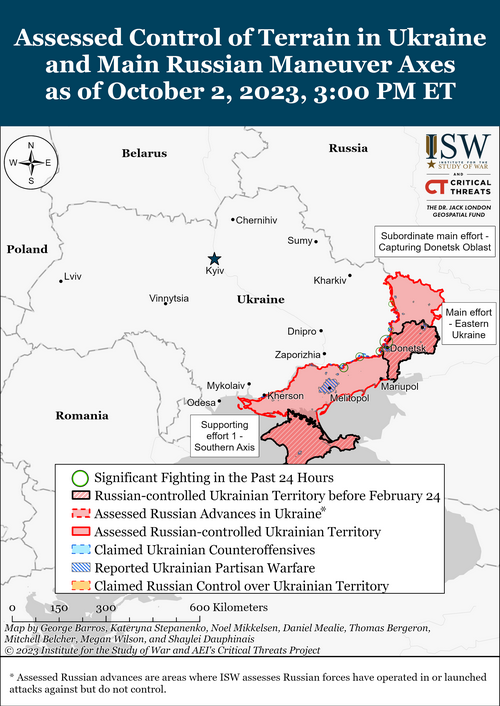
From The Institute For The Study of War:
Russian Offensive Campaign Assessment, October 2, 2023
Grace Mappes, Christina Harward, Angelica Evans, Kateryna Stepanenko, and Frederick W. Kagan
October 2, 2023, 7:30pm ET
Click here to see ISW’s interactive map of the Russian invasion of Ukraine. This map is updated daily alongside the static maps present in this report.
Click here to access ISW’s archive of interactive time-lapse maps of the Russian invasion of Ukraine. These maps complement the static control-of-terrain map that ISW produces daily by showing a dynamic frontline. ISW will update this time-lapse map archive monthly.
Note: The data cut-off for this product was 1:30pm ET on October 2. ISW will cover subsequent reports in the October 3 Russian Offensive Campaign Assessment.
A prominent Russian milblogger and front-line unit commander claimed that Russian Airborne Forces (VDV) Commander Colonel General Mikhail Teplinsky “saved” the Russian 31st Guards VDV Brigade, which was fighting south of Bakhmut, mirroring claims made by a much smaller milblogger about VDV units in western Zaporizhia Oblast. Vostok Battalion commander Alexander Khodakovsky recalled a conversation with then-Commander of the 31st VDV Airborne Brigade Colonel Andrei Kondrashkin prior to Kondrashkin’s death around Bakhmut in mid-September, in which Kondrashkin revealed that his forces suffered personnel losses and that their motivation to fight dropped to a critical level.[1] Kondrashkin reportedly stated that the Russian military command demanded that his forces undertake “decisive actions,” while he knew that his personnel were suffering a critical lack of motivation. Khodakovsky noted that Kondrashkin refrained from raising his concerns to the military command and proceeded to blame his military failures on the lack of cohesion among Russian forces. Khodakovsky, in turn, noted that cohesion was not the problem, but rather that Kondrashkin needed to make a choice to either “waste” his troops in combat or protest the Russian military command’s order at the expense of his career. Khodakovsky observed that Kondrashkin never had a chance to make this choice because he sustained an injury in combat immediately after the conversation, and that Teplinsky “saved” the 31st VDV Brigade by taking the “remnants [of the brigade] under his wing” and giving them the opportunity to take a break from combat.
A Telegram channel that advocates for Teplinsky also amplified Khodakovsky’s account, claiming that Russian VDV forces – namely elements of the Russian 7th and 76th VDV divisions – are facing similar issues in western Zaporizhia Oblast.[2] The milblogger claimed that Teplinsky is no longer able to rescue these divisions, however, as he was quietly stripped of his responsibilities. ISW cannot confirm either Khodakovsky‘s or the pro-Teplinsky milblogger’s claims, but both narratives attempt to portray Teplinsky as a commander who values the wellbeing of his forces over his career – likely to advance political goals that could support changes in the Russian military command. Khodakovsky’s account of Kondrashkin’s dilemma prior to his death also supports ISW’s prior assessment that Ukrainian counteroffensive operations south of Bakhmut may be degrading Russian units defending and counterattacking the area.[3]
A Russian “Storm Z” assault unit instructor speculated that the Russian Ministry of Defense (MoD) removed Lieutenant General Andrey Sychevoy from commanding in the Bakhmut direction due to his poor performance. The instructor claimed on October 1 that the Russian military command removed Sychevoy from his position for conducting unprepared and unsupported counterattacks south of Bakhmut near Klishchiivka and Andriivka.[4] Sychevoy’s current formal position within the Russian military is unknown. Sychevoy previously commanded the Russian Western Group of Forces in Kharkiv Oblast until his dismissal in early September 2022, and this claim is the first observed speculation that Sychevoy has had a role in military operations in Ukraine since September 2022.[5] Prominent Russian ultranationalist media outlet Tsargrad claimed in August 2023 that Sychevoy refuses all journalistic requests for comment, indicating that Sychevoy retained an official position and may have intended to keep this position concealed.[6]
Ukrainian forces marginally advanced in the Donetsk-Zaporizhia Oblast border area amid continued counteroffensive operations in western Zaporizhia Oblast and near Bakhmut on October 2. Geolocated footage published on October 2 indicates that Ukrainian forces marginally advanced northwest of Novomayorske (18km southeast of Veylka Novosilka).[7] The Ukrainian General Staff reported that Ukrainian forces continued offensive operations in the Melitopol (western Zaporizhia Oblast) and Bakhmut directions.[8] ISW is updating its October 1 assessment that Ukrainian forces lost positions in a trench system southwest of Robotyne (13km south of Orikhiv) to Russian counterattacks between September 13 and 30.[9] Geolocated footage published on October 2 and satellite imagery indicate that Ukrainian forces likely retook these positions sometime between September 12 and 17 and currently hold them.[10]
Prominent actors in the Russian information space continue to speculate about the possible future of the Wagner Group under Rosgvardia. A Kremlin-affiliated milblogger claimed on October 2 that the Wagner Council of Commanders and Wagner Commander Anton Yelizarov (call sign “Lotos”) reached an agreement with Rosgvardia in which Wagner personnel must sign individual and group agreements to join Rosgvardia before January 1, 2024.[11] The milblogger claimed that the group agreements “serve as a guarantee that [Wagner] will not be ‘torn apart’” and that Wagner personnel will be able to keep their symbols and callsigns while serving under Rosgvardia. The milblogger claimed that although it is unclear where Rosgvardia will deploy its Wagner personnel in Ukraine, it will likely not be to the Bakhmut area where former Wagner personnel who signed contracts with the Russian MoD under former Wagner representative and current MoD employee Andrey Troshev are reportedly operating. The milblogger stated that the future of Wagner’s operations in Africa and the Middle East is also not clear as Rosgvardia has reportedly only approved Wagner’s use of aircraft for operations in the war in Ukraine and the new Wagner leader, Yevgeny Prigozhin’s son Pavel, is focusing only on Wagner’s business in Russia.[12] ISW continues to assess that the Kremlin’s ideas about the relationship(s) between Wagner elements and the Russian government are unclear at this time as Russian President Vladimir Putin publicly embraced Troshev and subordinated some Wagner elements to the Russian MoD on the one hand, while the Russian MoD will need to supply Rosgvardia with the equipment it lacks on the other.[13] Russian milbloggers’ continued discussion of the matter recently indicates that the relationship is likely still not fully defined or made public.
Interethnic tensions and claims about the superiority of Chechen “Akhmat” forces over regular Russian forces continue to generate controversy in the Russian information space. Chairman of the “Patriots of Russia” political party and the State Duma Committee on Nationalities Gennady Semigin reportedly published a since-deleted statement on the “Patriots of Russia” website in support of Chechen Republic Head Ramzan Kadyrov’s son on September 29 after Kadyrov’s son was filmed beating a detainee accused of burning a Quran.[14] The post stated that “if the Russian soldier defended his ideals as uncompromisingly, then the [Chechen] Akhmat battalion would not have to kick the soldiers of the Russian Armed Forces onto the battlefield.”[15] Semigin’s post generated widespread criticism within the Russian information space on October 2, with one Russian official going so far as to call for Russian authorities to ban Duma members from speaking publicly about the war in Ukraine.[16] One Russian milblogger accused Semigin of attempting to incite ethnic hatred by comparing ”brave Chechens with cowardly Russians.”[17] Semigin later issued a statement on Telegram claiming that unspecified actors hacked the ”Patriots of Russia” website to publish the statement in protest of a bill on interethnic relations that his team was developing.[18] A milblogger also criticized Semigin‘s claim of a hacker posting the message, asking why Semigin did not take down the statement sooner or how Semigin was able to access the “Patriots of Russia“ website if it had been hacked.[19] ISW has long observed tensions between Chechen and non-Chechen officials and military units, and the continued emotional reaction within the Russian information suggests that these tensions are still present.[20]
Russian forces conducted a small-scale Shahed-131/136 drone strike on Ukraine on the night of October 1-2 after Russian forces conducted a record number of drone strikes targeting Ukrainian grain and port infrastructure in September 2023. Ukrainian military officials reported that Russian forces launched seven drones from the Krasnodar Krai direction and that Ukrainian air defenses shot down four drones.[21] Ukrainian Air Force Spokesperson Colonel Yuriy Ihnat stated that even though Russian forces have launched fewer drones in the past days, the Russian strikes still target Ukrainian military and infrastructure areas and are reconnoitering Ukrainian air defenses.[22] Ukrainian military expert Aleksandr Kovalenko stated on October 1 that Russian forces launched a record number of 521 drones that mostly targeted Ukrainian port and grain infrastructure in September 2023.[23] Kovalenko stated that Russia is still dependent on Iran for drone production due to issues with domestic production and that this September increase was due to Iran’s possible increased production from 100 Shahed-136 drones per month at the end of 2022 to 150-200 per month by May 2023.
Key Takeaways:
- A prominent Russian milblogger and front-line unit commander claimed that Russian Airborne Forces (VDV) Commander Colonel General Mikhail Teplinsky “saved” the Russian 31st Guards VDV Brigade, which was fighting south of Bakhmut, mirroring claims made by a much smaller milblogger about VDV units in western Zaporizhia Oblast.
- A Russian “Storm Z” assault unit instructor speculated that the Russian Ministry of Defense (MoD) removed Lieutenant General Andrey Sychevoy from commanding the Bakhmut direction due to his poor performance.
- Ukrainian forces marginally advanced in the Donetsk-Zaporizhia Oblast border area amid continued counteroffensive operations in western Zaporizhia Oblast and near Bakhmut on October 2.
- Prominent actors in the Russian information space continue to speculate about the possible future of the Wagner Group under Rosgvardia.
- Interethnic tensions and claims about the superiority of Chechen “Akhmat” forces over regular Russian forces continue to generate controversy in the Russian information space.
- Russian forces conducted a small-scale Shahed-131/136 drone strike on Ukraine on the night of October 1-2 after Russian forces conducted a record number of drone strikes targeting Ukrainian grain and port infrastructure in September 2023.
- Russian forces conducted offensive operations near Kreminna, near Bakhmut, along the Avdiivka-Donetsk City line, in the western Donetsk-eastern Zaporizhia Oblast border area, and in western Zaporizhia Oblast and reportedly advanced in some areas on October 2.
- The Russian “Vostok” Battalion continued to complain on October 1 that the Russian military command is not fulfilling its promises of having the unit fight as a second-echelon force and is not providing state awards.
- Russian occupation officials continued to transport Ukrainian children to Russia under the guise of educational trips.
Go here to read the rest.
From Strategy Page:
October 2, 2023: In Ukraine it was noticed by Ukrainian soldiers that many, if not most, of the Russian soldiers were in the army as contract (higher paid long term) soldiers and were from rural areas where jobs were scarce and poverty was increasing. Many of the military-age men had already served one or two years as conscripts. In the last year, military recruiters have been offering these veterans well-paid (by Russian standards) jobs as contract soldiers if they signed up for a few more years. Most of their pay could be sent directly to their families and there were substantial death or disability payments.
So far over 200,000 Russian soldiers have died in Ukraine and in many rural towns it is noticeable that many men recently died in Ukraine. That’s made it difficult for recruiters, who have obtained most of their best recruits from these rural areas, where many men are accustomed to hunting or fishing. That means recruits who already know how to shoot and move quietly in the countryside, and are in need of a better paying job. As more local men die in Ukraine, fewer are inclined to join the army. This is a problem because most of the rural population of Russia has been slowly declining. In 1970 rural areas held half the population but currently it is only 37 percent and continuing to decline. A century ago, most Russians lived in rural areas but the movement to urban areas has been relentless and continuous.
Men in urban areas have access to more news, better education and more jobs. The urban men were not interested in joining the army as contract soldiers. It was voters from urban areas that led the opposition conscription, but so far the best they could do was get the term of conscript service reduced to one year. The current conscript laws prohibit conscripts from serving in foreign wars. The government tried to present the Ukraine War as an internal Russian matter. The government passed laws to that effect but most Russians still considered the Ukraine War a foreign war that was off limits for conscripts.
To get around this the government provided more cash bonuses to induce conscripts to become contract soldiers. This made sense to conscripts from poor regions but the urban conscripts were not interested, and concentrated on surviving their unfortunate circumstances. For urban military-age men, particularly in the Moscow and St. Petersburg areas, rampant corruption in the conscription bureaucracy provides opportunities for those with money to avoid conscription or at least avoid service in a combat unit.
As Russian conscripts and newly acquired contract soldiers continued to suffer casualties in Ukraine, the quality of those troops and their willingness to fight declined. This was accelerated by the even greater decline in the number of combat officers available in Ukraine. Russian officers were also reluctant to have a promising military career cut short by untimely death in Ukraine while trying to lead reluctant troops. Ukrainian forces more frequently encountered Russian units that seemed reluctant to fight, or surrender. The Russian government tried to deal with the situation by making it a criminal offense to surrender to Ukrainian troops. This has led a growing number of reluctant and desperate Russian soldiers to desert and not return to Russia. This makes them stateless but still alive. This is not a new problem and the UN refugee agency will issue travel documents to the stateless. This allows Russian deserters to move around outside Russia but they still encounter problems finding a job while also learning a new language. It is possible to covertly contact friends and family via the Internet to let them know you are still alive but that’s about all you can do.
Go here to read the rest. Traditionally in Russian and Soviet military history some form of conscription would provide the overwhelming number of troops necessary to wage war in the traditional Muscovite manner: large numbers of poorly trained troops overwhelming their better trained and equipped enemies. In the Ukraine War Putin, for fear of igniting a move against him, has been unwilling to do this. Thus the Russians have had to go over to the defensive as their forces are ground down in a war of attrition. The concept of voluntarism ill accords with Russian and Soviet military history and in the current War we see why.


Russia announced today (yesterday Russia time)that the next budget would slash money for social programs in order to fund the war. Seems their memory of 1991 and Afghanistan has gone blank.