
From The Institute For The Study of War:
Russian Offensive Campaign Assessment, July 22, 2023
Riley Bailey, Nicole Wolkov, Angelica Evans, George Barros, and Frederick W. Kagan
July 22, 2023, 8:30pm ET
Click here to see ISW’s interactive map of the Russian invasion of Ukraine. This map is updated daily alongside the static maps present in this report.
Click here to access ISW’s archive of interactive time-lapse maps of the Russian invasion of Ukraine. These maps complement the static control-of-terrain map that ISW produces daily by showing a dynamic frontline. ISW will update this time-lapse map archive monthly.
Note: The data cutoff for this product was 1:00pm ET on July 22. ISW will cover subsequent reports in the July 23 Russian Offensive Campaign Assessment.
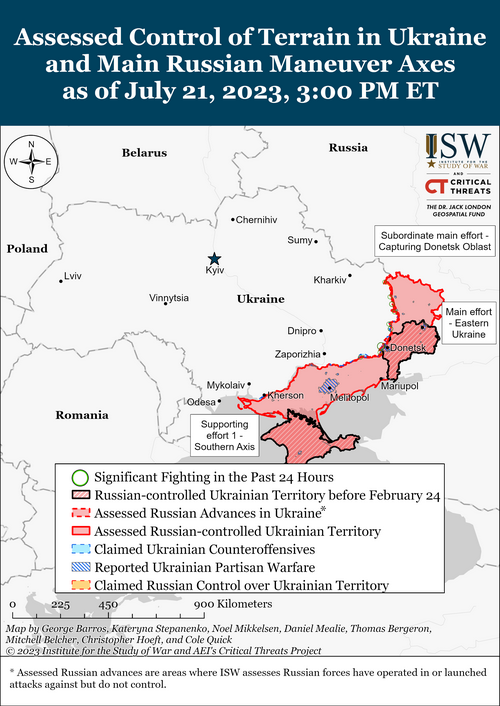
Ukrainian forces continued counteroffensive operations on at least three sectors of the front on July 22. The Ukrainian General Staff reported that Ukrainian forces conducted counteroffensive operations in the Berdyansk (Zaporizhia-Donetsk Oblast area) and Melitopol directions (western Zaporizhia Oblast).[1] The Russian Ministry of Defense (MoD) claimed that Russian forces repelled 14 Ukrainian attacks south of Kreminna, Luhansk Oblast, and in the Bakhmut area.[2] The Ukrainian General Staff did not publish a situation report about its counteroffensive operations on July 22.
Ukrainian President Volodymyr Zelensky stated that Ukrainian counteroffensive operations may soon increase in tempo and that the delay in counteroffensive operations was in part due to limited materiel. Zelensky stated at the Aspen Security Forum on July 21 that Ukrainian forces had plans to launch counteroffensive operations in the spring but that a lack of munitions and military equipment, such as mine-clearing equipment and continued Ukrainian training abroad, necessitated a delay.[3] Zelensky noted that the delay in Ukrainian counteroffensive operations allowed Russian forces to establish minefields and multiple defensive lines.[4] ISW assessed in January 2023 that the provision of Western weapons and materiel to Ukraine has been essential to Ukraine’s previous ability to conduct successful counteroffensive operations and that delays between Western pledges to send higher-end Western systems to Ukraine and the arrival of those systems likely hinder Ukraine’s ability to initiate and sustain large-scale counteroffensive operations.[5] Zelensky stated that counteroffensive operations may soon increase in tempo due to ongoing mine-clearing operations.[6] US Secretary of State Antony Blinken stated on July 21 at the Aspen Security Forum that it is too early to draw conclusions about Ukrainian counteroffensive operations and that Ukraine will likely “make a profound difference” on the battlefield as Kyiv commits all of the forces that Ukraine prepared for the counteroffensive.[7]
Ukrainian officials stated on July 22 that Ukraine’s interdiction campaign against Russian military targets in rear areas is successfully degrading Russian logistics and counterbattery capabilities, likely contributing to an asymmetrical attrition gradient in Ukraine’s favor. Ukrainian Chief of the Main Directorate of Missile Troops and Artillery and Unmanned Systems of the General Staff Colonel Serhiy Baranov stated on July 22 that Ukrainian missile and artillery units are responsible for approximately 90 percent of Russian losses.[8] Baranov stated that Ukrainian missile and artillery units have created a long-range “fire fist” thanks to Western high-precision missiles and artillery systems and that Ukrainian strikes are so powerful and accurate that Russian forces can no longer conduct effective counterbattery fire.[9] Ukrainian Southern Operational Command Spokesperson Captain First Rank Nataliya Humenyuk stated on July 22 that Ukrainian attacks on Russian ammunition concentrations in deep rear areas are causing logistical issues for the Russian military.[10] Humenyuk noted that this trend is reflected in decreased Russian shelling in Kherson Oblast, which indicates that Russian forces are experiencing “shell hunger” in the area.[11] Ukrainian Tavriisk Group of Forces Commander Brigadier General Oleksandr Tarnavskyi compared Ukraine’s counteroffensive to boxing on July 13 and stated that Ukraine intends to “hold the opponent at arm’s length” in order to avoid close combat because Ukraine can effectively defeat Russian forces from a long distance, likely referencing Ukraine’s continued interdiction campaign in eastern and southern Ukraine.[12] Baranov’s, Humenyuk’s, and Tarnavskyi’s statements suggest that the Ukrainian military is successfully carrying out this interdiction campaign. This campaign is a central aspect of Ukraine’s plan to create an asymmetrical attrition gradient that conserves Ukrainian manpower at the cost of a slower rate of territorial gains while gradually wearing down Russian manpower and equipment.[13]
Ukrainian forces struck a Russian oil depot and ammunition depot in Crimea as part of this Ukrainian pressure campaign. The Ukrainian Armed Forces reported on July 22 that Ukrainian forces destroyed an oil depot and ammunition depot near Oktyabrske, Krasnohvardiiske Raion, Crimea.[14] Russian sources claimed that Ukrainian forces also struck an airfield near Oktyabrske where Russian forces have reportedly been stockpiling equipment for a month.[15] Crimea occupation head Sergey Aksyonov confirmed that Ukrainian forces struck an ammunition depot, causing it to explode and prompting occupation officials to evacuate residents within a five-kilometer radius of the depot.[16] Aksyonov also stated that Russian authorities suspended rail traffic on the Kerch Strait bridge to minimize risk.[17] A Kremlin-affiliated milblogger claimed that Ukrainian forces launched two Storm Shadow cruise missiles, while other milbloggers claimed that Ukrainian forces used an unspecified number of drones for the strike.[18] ISW cannot confirm what kind of weapons Ukrainian forces used in this strike. A prominent Russian milblogger tied today’s strike to Ukraine’s previous strikes on Russian military warehouses in Crimea and the Chonhar and Kerch Strait bridges.[19] The milblogger claimed that Ukrainian strikes are aimed at disrupting Russian logistics and creating “shell hunger” in Russia’s forces fighting in southern Ukraine.[20]
Russian strikes against Ukrainian shipping and agricultural infrastructure in southern Ukraine may be subsiding or entering a temporary lull. The intensity of Russian drone and missile strikes against Ukrainian shipping and agricultural infrastructure in southern Ukraine has steadily decreased since July 19. The Ukrainian General Staff reported that Russian forces launched only five Shahed drones from the southeast direction – all of which Ukrainian air defense reportedly intercepted – on July 22.[21] In comparison, Russian forces launched 19 Shahed drones, four Iskander missiles, and three Kalibr missiles against Ukraine on July 21.[22] Russian forces launched seven Onyx cruise missiles, four Kh-22 anti-ship missiles, three Kalibr sea-based cruise missiles, five Iskander ballistic missiles, and 19 Iranian-made Shahed drones on July 20.[23] Russian forces fired even more ordnance at Ukraine on July 18 and 19, respectively.[24]
Further details about former Russian officer and ardent nationalist Igor Girkin’s arrest for extremism continue to suggest a shifting balance of power among Kremlin factions and a notable factionalism within the Russian Federal Security Service (FSB), in which Girkin had served. ISW has consistently assessed that Girkin likely had the backing of an unknown silovik, possibly within the FSB since Girkin was a former FSB officer and consistently used passports under fictitious names that he received from the FSB.[25] Russian sources, including the Angry Patriots Club, amplified a document from Girkin’s lawyer, Alexander Molokhov, on July 22 purporting to show that FSB investigators initiated the criminal case against Girkin on July 18 and that the Moscow Department of the FSB’s Service for the Protection of the Constitutional Order and Combating Terrorism (SZKSBT) provided the materials for the case.[26] Girkin previously suggested that the head of the SZKSBT’s Department for the Protection of the Constitutional Order (UZKS), Lieutenant General Aleksey Zhalo, censored Girkin’s July 9 speaking engagement at a bookstore in St. Petersburg.[27] Zhalo and Girkin have had a longstanding feud after Girkin publicly criticized Zhalo for the arrest of ultranationalist figures in 2018 and for failing to combat the Ukrainian Azov Regiment’s recruitment measures.[28]
The involvement of the SZKSBT in Girkin’s case may be indicative of this personal struggle, although it may also suggest a degree of factionalism within the FSB itself. The alleged document also states that the FSB’s Center for Criminalistics (TsST) formally assessed on July 17 that Girkin’s May 25, 2022 Telegram posts, likely referencing comments he made criticizing a lack of payments to Russian personnel, constituted a crime.[29] The TsST and SZKSBT may have approved the initiation of Girkin’s criminal case because FSB leadership decided to stop protecting Girkin as he increasingly became more adversarial towards the Kremlin. It is also possible that the two FSB entities acted on longstanding desires to arrest Girkin after a potential shift in the balance of power in the Kremlin to the FSB’s detriment. FSB Director Alexander Bortnikov reportedly secured security guarantees for Wagner Group financier Yevgeny Prigozhin in negotiations to end Wagner’s June 24 rebellion and may have lost what appeared to be the Kremlin’s increasing backing for the FSB.[30] Girkin himself recently claimed that Prigozhin’s rebellion shifted the balance of power within the Kremlin to favor factions hostile to the FSB and other Russian security organs.[31] Russian authorities’ recent initiation of criminal cases against other prominent Telegram administrators and ultranationalist figures with connections to the FSB and Russian security services suggests that select Russian officials may be trying to undermine the reputation of these security structures in the wake of a potential shift in the influence of Kremlin factions.[32]
Girkin’s affiliates have launched a public effort to cast Girkin as an embattled figure in opposition to the Russian leadership. Angry Patriots Club members gathered at the Moscow Meshansky Court on July 21 and denounced the court’s charges against Girkin and its decision to remand Girkin at an unspecified pre-trial detention center until September 18.[33] Angry Patriots Club Chairman Pavel Gubarev stated in front of the court that the group would fight for Girkin’s release by any legal means and accused Russian leadership of using all of its resources to knock Girkin out of his “public work.”[34] Angry Patriots member and the coordinator for the Other Russia Party, Eduard Limonov, announced in front of the court that the Angry Patriots Club will launch a public campaign defending Girkin as a “political prisoner.”[35] Russian authorities detained Gubarev, Limonov, and Angry Patriots member Yan Sidorov for their demonstrations in front of the court, but later released them.[36] Girkin’s Telegram channel posted on July 22 a screed against Russian authorities for punishing Girkin, a “patriot… who gave his whole life to the service of the motherland,” while allowing those that took part in Wagner’s rebellion to escape punishment.[37] Girkin’s Telegram signed the post as “the Russian Movement in Support of Igor Strelkov” indicating that Girkin’s affiliates intend to galvanize widespread public support for Girkin.[38] It is unclear if Girkin’s affiliates, specifically those in the Angry Patriots Club, will succeed in this effort given that they represent a small, insular group within the wider Russian ultranationalist community.
Girkin’s arrest has not generated widespread outrage in the Russian ultranationalist community as some previous cases have, suggesting an increasing fragmentation within the information space. Russian milbloggers notably did not express anger at Girkin’s arrest as they have in previous instances when Russian authorities have attempted to censor ultranationalist figures. Russian milbloggers recently decried Russian authorities charging pro-war Russian military doctor Yuri Yevich with discrediting the Russian military for offering a negative assessment of the state of Russian combat medicine.[39] The milbloggers defended Yevich and criticized Russian authorities for targeting someone they deemed to be a Russian patriot. Outrage at Girkin’s arrest and the subsequent defense of his patriotism was limited to members and supporters of the relatively isolated and small Angry Patriots Club, which Girkin launched in April, by contrast.[40] Girkin’s critics in the Russian ultranationalist information space notably did not celebrate his arrest, however. The lack of widespread outrage among milbloggers suggests that Girkin’s arrest is unlikely to deeply agitate the majority of the Russian ultranationalist community and Russian military personnel, contrary to some Western reporting. The tepid response from Russian milbloggers concerning Girkin’s arrest and Wagner-affiliated milbloggers’ continued support for Prigozhin after the Wagner rebellion likely indicates an increasing fragmentation within the Russian ultranationalist community along factional affiliations and significant ideological differences about Russia’s approach to the war in Ukraine.[41]
Girkin’s arrest is likely not an indicator of a wider effort to censor the Russian ultranationalist community, but rather an attempt to excise a specific segment of the community that is vocally hostile to the Kremlin. Russian insider sources claimed on July 22 that Russian Duma Deputy Oleg Matveychev recently submitted a report to the Russian Presidential Administration proposing to recognize Girkin as a foreign agent in support of an overall effort to encourage self-censorship among jingoistic patriots that criticize the Russian leadership.[42] ISW cannot verify these claims, although they suggest that the Kremlin may have been in active discussions about how it could silence the section of the ultranationalist community that Girkin represents. Putin has routinely sought to maintain relationships with select milbloggers in a bid to leverage their connections to the wider Russian ultranationalist community, and Girkin’s arrest does not likely portend a Kremlin effort to reverse course on courting the increasingly prominent ultranationalist milblogger community.[43] Girkin’s arrest does suggest that the Kremlin views those whose criticism passes certain not entirely clear boundaries as a threat, particularly following the Wagner Group rebellion that aimed to replace Russia’s military leadership.
Key Takeaways:
- Ukrainian forces continued counteroffensive operations on at least three sectors of the front on July 22.
- Ukrainian President Volodymyr Zelensky stated that Ukrainian counteroffensive operations may soon increase in tempo and that the delay in counteroffensive operations was in part due to limited materiel.
- Ukrainian officials stated on July 22 that Ukraine’s interdiction campaign against Russian military targets in rear areas is successfully degrading Russian logistics and counterbattery capabilities, likely contributing to an asymmetrical attrition gradient in Ukraine’s favor.
- Ukrainian forces struck a Russian oil depot and ammunition depot in Crimea as part of this Ukrainian pressure campaign.
- Russian strikes against Ukrainian shipping and agricultural infrastructure in southern Ukraine may be subsiding or entering a temporary lull.
- Further details about former Russian officer and ardent nationalist Igor Girkin’s arrest for extremism continue to suggest a shifting balance of power among Kremlin factions and a notable factionalism within the Russian Federal Security Service (FSB), in which Girkin had served.
- Girkin’s affiliates have launched a public effort to cast Girkin as an embattled figure in opposition to Russian leadership.
- Girkin’s arrest has not generated widespread outrage in the Russian ultranationalist community as some previous cases have, suggesting an increasing fragmentation within the information space.
- Girkin’s arrest is likely not an indicator of a wider effort to censor the Russian ultranationalist community, but rather an attempt to excise a specific segment of the community that is vocally hostile to the Kremlin.
- Ukrainian forces conducted offensive operations along the Kupyansk-Svatove-Kreminna line and in the Bakhmut area but did not make gains.
- Russian forces conducted offensive operations in the Kupyansk and Bakhmut areas and along the Avdiivka-Donetsk City line and made claimed advances in the Kupyansk area.
- Ukrainian forces conducted offensive operations along the western Donetsk-eastern Zaporizhia Oblast border area and in western Zaporizhia Oblast but did not make advances.
- Russian forces conducted offensive operations along the western Donetsk-eastern Zaporizhia Oblast border area but did not make any confirmed or claimed advances.
- Prominent Russian Federation Council members opposed a bill aimed at increasing the upper age limit for the conscription age while maintaining the lower limit of 18.
- Russian occupation authorities continue to relocate Ukrainian children in occupied Ukraine to Russia.
- The Wagner Group’s footprint in Belarus is likely expanding.
Go here to read the rest. The Ukrainian President talks about an increased tempo in the counteroffensive. Talk is always very cheap in war. As always, it is the doing that is tough.

