
From The Institute For The Study of War.
Russian Offensive Campaign Assessment, July 18, 2023
Karolina Hird, Grace Mappes, Nicole Wolkov, Angelica Evans, Christina Harward, and Frederick W. Kagan
July 18, 2023, 7:30pm ET
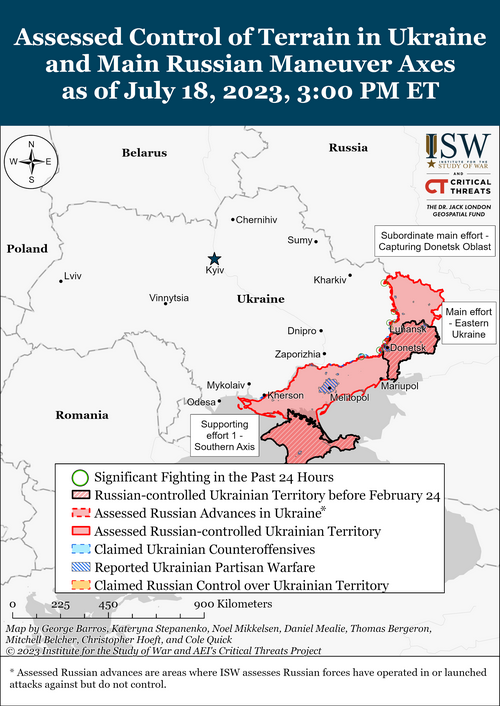
Click here to see ISW’s interactive map of the Russian invasion of Ukraine. This map is updated daily alongside the static maps present in this report.
Click here to access ISW’s archive of interactive time-lapse maps of the Russian invasion of Ukraine. These maps complement the static control-of-terrain map that ISW produces daily by showing a dynamic frontline. ISW will update this time-lapse map archive monthly.
Note: The data cutoff for this product was 2:30pm ET on July 18. ISW will cover subsequent reports in the July 19 Russian Offensive Campaign Assessment.
The July 17 Kerch Strait Bridge attack is likely having immediate ramifications on Russian military logistics in southern Ukraine. Footage and imagery published on July 17 and 18 show extensive traffic jams and accidents reportedly on the E58 Mariupol-Melitopol-Kherson City highway – Russia’s current main logistics line connecting Russia to southern Ukraine – at various points between Mariupol and Berdyansk, and in Kherson Oblast.[1] Russian occupation authorities claimed to have reduced traffic at Crimea-Kherson Oblast checkpoints near Chonhar and Armiansk following significant traffic jams in the morning.[2] Russian occupation authorities also advertised alternate routes and rest stops along them for tourists to drive from occupied Crimea through occupied Zaporizhia and Donetsk oblasts – rear areas in a war zone – to return to Russia.[3] Russian authorities also announced additional measures to mitigate resulting traffic jams and logistics issues, including a temporary road bridge next to the Kerch Strait Bridge, the reconstruction of a 60-kilometer stretch of road between Crimea and Kherson Oblast through Armiansk, and lowering security measures at the Kerch Strait Bridge checkpoints.[4] Russian authorities reopened one span of the Kerch Strait Bridge to one-way road traffic towards Russia on July 18, and plan to reopen the same span to two-lane traffic on September 15 and the whole bridge to road traffic in November.[5] Kremlin Spokesperson Dmitry Peskov stated on July 18 that the Russian government is still developing measures to increase the security of the Kerch Strait Bridge, and Russian milbloggers continued to criticize the claimed Russian security failure to adequately protect the bridge.[6]
Russian forces conducted a strike campaign ostensibly against Ukrainian military objects in southern Ukraine in explicit retaliation for the Kerch Strait Bridge attack. The Russian Ministry of Defense (MoD) claimed that Russian retaliatory strikes hit port infrastructure in Odesa City and to have destroyed Ukrainian fuel storage facilities holding a combined 70 thousand tons of fuel near Odesa and Mykolaiv cities.[7] Ukrainian military officials reported that Ukrainian air defenses shot down all six Russian Kaliber missiles and 31 of 36 Shahed 131/136 drones targeting these areas, but that falling missile fragments damaged port infrastructure and a residential area in Odesa.[8] Russian milbloggers heavily criticized the Russian MoD for only targeting Ukrainian military assets in retaliation for Ukrainian military ”provocations” rather than targeting these assets as part of the war effort.[9] These complaints are consistent with prior milblogger criticisms to the same effect following other major military events, including the October 2022 Kerch Strait Bridge attack.[10] The Russian MoD also accused Ukrainian forces of targeting occupied Crimea with 28 drones overnight on July 17 to 18 and claimed that Russian air defenses and electronic warfare systems downed all 28 drones.[11]
The dismissal of former Russian 58th Combined Arms Army (CAA) Commander Major General Ivan Popov and the issues he cited continue to have effects on Russian military operations in southern Ukraine and the discourse around these operations. A prominent, Kremlin-affiliated Russian milblogger accused Ukrainian forces of attempting to exhaust Russian forces defending in southern Ukraine and noted that the Russian military command has not solved the force rotation issues Popov outlined before his dismissal.[12] Another prominent milblogger supported Popov, noting that the issues Popov outlined seem more important issues for the Russian Ministry of Defense (MoD) to address than transferring Popov to Syria or other information mitigation measures.[13] Some Russian milbloggers amplified reports of several Russian assault groups with forces of up to a platoon simultaneously surrendering to Ukrainian forces in the Zaporizhia direction.[14] Persistent issues with Russian logistics and operations in southern Ukraine may have contributed to these forces’ inability or unwillingness to fight and reported resulting surrender.
Ukrainian forces conducted counteroffensive actions on at least three sectors of the frontline against the backdrop of increased Russian offensive operations and claimed tactical gains along the Kharkiv-Luhansk Oblast border on July 18. Russian and Ukrainian sources noted that Russian forces have recently increased offensive operations in the Kupyansk area (between northeastern Kharkiv Oblast and northwestern Luhansk Oblast).[15] The Russian Ministry of Defense (MoD) claimed that Russian forces advanced up to 2km along the front and up to 1.5km in depth in an unspecified area in the Kupyansk direction.[16] Ukrainian Deputy Defense Minister Hanna Malyar and Ukrainian Ground Forces Commander Colonel General Oleksandr Syrskyi reported that Russian forces continue to transfer reinforcements to the Bakhmut direction and are concentrating their main forces in the Kupyansk direction due to Ukrainian advances in the Bakhmut area, supporting ISW‘s assessment that Russian forces aim to draw Ukrainian reserves to the Kupyansk area and away from critical areas of the theater where Ukrainian forces are conducting counteroffensive operations.[17] ISW continues to assess that Russian forces will not likely make tactically significant advances or an operationally significant breakthrough between northeastern Kharkiv Oblast and Luhansk Oblast in part due to the poor quality of Russian forces deployed in this area. Russian and Ukrainian sources noted that elements of the 1st Guards Tank Army (Western Military District) and convict-formed “Storm-Z” units are operating in the Kupyansk area.[18] ISW has previously assessed that the elements of the 1st Guards Tank Army are heavily degraded and that “Storm-Z” units suffer from poor morale and discipline.[19]
Russia continues legislative manipulations to repress domestic dissent through introducing fear of criminal liability. Russian State Duma Deputy Vasily Piskarev stated on July 18 that he and several other deputies submitted a bill for consideration to the Duma on “liability for propaganda and justification of the ideology of extremism” that will introduce a 300 thousand ruble (roughly $3,297) fine and up to five years in prison for violation of the amendment.[20] ISW has previously reported on similar laws and amendments that are meant to set high penalties and criminal liability for anything that Russian authorities assert is “extremist” or “terroristic” behavior in order to encourage self-censorship and facilitate crackdowns against any dissenting parties.[21] Some facets of the Russian information space expressed concern that Russian authorities could use the law to crack down against any expressed viewpoints that contradict those of the Russian state, including support for Russian opposition parties or figures.[22]
The Telegraph concluded that Belarusian President Alexander Lukashenko and Belarusian authorities are actively involved in the forced deportation of Ukrainian children. The Telegraph quoted the head of the Belarusian opposition group National Anti-Crisis Management, Pavel Latushka, who alleged that Lukashenko is personally responsible for the forced displacement of Ukrainian children to Belarus and that he gave direct instructions on how to carry out and finance the displacement.[23] The Telegraph found that Belarusian authorities actively worked with Russian authorities to transport some Ukrainian children to Belarus and others to far eastern regions of Russia. The Telegraph reported that Belarusian and Russian authorities collaborated to forcibly transport at least 2,150 Ukrainian children to Belarus since September 2022 and that the number of Ukrainian children in Belarus will likely reach 3,000 by fall of 2023.[24] The European Parliament Foreign Affairs Council had previously called for an arrest warrant against Lukashenko in early June for actions relating to Ukrainian children and for facilitating other crimes committed in Ukraine.[25] ISW has long assessed that Belarus is involved in the deportation of Ukrainian children to Belarus and the Russian Federation.[26]
Key Takeaways:
- The July 17 Kerch Strait Bridge attack is likely having immediate ramifications on Russian military logistics in southern Ukraine.
- Russian forces conducted a strike campaign ostensibly against Ukrainian military objects in southern Ukraine in explicit retaliation for the Kerch Strait Bridge attack.
- The dismissal of former Russian 58th Combined Arms Army (CAA) Commander Major General Ivan Popov and the issues he cited continue to have effects on Russian military operations in southern Ukraine and the discourse around these operations.
- Ukrainian forces conducted counteroffensive actions on at least three sectors of the frontline against the backdrop of increased Russian offensive operations and claimed tactical gains along the Kharkiv-Luhansk Oblast border on July 18.
- Russia continues legislative manipulations to repress domestic dissent through introducing fear of criminal liability.
- The Telegraph concluded that Belarusian President Alexander Lukashenko and Belarusian authorities are actively involved in the forced deportation of Ukrainian children.
- Russian forces continued offensive operations along the Kupyansk-Svatove line, southwest of Kreminna, and in the Bakhmut and Avdiivka-Donetsk City areas and made limited territorial gains in all sectors.
- Ukrainian forces continued counteroffensive operations around Bakhmut and advanced north of Bakhmut.
- Ukrainian forces conducted counteroffensive operations in the western Donetsk-eastern Zaporizhia area and in western Zaporizhia Oblast and reportedly made limited advances.
- Russian forces conducted limited ground attacks in the western Donetsk-eastern Zaporizhia oblast area and recently made limited advances in western Zaporizhia Oblast.
- Some Russian sources suggested that recent measures supporting the development of the Russian National Guard (Rosgvardia) allow it to posture as an alternative Russian military formation.
- Russia continues to formalize methods of social programming targeted at youth in occupied areas of Ukraine.
Go here to read the rest.
From Strategy Page:
July 18, 2023: The 2022 invasion of Ukraine has been a disaster for Russia, because Russian troops ran into unexpected and very effective Ukrainian resistance. Russia lost more troops in less than a year of fighting in Ukraine than they did during eight years of fighting in Afghanistan during the 1980s. Russia did have one success because of the Ukraine War, but that occurred in Russia, not Ukraine. Back in Russia, many people opposed the war. While the Russian government portrayed the fighting in Ukraine as an effort to keep NATO from harming Russia, it was obvious that no one was invading or attacking Russia and that it was Russians that invaded Ukraine. Like the Germans who invaded Russia in 1941, the Russians invading Ukraine were soon on the defensive and driven out of Russia by 1944.
Fourteen months after Russia invaded Ukraine, the Ukrainians are attacking and driving the Russian forces out. This is bad news for the Russian government, which has been facing growing criticism from Russian citizens about not merely the war’s cost, but the need for it at all. The Russian government responded to the internal criticism and did so more effectively than their military efforts in Ukraine.
Throughout most of its history, Russia has been a police state. In addition to the secret police, Russia also intercepted and read mail and overheard radio and telephone conversations. Russia mobilized support inside Russia for detecting anonymous critics and threatening them with arrest if they did not curb their criticism.
This criticism made it obvious that the Russian government was losing the support of its own people, including a growing number of senior officers who spoke out, usually via encrypted messages on Telegram, a popular cell phone app in Russia and Ukraine. Early on many of these Russian Telegram based military bloggers (“mil-bloggers” supported the invasion and were supplied with information by the Russian government, including opportunities to spend some time with the troops inside Ukraine. By June the Russian mil-bloggers were no longer reporting the official Russian version of events in Ukraine, but what was being reported by Russian veterans of the fighting in Ukraine.
After Russia announced a pause in offensive military operations in early July, one of these mil-bloggers, a former general who had served in occupied Donbas before the invasion, reported a different reality. He insisted that Russia had suffered higher losses in eastern Ukraine (Luhansk province) than the Ukrainians, who were conducting a classic attrition defense. The Russians had suffered far more losses in men and equipment than the Ukrainians who were not driven out of Luhansk, but withdrew slowly and deliberately to encourage Russia to keep attacking and losing troops and combat vehicles that could not be replaced. Meanwhile the Ukrainians were receiving more weapons and equipment from NATO and forming new units, including armed resistance groups in Russian occupied Ukraine. This was not the official Russian assessment but it was the reality that Russian troops in Ukraine were experiencing and some Russian mil-bloggers were reporting.
All this was nothing new. When the most modern and effective Russian forces were assembled to invade Ukraine in 2022, they quickly discovered they were not facing an inept, poorly trained and armed foe but one that was far more effective than the Russians were. The main offensive in the north against the Ukrainian capital took heavy losses and within weeks was forced to retreat. Russian troops were told by their government that they had encountered NATO troops who were in Ukraine preparing to invade Russia. The surviving Russian troops knew better because all they encountered were Ukrainians, usually armed with weapons similar to what Russia used as well as more effective ones they had received from NATO. The Ukrainians used more effective tactics and some new weapons that were based on Western models but Ukrainian- made. The Russian state-controlled media was ordered to ignore reports like this and stick with the official story that this was all a secret NATO operation to attack Russia via Ukraine.
While this information war played on, the Russian military ordered everything Russia had, short of nuclear and chemical weapons, into use in an effort to salvage the situation. Russia was at war with a near-peer opponent and losing. Many Russians, civilian and military, figured out what was happening and openly criticized, or sometimes even physically attacked, their government because of the mess in Ukraine that was killing a lot of Russian troops. These Russian critics were often well-educated professionals in regular contact with Westerners, including more than a million Russians who had left since 2014 because of fears Russia was headed for what actually happened in 2022.
Russia encountered major problems trying to control information made available to its people. This became a critical problem after the invasion of Ukraine and the government wanted to conceal the extent of their military failures. Passing new laws against disclosing such information and shutting down the last few media operations that were not state-controlled were not enough. The ban on casualty information created a lot of public protest that found ways to get past the censorship.
The Russian government persevered and was eventually successful at organizing effective resistance to internal criticism by Russian officials and civilians. This was done by relying on the growing number of Russian firms that were developing new tools to read encrypted messages and track those who were anonymously news of the Ukraine War that was critical of Russian efforts. The FSB, the Russian secret police that replaced the Cold War era KGB in the 1990s, encouraged the establishment and growth of Russian companies that were developing new tools for the KGB to use for detecting, tracking and eavesdropping on the communications of Russian critics who thought they were safe when using encrypted apps like WhatsApp and Telegram. The Telegram app was developed by the two Russian Durov brothers in 2013 and soon attracted unwanted attention from the Russian government, which wanted to take possession of Telegram before it became widely used in Russia and prevented the government from knowing who was saying what to whom. The Durov brothers left Russia and continued their work on Telegram elsewhere. Over the last decade Russia has sought Russian firms willing and able to develop tools to degrade the effectiveness of Telegram and other encrypted messaging apps that have become common on the Internet. These encrypted apps were used by government critics inside Russia and the Russian leader wanted to put an end to it. Several Russian firms responded to this by developing tools and apps that can track the use of encrypted messages and identify who is saying what to who.
These efforts to track the users of encrypted apps and even decrypt some of the messages have produced some successes. Despite that Russians continue criticizing their government, especially the Russian actions in Ukraine. Portions of Ukraine still under Russian control are dealing with resistance from the native Ukrainians by moving the Ukrainians to Russia and uncertain future. The departed Ukrainians are replaced by Russians willing to risk living in a disputed area. The reward is that they receive free housing as they occupy the empty homes of the forcibly departed Ukrainians. Russia has already been condemned for its policy of seizing the young children of hostile Ukrainian civilians and sent the kids to Russia and adoption by Russian couples. This sort of thing appalls many Russians because Russian history books describe similar behavior by the nazi German invaders during World War II. The Russian government denies any similarities between its activities in Ukraine now and what the German invaders did inside Russia nearly 80 years ago. Russia declared it illegal to spread these ideas. There were a few arrests, but that was also unpopular and the prison system could not handle a large number of Russians convicted of thought crimes.
Successful government tracking and identification of Russians criticizing their government was seen as a victory against the spread of anti-Russian information on the Internet. However, this did little to stop Russians from discussing and criticizing government misbehavior. The government is undeterred and continues to reward Russians and Russian firms that come up with new tools to decrypt encrypted messages and track the extent of this critical information and who was involved.
Go here to read the rest. Throughout almost all Russian history, the Russians have endured patiently tyrannical government until wild rebellions break out, times of trouble to use the Russian phrase. Every day the Ukraine War continues is another day when the Russian people, as they have often done in the past, slip their leashes and go wild.

