
From The Institute For The Study of War:
Russian Offensive Campaign Assessment, May 16, 2023
Riley Bailey, Kateryna Stepanenko, Karolina Hird, Nicole Wolkov, and Frederick W. Kagan
May 16, 2023, 5:30pm ET
Click here to see ISW’s interactive map of the Russian invasion of Ukraine. This map is updated daily alongside the static maps present in this report.
Click here to access ISW’s archive of interactive time-lapse maps of the Russian invasion of Ukraine. These maps complement the static control-of-terrain map that ISW produces daily by showing a dynamic frontline. ISW will update this time-lapse map archive monthly.
Note: The data cutoff for this product was 3pm ET on May 16. ISW will cover subsequent reports in the May 17 Russian Offensive Campaign Assessment.
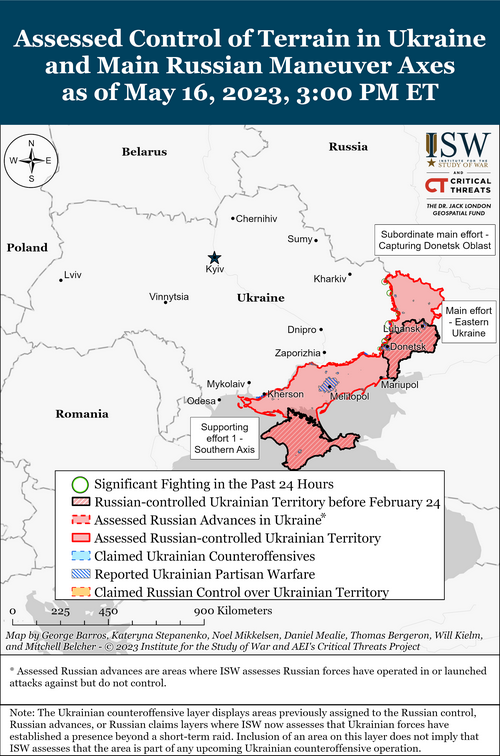
Important Note: ISW has reindexed its map layer for reported Ukrainian counteroffensives on May 12, 2023. We removed reported Ukrainian counteroffensive coded before May 1, 2023, in order to delineate more clearly new Ukrainian territorial gains from gains secured in previous Ukrainian counteroffensives. ISW retained a few reported Ukrainian counteroffensives polygons from before May 1, 2023, specifically on the Dnipro River Delta south of Kherson Oblast, to preserve context in that complex area of operations. May 1, 2023, is an arbitrary date and does not mark the beginning or end of any assessed Ukrainian or Russian effort. ISW has reindexed its map layers before and similarly removed old reported Ukrainian counteroffensives around Kyiv, Zhytomyr, Chernihiv, and Sumy oblasts following the conclusion of the Battle of Kyiv in April 2022.
Russian forces have likely committed to reinforcing their tactical offensive effort in the Bakhmut area despite Ukraine’s apparent focus on limited and localized counterattacks. Donetsk People’s Republic (DNR) Head Denis Pushilin claimed on May 16 that Russian forces have strengthened their forces in the Bakhmut area to stabilize the situation, and a prominent Russian milblogger claimed that four unspecified Russian battalions have deployed to the flanks around Bakhmut to prevent Ukrainian breakthroughs.[1] Russian claims about Russian reinforcements are consistent with Ukrainian Deputy Defense Minister Hanna Malyar’s May 15 statement that Russian forces are deploying additional airborne (VDV) forces to defend Bakhmut’s flanks, presumably from other areas of the front.[2] Russian forces have continued to make marginal gains within Bakhmut itself as of May 16, and the Russian Ministry of Defense (MoD) continues to claim that Russian forces around Bakhmut are focused on repelling Ukrainian counterattacks.[3] The Russian MoD claimed on May 16 that elements of the 4th Motorized Rifle Brigade (2nd Luhansk People’s Republic Army Corps) repelled 10 Ukrainian counterattacks near Ivanivske (6km west of Bakhmut).[4]
Ukrainian military officials continue to indicate that Ukraine is pursuing much more limited operations in the Bakhmut area than Russian forces, who appear to be committed to Bakhmut as a renewed main effort. Malyar stated on May 16 that while Ukrainian forces have liberated roughly 20 square kilometers of territory in recent days, Russian forces are continuing to make marginal gains within Bakhmut.[5] Ukrainian Eastern Grouping of Forces Commander Colonel General Oleksandr Syrskyi stated that Ukrainian forces are continuing to use the concept of “active defense” in conducting counterattacks in unspecified areas near Bakhmut.[6] Ukrainian Eastern Grouping of Forces Spokesperson Colonel Serhiy Cherevaty reiterated that the main objective of the Ukrainian defensive operation in the Bakhmut area is to exhaust Russian forces in the area.[7] ISW has geolocated footage published on May 16 of Ukrainian positions in southwestern Bakhmut that suggests that Ukrainian forces have recently made limited gains in the city itself.[8] Geolocated footage published on May 16 indicates that Ukrainian forces made marginal gains east of Orikhovo-Vasylivka (11km northwest of Bakhmut), although ISW has not observed any further Ukrainian gains around Bakhmut as of May 16.[9]
The reported Russian reinforcements to the Bakhmut area suggest that Russian forces are continuing to concentrate offensive capabilities there despite an assessed wider effort to reprioritize operations to prepare for potential Ukrainian counteroffensives. Russian forces have also recently transferred elements of the 6th Guards Motorized Rifle Division (20th Guards Combined Arms Army, Western Military District) to an unspecified area north of Bakhmut, likely from positions along the Svatove-Kupyansk line.[10] The movement of Russian forces from other sectors of the front to the Bakhmut area is likely a response to persisting Russian concerns about the stability of frontlines in the area amid Wagner Group’s continued degradation in the offensive to capture Bakhmut.[11] These concerns were likely more pronounced in recent days that saw limited Ukrainian gains around Bakhmut and may have prompted further Russian concentration on the tactical offensive effort in the area. The reinforcements are also likely meant to enhance Wagner’s ability to capture the remainder of Bakhmut rapidly and present a Russian tactical victory before possible setbacks during a Ukrainian counteroffensive operation. ISW assesses that the Russian military command likely decided to reprioritize operations and sustainment efforts in recent weeks to prepare for potential Ukrainian counteroffensive operations, although the continued concentration on Bakhmut may suggest that immediate tactical concerns could be undermining the larger effort.[12]
Russia conducted another large-scale drone and missile strike on the night of May 15 to 16. Ukrainian sources reported that Russian forces launched six Kh-47 Kinzhal air-launched ballistic missiles from six MiG-31K aircraft at Kyiv, as well as nine Kalibr cruise missiles and 10 land-based S-400 and Iskander-M missiles at other rear areas of Ukraine.[13] Ukrainian air defense shot down all missiles, including all six Kinzhals (repeatedly touted by Russian forces as unstoppable) and nine total drones, including six Shahed-131/136s.[14] It is unclear which systems Ukrainian forces used to shoot down the Kinzhals, but Ukrainian officials previously attributed the defeat of a Kinzhal missile to US-provided Patriot air defense system on May 4.[15] Ukrainian Joint Forces Commander Lieutenant General Serhiy Nayev noted that the missile strike on Kyiv is the eighth in the month of May alone.[16] The Russian Ministry of Defense (MoD) notably claimed that one of the Kinzhals struck a Patriot air defense system in Kyiv.[17] An unidentified US defense official told CNN that the Patriot system has likely suffered damage but has not been destroyed and that the US is still assessing the extent of the damage.[18]
Wagner Group financier Yevgeny Prigozhin attempted to downplay his reported cooperation with Ukrainian intelligence on May 15. Prigozhin responded to a media inquiry about leaked US intelligence report published in The Washington Post that revealed that he attempted to disclose positions of Russian conventional forces to Ukrainian intelligence in exchange for Ukraine’s withdrawal from Bakhmut.[19] Prigozhin stated that ”in any war exchanges are made, and this is not a secret for the warring parties” in an attempt to downplay his reported connections with the Ukrainian Main Military Intelligence Directorate (GUR).[20] Prigozhin argued that information about troop positions is ”not secretive at all” in modern warfare due to the use of satellite imagery. Prigozhin also paradoxically attempted to deny the validity of the leaked US intelligence documents, claiming that a junior US officer would have not had access to such secret documents. GUR Spokesperson Andriy Yusov stated that Ukraine will not comment on the leaked document.[21]
The Wagner Group’s continued glorification and normalization of violence is evident in a widely circulated video purportedly showing a killed American volunteer in Bakhmut. A Wagner Group-affiliated Telegram channel posted footage on May 16 of Wagner Group financier Yevgeny Prigozhin and former Russian Deputy Minister of Defense for Logistics-turned-Wagner-Group-deputy-commander Colonel General Mikhail Mizintsev showing the documents and body of an American volunteer serving with the Ukrainian military.[22] Prigozhin claimed that he would give the body to US authorities because he likely died a worthy death in war.[23] Prigozhin’s video emphasizes Wagner’s continual promotion of brutality and glorification of war, as the video appeared to showcase Wagner gloating over the death of an American and amplified the graphic nature of his death. ISW previously reported on Wagner’s promotion of violence through the use of widely-shared graphic video footage.[24] A US State Department spokesperson stated that the State Department is ”aware of the reports” and ”seeking additional information.”[25]
Russia and Iran continue efforts to strengthen bilateral military-economic cooperation. Iranian state-run news agency IRNA reported on May 16 that Iranian Ambassador to Russia Kazem Jalali announced that Russia and Iran will sign an agreement on the construction of the Rasht-Astara railway line during Russian Deputy Prime Minister Alexander Novak’s visit to Tehran on May 16 and 17.[26] This agreement will reportedly advance the completion of Iran’s North-South corridor project by completing a 162km link between the Iranian cities of Rasht and Astara and will create a connection between St. Petersburg and the Persian Gulf.[27] The completion of this sector has been a long-standing Iranian line of effort, partially aimed at strengthening Iran‘s domestic economy and facilitating sanctions evasion efforts. Both Russia and Iran are taking additional steps to further bilateral military cooperation. The White House reported on May 15 that Russia seeks to buy additional drones from Iran after having used most of the 400 Iranian drones purchased since August 2022 in attacks on Ukrainian infrastructure.[28] Iranian media also reported on May 13 that Iran will receive its first shipment of Russian Su-35 multi-role fighter aircraft in the coming week.[29] Moscow will likely continue to pursue mutually beneficial military-economic programs in order to ensure continued Iranian material support for Russian operations in Ukraine.
The Russian Federal Security Service (FSB) proposed a draft regulatory act that would allow FSB officers to conduct searches without a court order, likely to support the Kremlin’s ongoing efforts to strengthen domestic repression. The draft regulatory legal act would allow FSB officers to conduct operational search activities not associated with an ongoing criminal case without a court order in instances “that are urgent and may lead to the commission of a serious …crime.”[30] FSB officers would also be allowed to conduct searches without court orders in connection with ”events or actions that pose a threat to the state, military, economic, information, or environmental security of Russia.”[31] ISW has previously assessed that the FSB appears to be currently conducting an overhaul of domestic security organs, and the new regulatory act is likely meant to augment these efforts.[32] The Kremlin has recently supported laws strengthening punishments for trespassing at facilities run by certain federal bodies, for the misappropriation of Russian military assets, and for the discreditation of all Russian personnel fighting in Ukraine to expand pretexts for the arrests of Russian citizens and the removal of officials who have fallen out of favor.[33] The FSB’s involvement in ongoing overhauls and the increasingly broad regulations to conduct searches suggest that the Kremlin is preparing for the FSB to be the internal security organ that would conduct a wider domestic crackdown.
Russian forces reportedly shut down another Ukrainian evangelical Christian church in Mariupol likely as part of a wider systematic religious persecution campaign in occupied Ukraine. Ukrainian Mariupol Mayoral Advisor Petro Andryushchenko reported that Russian forces seized the Ukrainian Christian Evangelical Church of the Holy Trinity in Mariupol and are using the church to house 10 to 30 Russian servicemen.[34] ISW reported on April 9 that Protestants suffered two-thirds of all of the reported religious repression events in occupied Mariupol.[35] ISW identified that Russian occupation officials most commonly persecute members of the Ukrainian Orthodox Church and Protestants, particularly evangelical Baptists.[36]
Key Takeaways
- Russian forces have likely committed to reinforcing their tactical offensive effort in the Bakhmut area despite Ukraine’s apparent focus on limited and localized counterattacks.
- The reported Russian reinforcements to the Bakhmut area suggest that Russian forces are continuing to concentrate offensive capabilities there despite an assessed wider effort to reprioritize operations to prepare for potential Ukrainian counteroffensives.
- Russia conducted another large-scale drone and missile strike on the night of May 15 to 16.
- Wagner Group financier Yevgeny Prigozhin attempted to downplay his reported cooperation with Ukrainian intelligence on May 15.
- The Wagner Group’s continued glorification and normalization of violence is evident in a widely circulated video purportedly showing a killed American volunteer in Bakhmut.
- Russia and Iran continue efforts to strengthen bilateral military-economic cooperation.
- The Russian Federal Security Service (FSB) proposed a draft regulatory act that would allow FSB officers to conduct searches without a court order, likely to support the Kremlin’s ongoing efforts to strengthen domestic repression.
- Russian forces reportedly shut down another Ukrainian evangelical Christian church in Mariupol likely as part of a systematic religious persecution campaign in occupied Ukraine.
- Russian forces are reportedly deploying additional manpower and equipment from Belarus to reinforce their positions in Luhansk Oblast.
- Russian forces continued unsuccessful offensive operations along the Kupyansk-Svatove-Kremmina line.
- Russian forces have made marginal gains within Bakhmut as of May 16 and continued limited ground attacks along the Avdiivka-Donetsk City line.
- Russian forces are continuing to panic about maintaining their positions in the east (left) bank Kherson Oblast ahead of anticipated Ukrainian counteroffensives.
- The Kremlin continues to pass legislation that provides benefits to participants of the war and their families in order to incentivize military service.
- Russian authorities continue efforts to consolidate the economic subordination of occupied areas of Ukraine into the Russian economy.
Go here to read the rest. ISW adjusting its maps to highlight new Ukrainian territorial gains in the coming, or current, Ukrainian offensive, indicates to me that the believe the offensive is underway or is about to begin.


The Russians say their kinzhal missiles destroyed all their targets … Isn’t it nice that Putin is targeting U.S. Patriot missiles … one missile at a time? 😀