
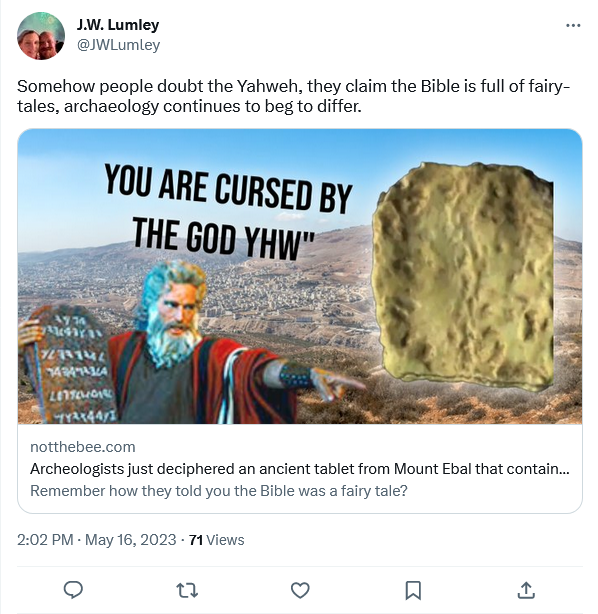
We have a tablet with a curse from an altar on Mount Ebal that dates to the 13th century B. C., which would be around the time when the Israelites fled Egypt.
Now let’s turn to the Book of Deuteronomy, Chapter 11, starting with verse 26. These are the last instructions of Moses to his successor, Joshua, and the Israelites before they cross into the Promised Land.
See, I am setting before you today a blessing and a curse: the blessing, if you obey the commandments of the Lord your God, which I command you today, and the curse, if you do not obey the commandments of the Lord your God, but turn aside from the way that I am commanding you today, to go after other gods that you have not known. And when the Lord your God brings you into the land that you are entering to take possession of it, you shall set the blessing on Mount Gerizim and the curse on Mount Ebal.
I’ve been to Mount Nebo, where Moses died. From there, you can see the Jordan Valley and the mountains of Israel to the west.
Moses told the people to set up two altars on opposing mountains – Gerizim and Ebal – as a reminder of the choice that lay before them in conquering the land ahead of them. It was a physical metaphor for the spiritual choice ahead of them.



Modern Catholic Biblical scholarship whose notes you can find in the Catholic New American Bible Revised Edition and New Jerusalem Bible accepts and promotes the lies of liberal progressive Protestant Biblical scholarship that the Torah or Pentateuch was cobbled together by post exilic scribes at the end of the 6th century AD from Yahwehist, Elohimist, Deuteronomistic and Priestly stories and fairy tales. This is the kind of blasphemous crap that the Bishops in the USCCB endorse. But again and again when Jesus Christ quotes from anyplace in the Torah, He said, “Moses wrote…” So who is right? Jesus Christ? Or those apostate effeminate lavender-laced Bishops and their intellectual aristocratic friends in secular Academia? Well once again from the article Donald posted, archeology shows Jesus is correct, and the Bishops and their scholars are worthless liars. Frack these people one and all. Why would ANY Evangelical or Pentecostal Christian who believes in Scriptural inerrancy contrary to modern Episcopalian, Presbyterian, Methodist and Lutheran scholarship ever want to become a Catholic? What’s the difference between what the study notes in the USCCB-endorsed NABRE says, and what the ECUSA or UMC or PCUSA says? None! No difference!
Eloquently stated, LQC. During my period of Biblical refresher study (at nearly 50 years of age after essentially ignoring Scripture since my childhood Sunday School days), after I had enrolled in RCIA, I was given a New American Bible by a Catholic friend. I was amazed upon reading the notes that a book endorsed by the Catholic bishops contained so much material challenging the historicity and inerrancy of the Scriptures. Fortunately we had discovered EWTN by then, so at the urging of men like Fr. Mitch Pacwa and Fr. Benedict Groeschel, I purchased an Ignatius RSV-CE translation, and started reading the Ignatius New Testament Study Edition. The NAB is a money pipeline for the USCCB. Like you, I believe its contents (the translation itself in addition to the notes) are scandalous Modernist garbage. Prof. Anthony Esolen has written much on this topic; run a search on his name with the word “Nabbish” to see his articles. Well worth the time.
The “biblical minimalist” wing of Holy Land archaeology continues to take it on the chin.
And yeah, “mainstream” contemporary Catholic biblical scholarship is as clapped out as the mainline Protestant endeavor that it slavishly imitates.
I recall the late Fr. John Meier’s misguided series on the historical Jesus, which became increasingly “Jesus Seminar”-like in its later stages. It purported to be an effort to discern what Protestant, Catholic, Jewish and agnostic scholars could come to agreement about using historical tools. From a quick perusal of issues like the perpetual virginity of Mary, it seems clear that Meier’s Catholic was the most amiable of mutes.
By the end, Meier had gone completely off the rails and argued in his last published work that only four of the parables were actually said by Jesus.
Thank God for the Ignatius Study Bible.
https://en.wikipedia.org/wiki/John_P._Meier#A_Marginal_Jew:_Rethinking_the_Historical_Jesus
It is my understanding that only the text of the books of the Bible is inerrant. The footnotes and study notes are not inerrant.
Correct. But, alas, the Catholic Study Bible (non-Ignatius version) comes with a nihil obstat and imprimatur right up front, which suggests to the reader that such notes and guides are okey-fine with the Catholic faith. And given that those are what the Catholic newbie to scripture study are going to rely on to understand the inerrant text, that’s a problem.
So many people start Bible study and come with their NAB Bible that had been given to them by their parish for confirmation gifts – over the years – and it is still going on.
I always talk with them about the footnote issues – and also critical theory. they like that it is the translation at Mass. but eventually most new Bible studiers get the NRSV-Catholic – I always recommend Ignatius with great footnotes and study pages
Ignatius “Didache”