
From The Institute For The Study of War:
Karolina Hird, Grace Mappes, Layne Philipson, George Barros, and Frederick W. Kagan
July 21, 5:00 pm ET
Click here to see ISW’s interactive map of the Russian invasion of Ukraine. This map is updated daily alongside the static maps present in this report.
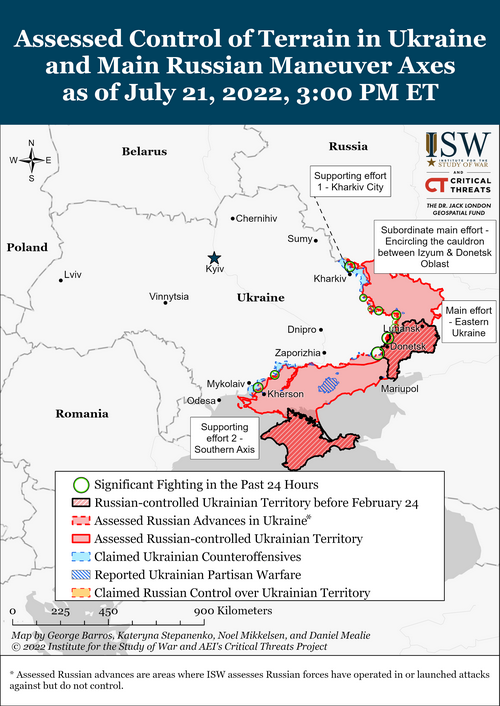
Russian forces conducted a few limited and highly localized ground attacks on July 21. The current Russian operational tempo is not markedly different from what it was during the officially declared operational pause between July 7 and July 16. Russian forces continued to conduct minor attacks throughout that period to the northwest of Slovyansk and around the Siversk and Bakhmut areas without capturing any decisive ground.[1] Since July 16, Russian troops have continued local attacks to the east of Siversk as well as east and south of Bakhmut; they have not made any major territorial gains in these areas as of July 21. The Russian grouping northwest of Slovyansk has in fact conducted fewer ground attacks along the Kharkiv-Donetsk Oblast border than it did during the official operational pause. The lack of successful ground attacks beyond the Slovyansk, Siversk, and Bakhmut areas is consistent with ISW’s assessment that the Russian offensive is likely to culminate without capturing Slovyansk or Bakhmut.[2]
Ukraine’s Main Intelligence Directorate (GUR) reported on July 21 that Russian troops have used up to 55-60% of Russia’s pre-war reserve of high-precision missiles.[3] GUR spokesperson Vadym Skibitksy specified that these high-precision missiles include Kh-101, Kh-555, Iskander, and Kalibr systems, which he stated Russian forces have been using less frequently, partially due to the effect of Western sanctions on the availability of needed components for high-precision systems.[4] On the other hand, Ukrainian forces have recently acquired an influx of Western-provided high-precision systems such as high mobility artillery rocket systems (HIMARS), which they are using to a more decisive effect than the Russians have been achieving with their precision systems. Russian forces will likely continue to employ their reserves of lower-precision Soviet weapons systems, but the decisiveness of these strikes, compared to the impact of Ukrainian HIMARS strikes, is likely to remain limited.[5]
Key Takeaways
- The current Russian operational tempo is not markedly different from the pace of Russian offensive operations during the official Russian operational pause, and Russian forces are unlikely to be able to take significant ground in the coming weeks.
- Russia has likely used as much as 55-60% of its high-precision weaponry reserve.
- Russian forces continued limited ground attacks to the east of Siversk and south of Bakhmut.
- Russian forces conducted an unsuccessful ground attack north of Kharkiv City.
- Russian forces conducted a limited ground attack in Kherson Oblast.
- Russian forces may be storing equipment in Zaporizhzhia Nuclear Power Plant facilities to protect it against Ukrainian strikes.
- Russia’s Murmansk Oblast is reportedly forming a volunteer battalion.
Go here to read the rest. The brevity of the Operational Pause indicates to me that the Russians decided it was costing them domestic support from Russians who want a more vigorous conduct of the War. The fact that the ending of the Operational Pause has changed nothing in the Russian conduct of the War indicates that the weaknesses in the Russian forces are not being addressed by the Russians and perhaps cannot be addressed.

