Vicki Lynne Hoskinson, the little girl he murdered in 1984, would have been 46 this year. Her mother fortunately is still alive to see justice, far too long delayed, done to her murderer.
Donald R. McClarey
Cradle Catholic. Active in the pro-life movement since 1973. Father of three, one in Heaven, and happily married for 43 years. Small town lawyer and amateur historian. Former president of the board of directors of the local crisis pregnancy center for a decade.
It appears that Atwood’s life has already been extended over that of his victim by a factor of seven. Get him his chaplain and get on with the business at hand.
John F. Kennedy
Tuesday, June 7, AD 2022 1:40pm
I have compassion for him. He has been in prison unjustly too long. He should have been executed in 1987 or 1988 at the latest.
You notice a Canadian appellate court has declared life-without-parole ‘unconstitutional’. Tom McKenna called that one years ago. The vector driving the agitation contra capital punishment is an objection to punishment per se.
IIRC, there isn’t any reasonable doubt about his guilt. It has taken the system in Arizona 35 years to get around to executing him because the imperative of the system is process-for-the-hell-of-it. Five years is satisfactory for the appellate courts and the governor to review the case. He should have been put in front of a firing squad thirty years ago.
John F. Kennedy
Tuesday, June 7, AD 2022 2:28pm
It drives me crazy when the media uses “alleged” and “accused” for those caught in the act. The trial of the driver of the SUV who ran over all of those people, the “alleged killer” should take a day and the execution the following day. The subway shooter, the same. I’m quite sure we could all name ten or more such cases. Justice delayed is justice denied and in most of these cases justice isn’t even a concern.
Pinky
Tuesday, June 7, AD 2022 3:39pm
If I’m 66 years old and I’ve just spent the last 38 years in prison, and you’re offering me either an execution or old age and death in prison, I don’t know, man. I’m not saying a person should give into despair, but living out your days aching, knowing that you’ve left the world a worse place and have no family to remember you…are we really going to call that “mercy”? A great chance for a saint to offer up his suffering maybe. And would that we all do so. But I don’t know that fighting to prevent his execution is a merciful act. (Maybe I’m just in a mood. If this is theologically or morally wrong, then please ignore it.)
Pinky-
if I remember correctly, it is a matter of prudence, rather than settled theology.
I don’t find a lifetime in prison very merciful, either– if there was some relatively safe way to have someone try to make things right, it might work, but as it is…prison is just prison.
There are two reasons for capital punishment: to prevent the criminal from repeating his act; as a deterrent to others not to commit such acts. Life imprisonment, without parole, would serve both purposes. I should add that I’m against capital punishment though there are numerous occasions when I’ve been tempted to waver from that position. BTW, it is God who will render the ultimate punishment for sin.
There is a third reason for the penalty of death. It is called Justice. One may argue about what constitutes Justice in a particular case, but nevertheless, it should be a constituent element in every case. In the most egregious cases, a penalty less than death mocks the entire system.
Greg Mockeridge
Tuesday, June 7, AD 2022 9:20pm
First of all, Bob, Church teaching goes significantly further than the two things you listed. In fact, it considers retribution a legitimate cause. Life with parole comes nowhere close to having the deterrent effect the death penalty does. And since life without parole is often not that in fact, it doesn’t render the murderer unable to murder again. Nor does it stop murderers from murdering other prisoners or correctional officers. Nor does it prevent gang leaders from ordering and coordinating murders beyond prison walls. And that is a common occurrence.
Frank
Wednesday, June 8, AD 2022 7:36am
My sole issue with capital punishment is the often arbitrary manner in which it is applied. The author of the erstwhile St. Corbinian’s Bear blog spent decades handling death penalty cases in just one state, and has stories that would appall most of us. In Anglo-American law, in difficult cases at least, the system leading to execution depends upon the virtue and scrupulous honesty of every participant at every step. But how to distinguish the “easy” cases from the difficult ones is the problem. Nevertheless, because the Church’s waffling on this issue is a very recent development, I question the theological validity of the JP2/Francis position. It appears to seek to transform a matter of prudential judgment into one of dogma. This seems inappropriate to me.
T. Shaw
Wednesday, June 8, AD 2022 8:31am
In the meantime, one or more of the lovely people fire-bombed another pro-life facility in New York.
The innocent suffer when the when the guilty are not punished – see 21 bloody bodies in Uvalde, TX.
My sole issue with capital punishment is the often arbitrary manner in which it is applied. The author of the erstwhile St. Corbinian’s Bear blog spent decades handling death penalty cases in just one state, and has stories that would appall most of us. In Anglo-American law, in difficult cases at least, the system leading to execution depends upon the virtue and scrupulous honesty of every participant at every step.
Waal, our appellate judges have insisted, arbitrarily, that capital sentences cannot be prescribed by statute but must be the result of serial exercises in discretion – by the prosecutor, by the jury, often by the judge. Then everything gets reviewed ad infinitum by appellate judges.
The scandalous case that John Grisham reviewed was a consequence of lying and abuse of power by (1) the prosecutor, (2) a crooked forensic technician employed by the state police, (3) two crooked state police investigators. The local police were not implicated bar that the actual perpetrator slipped through the dragnet due to their inattention. The sheriff also allowed himself to be rooked into the prosecutor’s jailhouse informant scheme. The sachems of local bar were implicated because once the prosecutor’s abuses were exposed, they did nothing to recruit someone to run against him. The local public was implicated because that prosecutor was repeatedly returned to office and retired in 2008 and turned the office over to his longtime deputy.
The courts in this country do nothing well.
Interviewed about his book, Grisham said he’d practiced law in Mississippi for ten years and had never seen anything like it. The prosecutors and police officers he’d dealt with were ‘straight-up guys’.

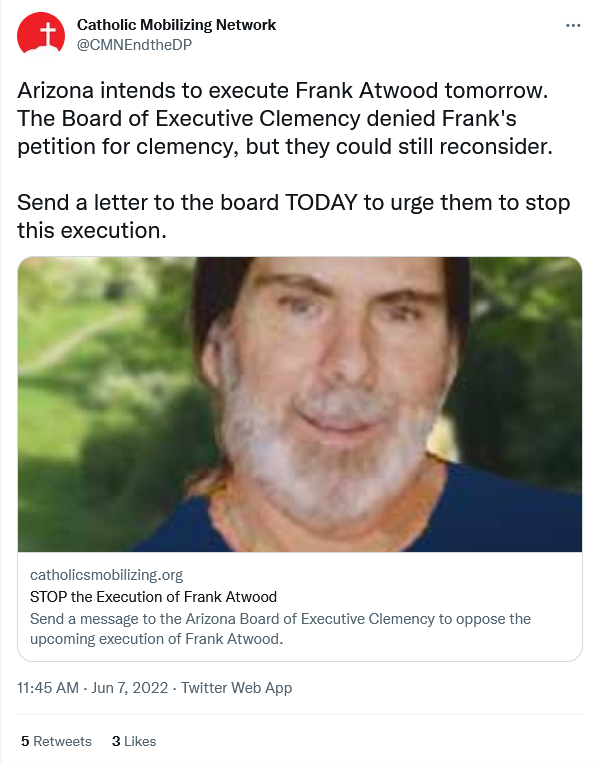


It appears that Atwood’s life has already been extended over that of his victim by a factor of seven. Get him his chaplain and get on with the business at hand.
I have compassion for him. He has been in prison unjustly too long. He should have been executed in 1987 or 1988 at the latest.
You notice a Canadian appellate court has declared life-without-parole ‘unconstitutional’. Tom McKenna called that one years ago. The vector driving the agitation contra capital punishment is an objection to punishment per se.
IIRC, there isn’t any reasonable doubt about his guilt. It has taken the system in Arizona 35 years to get around to executing him because the imperative of the system is process-for-the-hell-of-it. Five years is satisfactory for the appellate courts and the governor to review the case. He should have been put in front of a firing squad thirty years ago.
It drives me crazy when the media uses “alleged” and “accused” for those caught in the act. The trial of the driver of the SUV who ran over all of those people, the “alleged killer” should take a day and the execution the following day. The subway shooter, the same. I’m quite sure we could all name ten or more such cases. Justice delayed is justice denied and in most of these cases justice isn’t even a concern.
If I’m 66 years old and I’ve just spent the last 38 years in prison, and you’re offering me either an execution or old age and death in prison, I don’t know, man. I’m not saying a person should give into despair, but living out your days aching, knowing that you’ve left the world a worse place and have no family to remember you…are we really going to call that “mercy”? A great chance for a saint to offer up his suffering maybe. And would that we all do so. But I don’t know that fighting to prevent his execution is a merciful act. (Maybe I’m just in a mood. If this is theologically or morally wrong, then please ignore it.)
Pinky-
if I remember correctly, it is a matter of prudence, rather than settled theology.
I don’t find a lifetime in prison very merciful, either– if there was some relatively safe way to have someone try to make things right, it might work, but as it is…prison is just prison.
There’s fast taking your life, or slow.
And none of it undoes the objective wrong done to the little girl.
There are two reasons for capital punishment: to prevent the criminal from repeating his act; as a deterrent to others not to commit such acts. Life imprisonment, without parole, would serve both purposes. I should add that I’m against capital punishment though there are numerous occasions when I’ve been tempted to waver from that position. BTW, it is God who will render the ultimate punishment for sin.
If it could be accomplished without putting others at risk, and if it could be reasonably believed that there is truly no chance they’d be released.
There is a third reason for the penalty of death. It is called Justice. One may argue about what constitutes Justice in a particular case, but nevertheless, it should be a constituent element in every case. In the most egregious cases, a penalty less than death mocks the entire system.
First of all, Bob, Church teaching goes significantly further than the two things you listed. In fact, it considers retribution a legitimate cause. Life with parole comes nowhere close to having the deterrent effect the death penalty does. And since life without parole is often not that in fact, it doesn’t render the murderer unable to murder again. Nor does it stop murderers from murdering other prisoners or correctional officers. Nor does it prevent gang leaders from ordering and coordinating murders beyond prison walls. And that is a common occurrence.
My sole issue with capital punishment is the often arbitrary manner in which it is applied. The author of the erstwhile St. Corbinian’s Bear blog spent decades handling death penalty cases in just one state, and has stories that would appall most of us. In Anglo-American law, in difficult cases at least, the system leading to execution depends upon the virtue and scrupulous honesty of every participant at every step. But how to distinguish the “easy” cases from the difficult ones is the problem. Nevertheless, because the Church’s waffling on this issue is a very recent development, I question the theological validity of the JP2/Francis position. It appears to seek to transform a matter of prudential judgment into one of dogma. This seems inappropriate to me.
In the meantime, one or more of the lovely people fire-bombed another pro-life facility in New York.
The innocent suffer when the when the guilty are not punished – see 21 bloody bodies in Uvalde, TX.
My sole issue with capital punishment is the often arbitrary manner in which it is applied. The author of the erstwhile St. Corbinian’s Bear blog spent decades handling death penalty cases in just one state, and has stories that would appall most of us. In Anglo-American law, in difficult cases at least, the system leading to execution depends upon the virtue and scrupulous honesty of every participant at every step.
Waal, our appellate judges have insisted, arbitrarily, that capital sentences cannot be prescribed by statute but must be the result of serial exercises in discretion – by the prosecutor, by the jury, often by the judge. Then everything gets reviewed ad infinitum by appellate judges.
The scandalous case that John Grisham reviewed was a consequence of lying and abuse of power by (1) the prosecutor, (2) a crooked forensic technician employed by the state police, (3) two crooked state police investigators. The local police were not implicated bar that the actual perpetrator slipped through the dragnet due to their inattention. The sheriff also allowed himself to be rooked into the prosecutor’s jailhouse informant scheme. The sachems of local bar were implicated because once the prosecutor’s abuses were exposed, they did nothing to recruit someone to run against him. The local public was implicated because that prosecutor was repeatedly returned to office and retired in 2008 and turned the office over to his longtime deputy.
The courts in this country do nothing well.
Interviewed about his book, Grisham said he’d practiced law in Mississippi for ten years and had never seen anything like it. The prosecutors and police officers he’d dealt with were ‘straight-up guys’.