
From The Institute For the Study of War:
Mason Clark, Fredrick W. Kagan, and George Barros
March 25, 5:00 pm ET
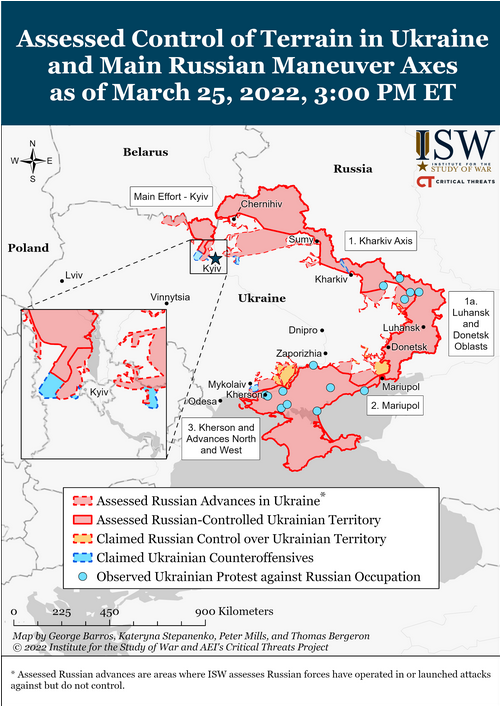
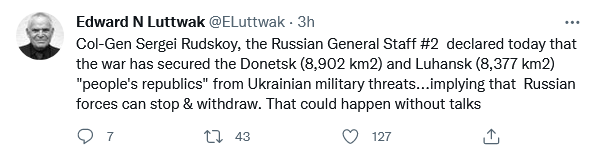
The Russian General Staff issued a fictitious report on the first month of the Russian invasion of Ukraine on March 25 claiming Russia’s primary objective is to capture the entirety of Donetsk and Luhansk oblasts. Sergei Rudskoi, first deputy chief of the Russian General Staff, gave a briefing to Russian press summing up the first month of the Russian invasion on March 25.[1] Rudskoi inaccurately claimed Russian forces have completed “the main tasks of the first stage of the operation,” falsely asserting that Russia has heavily degraded the Ukrainian military, enabling Russia to focus on the “main goal” of capturing Donetsk and Luhansk oblasts.
Rudskoi’s comments were likely aimed mainly at a domestic Russian audience and do not accurately or completely capture current Russian war aims and planned operations. Russia’s justification for the invasion of Ukraine from the outset was the fictitious threat Moscow claimed Ukrainian forces posed to the people in Russian-occupied Donbas. The Kremlin has reiterated this justification for the war frequently as part of efforts to explain the invasion to its people and build or sustain public support for Putin and the war. Rudskoi’s framing of the capture of the rest of Donetsk and Luhansk oblasts as the “main goal” of the operation is in line with this ongoing information operation.
Rudskoi’s assertion that securing the unoccupied portions of Donetsk and Luhansk Oblasts was always the main objective of Russia’s invasion is false. The Kremlin’s initial campaign aimed to conduct airborne and mechanized operations to seize Kyiv, Kharkiv, Odesa, and other major Ukrainian cities to force a change of government in Ukraine.[2] Rudskoi’s comments could indicate that Russia has scaled back its aims and would now be satisfied with controlling the entirety of Donetsk and Luhansk Oblasts, but that reading is likely inaccurate. Russian forces elsewhere in Ukraine have not stopped fighting and have not entirely stopped attempting to advance and seize more territory. They are also attacking and destroying Ukrainian towns and cities, conducting operations and committing war crimes that do not accord with the objectives Rudskoi claims Russia is pursuing.
Russia continues efforts to rebuild combat power and commit it to the fight to encircle and/or assault Kyiv and take Mariupol and other targets, despite repeated failures and setbacks and continuing Ukrainian counter-attacks. The Ukrainian General Staff reports that the Russian military is building “consolidated units,” likely comprised of individuals or small units drawn from a number of different battalions, brigades, and regiments, to replace combat losses and deploying them on the west bank of the Dnipro near the Chernobyl exclusion zone, among other locations. Russian forces continue their grinding and likely costly advance in Mariupol as well.
The absence of significant Russian offensive operations throughout most of Ukraine likely reflects the inability of the Russian military to generate sufficient combat power to attack rather than any decision in Moscow to change Russia’s war aims or concentrate on the east. Rudskoi’s comments are likely an attempt to gloss the Russian military’s failures for a domestic audience and focus attention on the only part of the theater in which Russian troops are making any progress at this point. The West should not over-read this obvious messaging embedded in a piece of propaganda that continued very few true statements.
Key Takeaways
- The Russian General Staff is attempting to adjust the war’s narrative so make it appear that Russia is achieving its aims and choosing to restrict operations when in fact it is not achieving its objectives and is being forced to abandon large-scale offensive operations because of its own failures and losses as well as continuing skillful Ukrainian resistance.
- Ukrainian forces claimed to kill the commander of Russia’s 49th Combined Arms Army, operating around Kherson.
- Ukrainian counterattacks northwest of Kyiv made further minor progress in the past 24 hours.
- Ukrainian forces additionally conducted a successful counterattack east of Kyiv in the past 24 hours, pushing Russian forces east from Brovary.
- Russian attempts to encircle Chernihiv remain unsuccessful.
- The military situation in northeastern Ukraine did not change in the past 24 hours.
- Russian forces continue to take Mariupol street-by-street and have entered the city center.
- Russian forces did not conduct any offensive operations around Kherson in the past 24 hours.
Go here to read the rest. From Strategy Page:
By March 2022 the U.S. had approved a billion dollars’ worth of weapons for Ukraine. One of items being sent is the Switchblade loitering munition, which is little-known to the general public but extremely popular with American troops fighting in small units, especially in places like Afghanistan. Switchblade was first revealed in 2005 and the Ukrainians are receiving at least a hundred of the Switchblade 300.
Switchblade is a small UAV (Unmanned Aerial Vehicle) fired from its storage container. Switchblade was sent to Afghanistan in 2009 for secret field testing. This was very successful and the troops demanded more, and more, and more. Switchblade completed development later in 2009 and was initially thought useful only for special operations troops. In 2011, after a year of successful field testing, the army ordered over a hundred Switchblades for troop use and since then has ordered a lot more.
While Switchblade was developed for the army, the marines apparently noted the success that soldiers and SOCOM (Special Operations Command) had with this system and ordered them as well. Switchblade was very popular with troops in Afghanistan and with SOCOM in all sorts of places they won’t discuss in detail. Switchblade is still used and thousands have been ordered and many of them used. There have been several upgrades
The original 2009 Switchblade was a lightweight and expendable (used only once) UAV that could also be equipped with explosives. The Switchblade is launched from its shipping and storage tube, at which point wings flip out, a battery-powered propeller starts spinning and a vidcam begins broadcasting images to the controller. The Switchblade is operated using the same controller as the larger (two kg) Raven UAV. A complete Switchblade system (missile, container, and controller) weighed 5.5 kg (12.1 pounds).
Moving at up to a kilometer a minute, the original Switchblade can stay in the air for 20-40 minutes, depending on whether or not it was armed with explosives. Switchblade can operate up to ten kilometers from the operator. The armed version can be flown to a target and detonated, having about the same explosive effect as a hand grenade. Thus, Switchblade enables ground troops to get at an enemy taking cover in a hard to see location.
Technically a guided missile, the use of Switchblade as a reconnaissance tool encouraged developers to refer to it as a UAV. But because of the warhead option, and its slow speed, Switchblade also functions like a rather small cruise missile. The troops were particularly enthusiastic about the armed version because it allowed them to more quickly take out snipers or a few enemy gunmen in a compound full of civilians.
Switchblade has been so successful that the army ordered several upgrades and the updated original Switchblade was renamed Switchblade 300. The new version appeared in 2016. It is heavier (2.7 kg) with 15 minutes endurance and a 10-kilometer range. The sensor has night vision and is stabilized. The 300 can lock onto a target and track it. The 300 comes with optional accessories, like a six-pack launcher that is used as part of base defense. This was first used for base protection in 2019 and proved effective. One or more of these six packs are placed near the base perimeter and power is maintained with a solar panel. The base security commander can order a Switchblade to be launched from the six-pack and control it as it searches for a potential target. Switchblade 300 is also capable of being used from a helicopter or larger UAV and controlled from the helicopter or by the operator of the larger UAV (like a Reaper).
In 2020 AeroVironment, the company that developed the unlikely, but popular, Switchblade loitering munition, introduced a third version; Switchblade 600. While the original Switchblade weighed one kilogram (2.2 pounds), the latest Switchblade is ten times heavier at 23 kg (50 pounds), can stay in the air for 40 minutes and be controlled up to 80 kilometers from the operator. Top speed is 180 kilometers an hour and more economical cruise speed is closer to 150 kilometers an hour. The heavier warhead can destroy most tanks, although some modern tank designs include protection from top attack.
Go here to read the rest. The Ukrainians battled the Russians to a standstill, largely with the weaponry they had on hand. Now the Russians are facing Ukrainian forces increasingly armed with the latest Western technology. The Russian army is a Potemkin village: largely manned by unwilling conscripts, starved for resources and hollowed out with corruption. Putin did not think that his army would have to fight to conduct regime change in Ukraine. More fool he.


“…The Russian military is building ‘consolidated units’…”
It has already been reported that the SV (Russian army) commanders were rebuilding depleted offensive regiments with former support/logistics personnel. This is hardly likely to succeed because these source units have even less (if any?) combat training and are conscripts not considered top-drawer fit personnel. This is also evidently why the Russian high command has attempted to draft into the fight Chechnyan, Syrian and Libyan infantry units. To date, the Chechnyans are stationed near Mariupol and have had no reported success. The Syrians snd Libyans have yet to supply active personnel. The Libyan commander gave the Russians a definite “maybe.” Like, after my golf game next month. Or the month after.
It is obvious now that the total casualty numbers suffered by the Russian offensive units was likely over the 30% mark for their frontline units—the number at which US military commanders consider the rendering of a regiment “combat ineffective” (although there is no actual “official” number).
Unanswered for the SV is the question of how the near-complete logistical failure to supply the frontline troops will possibly get better by cannibalizing second-line support and logistics personnel.
Also the Times of Israel is reporting today the toll on Russian commanders is approaching October, 1917 levels:
1) A commander of the 37th Guards Motorized Rifle Brigade, Lt. Col. Yuri Medvedev, was deliberately run over by one of his own units’ armor and later died. His unit was apparently enraged after taking over 50% casualties in the fighting near Kiev.
2) Another top Russian general, Lt. Gen. Yakov Rezantsev, commander of the 49th Combined Arms Brigade, was also killed in fighting near Kiev, although exactly where it is not clear.
3) A Chechen commander, Gen. Magomed Tushaev, was reported killed also by the Times of Israel. It would appear he was killed near Mariupol.
The Times also reports “an unnamed Western official” as stating that of the approximately 120 tactical combat units deployed by the SV, now approximately 20 are “combat ineffective” due to casualty losses, or should 1/6th. That would correspond with the fact that at least 7 high-ranking Russian commanders—an astounding loss rate— have been killed in action.