
Dale Price at Dyspeptic Mutterings continues his look at the Spanish Civil War:
Building upon the review of Mine Were of Trouble, I would like to offer a list of books to help cradle English speakers get a grip on the War in Spain.
I am compelled to offer three framing comments at the beginning.
1. First, works about the War–even in English–are inevitably politicized. The War inspires strong passions in the Western world to this very day, and the historians who write about it are no exception. Even the act of toning down one’s reactions and trying to assess the facts objectively, in a comparative framework with other ideological conflicts, is subject to accusations of bias. One is accused of (or lauded for) being pro-Republican or pro-Nationalist, pushing a narrative. And readers can be sucked in as well.
Raises hand.
The necessity for the reader is to recognize the historian’s biases and his own and to engage in periodic reality checks.
For example: is the author presenting one side’s atrocities in a different light than the other’s? Pro-Republic authors frequently have a tic in this respect. This is best seen in what I call “the church caught fire and the priest died” pro-Republic depictions of the Loyalist pogroms of 1936.
Thousands of Catholics–laity, clergy and religious–were targeted and slaughtered by Republican forces in the wake of the rising of the generals.
In a grand irony, this butchery turned the officer corps’ rising into a Catholic crusade. The initial proclamations of the Generals explicitly spoke of restoring order to the Republic and respecting its institutions, including the separation of church and state. And there really is no evidence that such were insincere.
The massacre of the Faithful changed all of that, with Catholics of every class and region under Nationalist control becoming fiercely pro-Nationalist and swelling the ranks and resources of the Generals’ forces. This forced the Generals to change their tone fairly quickly: by autumn of 1936 the Crusade for Catholic Spain was on.
The slaughter is acknowledged by Republic-favoring historians, but it is often described in the passive voice, occurring as opposed to directed, spasmodic, spontaneous and unforeseeable–definitely not the systematic killing of Nationalist firing squads.
Um…no. The Republic threw open the arsenals to anti-religious fanatics and what followed was entirely foreseeable. Anti-religious rages had been blazing, albeit at a much lower level, for months before the War. What did they expect when they handed the militias military weaponry and the color of law?
It is true that members of the Republican leadership tried–sometimes successfully–to intervene to save people, and eventually the pogrom wound down. But this was due as much to the flight of Catholics to Nationalist territory and the sending of the fanatical militias to the front lines to do some actual fighting against people who could shoot back as to policy.
Bottom line: watch how each side is depicted for similar actions. Because pro-Nationalists get their passive voice on as well.
2. Secondly, have a note pad handy. It is taken me years to get the names of the various personages straight. When you first run across someone who appears to be a major personage, write down his or her name and political affiliation. Gil Robles was not Calvo Sotelo–that took me a while, for some reason.
And do the same for the major factions. Because, you see, there is usually a very unhelpful Spanish acronym, or a puzzling adjective before an otherwise understandable noun, which describes the welter of contending organizations.
Trust me: you do not want to confuse the CEDA with the CNT, the PSOE for the PCE or POUM, or the Alphonsine monarchists with the Carlist ones, etc.
3. Learn Spanish.
At least the pronunciation–you are much less likely to sound like an idiota. Canada and Cañada are…different places after all. But getting at least a tentative grip on the language will help you see the mindsets better, too.
With those advisories in hand, on to the recommendations:
1. Hugh Thomas’ one volume history. Still the gold standard. First published in 1961, and considered fair enough by the censors to be published and sold in Franco’s Spain. Genuinely even-handed, even if it focuses more on the Republic. Which is actually fair enough in and of itself: the dysfunction of that half of Spain necessitates more words.
2. The Victorious Counterrevolution by Michael Seidman. Absolutely essential. It could also be entitled “How the Nationalists Won.” A searching evaluation of the factors that led the Spanish “Right” to win their civil war when similar forces in Russia and China lost theirs.
Bottom line: no bleed-out from a previous war (World Wars I and II, respectively), better logistics, better use of resources, much less corruption and infighting. Nationalist soldiers ate well and civilians had a functional currency which meant they managed to do the same. Foreign assistance was not as decisive as pro-Republic historiography suggests–the Nationalists just did better with theirs than the Republic did. Alas for Spain, the regime would founder economically after the War and only start to get its legs underneath it with American aid and the abandoning of quasi-fascist demands for autarky.
3. Martin Blinkhorn’s history of the Carlists in the Second Republic and the War. At least you will understand how one of the major members of the Nationalist coalition thought and fought.
Go here to read the rest. I agree with Dale’s choices and his general advice. There is a great deal of drek in English language accounts of the Spanish Civil War, with quite a few authors demonstrating a very shallow knowledge of Spanish history and obviously recycling anecdotes from prior bad histories. The Spanish Civil War had a very long fuse, extending well into the Nineteenth Century. Indeed, a good argument could be made that the Spanish Civil War was the ending of the long Spanish Nineteenth Century. Unless that period of Spanish history is mastered any history of the Spanish Civil War reads like a review of a play which is confined to the last act of the play. It also does not help that the war was massively complicated with numerous factions, many of which are quite obscure outside of Spain. Here are some additions to Dale’s list:
The go to man on the Spanish Civil War is Stanley Payne. He has been writing on the conflict since the Fifties. He interviewed many of the leaders of the various factions in the Fifties, Sixties and Seventies. Originally a man of the Left, I think it would be fair now to call him a conservative, but what he is above all is a first class historian.
I would recommend his The Spanish Civil War, the Soviet Union and Communism, and for background his Spain a Unique History, which is not only an overview of controversies in Spanish History, but also a memoir of his life spent studying Spanish History. His look at how the present Spanish Socialist government is using the Civil War for political purposes is biting and incisive.
Here is a link to his books on Amazon. Everything he has written is worth reading, and I read most of his work.
Anthony Beevor, although somewhat sympathetic to the Anarchists, did an excellent one volume history a few years ago which is superb about showing the military mistakes of the Republic.
The best memoir of a participant that I have read is Combat Over Spain by the Duke of Lerma. He served as a nationalist pilot during the war. Growing up in a bi-lingual family, he wrote his memoir in both English and Spanish. His descriptions of life in Spain prior to the Civil War and during it give the reader a feel for the conflict lacking in other works.
Spain in Arms: A Military History of the Spanish Civil War by E. R. Hooton is one of the better military histories of the struggle that I have read, but it is cursed by bad maps.
Burnett Bolloten’s The Spanish Civil War: Revolution and Counter-Revolution. The late Mr. Bolloten made an in depth study of magazines, newspapers, pamphlets and other publications published in Spain during the war. You find material in his history you find nowhere else. He is especially good on the byzantine Republican factional infighting.
Jose Alvarez has written two volumes on the Spanish Foreign Legion in the Rif War and in the first year of the Spanish Civil War. Lots of painstaking original research. Three drawbacks: the writing is dry, the minute account of skirmishes and battles can blur together and the maps are close to useless.
I have learned more about Spain and the Spanish Civil War from Gironella’s trilogy of novels, however, than I have from all the hundreds of histories I have read on that conflict. In the first volume in his trilogy, the lead up to the war is depicted in Cypresses; the war is set forth unforgettably in One Million Dead; and the aftermath of the war is depicted in Peace After War. Gironella, a veteran of the Nationalist Army, achieves the remarkable feat of creating sympathetic characters in all the warring factions. Many of these characters do terrible things, but Gironella skillfully leads the reader to understand why they did them without condoning their actions. Spain is very much a figure in these novels as the characters act out the various aspects of the Spanish character and fight over what Spain was, is and should be. The whole work is suffused by a deeply Catholic spirit and sensibility as the characters come closer to God or repel themselves away from Him. The finest novels I have ever read.
In studying the Spanish Civil War I ever keep in mind the foreword that Gironella wrote to his trilogy for his American readers:
“Author’s Note for the American Edition
Spain is an unknown country. Experience proves that it is hard to view my country impartially. Even writers of high order succumb to the temptation to adulterate the truth, to treat our customs and our psychology as though everything about them were of a piece, of a single color. Legends and labels pile up: black Spain, inquisitorial Spain, beautiful Spain, tragic Spain, folkloric Spain, unhappy Spain, a projection of Africa into the map of Europe.
I defend the complexity of Spain. If this book attempts to demonstrate anything it is this: that there are in this land thousands of possible ways of life. Through a Spanish family of the middle class–the Alvears–and the day-by-day living of a provincial capital–Gerona–I have tried to capture the everyday traits, the mentality, the inner ambiance of my compatriots in all their pettiness and all their grandeur. In Spain the reaction to this novel has been that it is “implacable”. Nothing could satisfy me more.
This book spans a period of five years, five years in the private and public life of the nation: those which preceded the last civil war, which speeded its inevitable coming. The explosion of that war, its scope, and its significance are described in minute detail.
A single warning to the American reader: Spain is a peculiar country and its institutions therefore take on unique coloration. Certain constants of the Spanish temperament operate under any circumstance. A Spanish Freemason is not an international Freemason. A Spanish Communist is not even an orthodox Communist. In every instance what is characteristic is a tendency toward the instinctive, toward the individualistic, and toward the anarchic. Spaniards follow men better than they follow ideas, which are judged not by their content, but by the men who embody them. This accounts for the inclemency of personal relationships, the small respect for laws; this, too, is what causes our periodic civil wars.
To bear all this in mind is important in understanding this book. When the narrative deals with a priest, a policeman, a Socialist, a bootblack, it is essential to remember that it is dealing with a Spanish priest, a Spanish policeman, a Spanish Socialist, a Spanish bootblack, not with generic types. This warning is doubly necessary with reference to Freemasonry, Communism, and Catholicism, the interpretation of which will undoubtedly clash with the American reader’s concept of these doctrines.
The book’s protagonist–Ignacio Alvear–is a type of young man who abounds in present-day Spain.
Palma de Mallorca, Spain
August 1954
José Maria Gironella”


It all makes sense when one accepts the premise that, for the left, the truth is that which advances the revolution.
Years ago, The De La Salle Brothers of the Christian Schools did a study on the general massacre of Catholic religious and laymen in the Republican-controlled areas during the civil war in Spain. They had scores of brothers among the saintly dead and the total was in the tens of thousands.
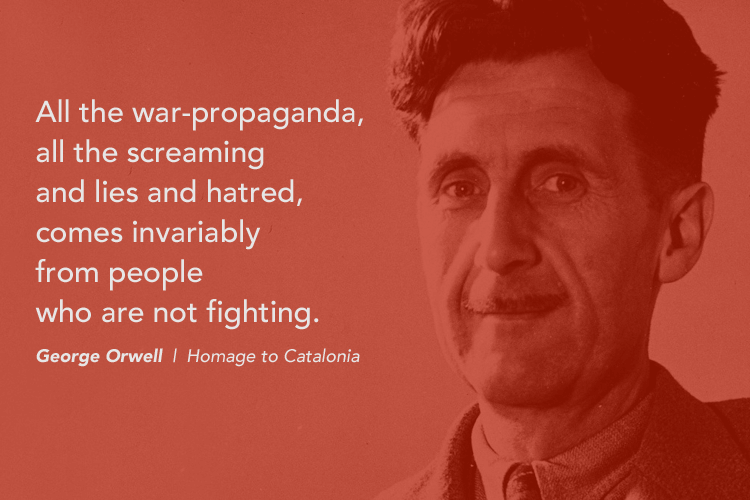
Years ago, I read Orwell’s “Homage to Catalonia” based a recommendation. Not as good as advertised. .
About reporting on the Spanish Civil War, Orwell said something to the effect that he saw reports that did not contain the kernel of truth contained in the common lie.
What he saw in the Spanish Civil War made Orwell the leading British critic of Stalinism on the British Left. One thing I like about Orwell’s Homage is that he freely admitted there was a lot going on in Spain that he simply did not understand.
Thank you for this. I have wanted to study the Spanish Civil War for some time, but have been held back by ignorance of whose story to study. I want an honest account, not leftist propaganda.
A co-worker, some time ago, whose grandparents immigrated from Spain prior to the Civil War, because of the coming conflict, had insights to that conflict connected to our own situation (this was during Obama’s illegitimate regime). I saw a coming civil war in America and connected the current situation to our past Civil War. His comments in essence: “Yours was not Civil War, but a second revolutionary war. It was between governments to decide what kind of nation you were to be. It involved governments and troops, competing civilizations. Spain’s was a civil war, properly defined. It was chaotic, bloody, street level and involved citizens fighting each other at the level of neighborhoods. The alliances were extremely complicated and shifted multiple times during the conflict”
Another piece of information I found interesting was his views on Franco. He said he was profoundly misunderstood. He was not Catholic, but Catholic Bishops allied with him because his government offered the most fertile ground for the Church to survive and thrive (my friend said it better and differently).
Thanks again for this article link and your thoughts on the matter. I think the Spanish Civil War offers the best guide to understand what now besets us.
Thanks again, Don.
As to the Anarchists, I’m a bit sympathetic myself. Their anti-Catholicism makes them impossible for me to embrace, but of all the pro-worker factions of the Republic, the CNT truly meant it.
Which is one of the reasons Stalin’s communists were determined to liquidate them.
I am going to be adding more to the list eventually–especially Stanley Payne’s books. I have his biography of Franco and “The Franco Regime” in the hopper next. If you can find it, his WSJ book review of Paul Preston’s “The Spanish Holocaust” is spectacular. Preston is not a bad historian, but he is very much hobbled by his Republican sympathies.
Payne absolutely takes him to the woodshed in the review.
There is no love lost between Payne and Preston. Preston’s wife wrote a psycho babble bio of Franco which is one of the weirdest things I have ever read.
In regard to the Anarchists I recall an episode where Durruti was trying to convince a captured 15 year old Falangist to join the Anarchists. The kid refused and was executed. The strange thing is that it was obvious from the account that Durruti was trying desperately to save the kid’s life and the kid appreciated his efforts but that he would rather die than turn his back on his beliefs.
Interesting interview with Payne:
http://www.identitanazionale.it/Sesia_Payne_eng.pdf
Aqua: Your friend’s analysis is a good one, and one I have come to share.
I will quibble a bit with the depiction of Franco’s Catholicism. Payne’s biography argues that he was an observant Catholic, if not ostentatiously devout. Franco’s father was an unutterable cad who abandoned the family and the Faith, and Franco appears to have deliberately charted his moral path as a rejection of his father’s, at least in terms of personal rectitude. His mother was a very devoted Catholic, and he was devoted to his mother. And Franco’s wife attended daily Mass (to the disgust of Hitler, who remarked on it in a conversation about Franco with his inner circle).
Prior to his marriage to his wife Franco was fairly indifferent in his Catholicism. That changed with his marriage. Shortly before the Spanish Civil War Franco berated a bunch of Spanish cops as they did nothing as a Cathedral set fire by Leftists burned.
His father died in 1942. He never had a kind word about Franco as an adult. Franco had him buried with full military honors, but Franco did not attend his funeral and made certain that his father’s long time mistress did not attend.
Years ago, The De La Salle Brothers of the Christian Schools did a study on the general massacre of Catholic religious and laymen in the Republican-controlled areas during the civil war in Spain. They had scores of brothers among the saintly dead and the total was in the tens of thousands.
IIRC, there were in 1933 about 30,000 priests in Spain. About 18,000 were within weeks of the rebellion’s beginning to be found in territory controlled by the Nationalist forces or by the Basque militias (who did not have issues with the Church). The other 12,000 can be sorted into three sets of about equal size: those that went underground, those that fled into exile, and those executed. The mortality rate for priests and religious trapped in Barcelona was around 80%. Also, the Republican forces were much more likely to execute people behind the lines. Payne, IIRC, estimates there were twice as many such executions in Republican Spain than in Nationalist Spain during the war.
What’s distressing about our time is that you see the common-and-garden blather of street level Democrats, and it could have been uttered by Manuel Azana in 1936.
Goldmine of books from this post!
The Last Crusade: Spain 1936
by Warren H. Carroll
https://www.amazon.com/Last-Crusade-Spain-1936/dp/0931888670
Also, for a novelized version of succeeding events:
Hitler: Stopped By Franco
by Jane & Burt Boyar
https://www.amazon.com/Hitler-Stopped-Franco-Jane-Boyar-dp-1480264393/dp/1480264393
From the back cover:
In Winston Churchill’s “The Second World War”, Vol.2: Their Finest Hour Pages 519-530, the British Prime Minister wrote that the last possibility of Hitler’s triumph was foiled by Franco:
“It is fashionable at the present time to dwell on the vices of General Franco and I am glad therefore to place on record this testimony of duplicity… I shall presently record even greater services which… General Franco rendered the Allied cause.”
One notes that today’s Spanish Socialists 2.0 seem to have little appreciation of their country’s history during the Civil War. They want to desecrate the Valley of the Fallen, apparently not realizing it’s purpose is both a memorial and a lesson in national unity. Spain, as a country, was essentially cobbled together during and immediately after the reconquista over a period of about five hundred years and yet the strains of regional division are not yet resolved. It would seem for the good of the country that this matter be finally put to rest.