
From The Institute for the Study of War:
Russian Offensive Campaign Assessment, July 15, 2024
Christina Harward, Nicole Wolkov, Karolina Hird, Grace Mappes, and George Barros
July 15, 2024, 7pm ET
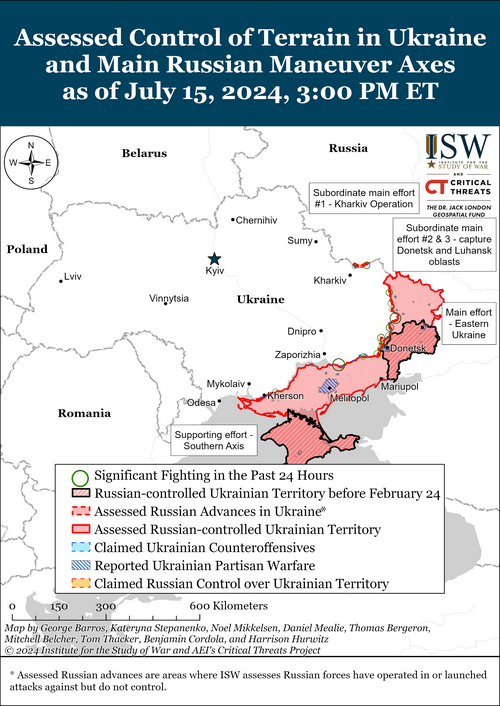
Click here to see ISW’s interactive map of the Russian invasion of Ukraine. This map is updated daily alongside the static maps present in this report.
Click here to see ISW’s 3D control of terrain topographic map of Ukraine. Use of a computer (not a mobile device) is strongly recommended for using this data-heavy tool.
Click here to access ISW’s archive of interactive time-lapse maps of the Russian invasion of Ukraine. These maps complement the static control-of-terrain map that ISW produces daily by showing a dynamic frontline. ISW will update this time-lapse map archive monthly.
Note: The data cut-off for this product was 12pm ET on July 15. ISW will cover subsequent reports in the July 16 Russian Offensive Campaign Assessment.
A recent Ukrainian poll indicates that Ukrainians widely reject Russia’s demands for total Ukrainian capitulation, emphasizing that the Kremlin’s conditions for the end of the war are entirely unreasonable and widely unpopular within Ukraine. Ukrainian outlet Dzerkalo Tyzhnya commissioned a poll by the Ukrainian Razumkov Center and published its results on July 15.[1] The poll found that 83 percent of respondents rejected Putin’s statement that Ukraine must withdraw from all of Donetsk, Luhansk, Kherson, and Zaporizhia oblasts — including territory in these oblasts currently under Ukrainian control.[2] The poll also reported that 58 percent of respondents stated that Ukraine should not agree to enshrine a neutral, non-aligned, and non-nuclear status in its constitution. Putin demanded in June 2024 that Ukraine recognize Russia’s territorial claims over eastern and southern Ukraine (including territory that Russia does not currently occupy), “demilitarize,” and pledge not to join NATO as preconditions to begin “peace” negotiations.[3] Putin’s extreme terms are tantamount to Ukraine’s capitulation, indicating that Putin continues to be uninterested in good-faith negotiations on any terms other than Russia’s. Kremlin Spokesperson Dmitry Peskov recently accused NATO on July 14 of not respecting “Russia’s main concern” when NATO announced Ukraine’s prospects of admission into the alliance, claiming that the alliance’s behavior suggests that there is no basis for negotiations about the war in Ukraine.[4] Putin’s framing of Ukraine’s total capitulation as a reasonable precondition for peace negotiations is also part of an attempt to undermine Ukraine’s efforts to garner international support for Ukraine’s own legitimate negotiating positions, which are based on and backed by international law, by shifting international perceptions of logical negotiating terms in Russia’s favor. Continued Russian efforts to claim that Ukraine is refusing “reasonable” demands intend to cast Ukraine as the unreasonable actor, despite the fact that Ukraine’s rightful borders have been recognized by international law since 1991.
Ukraine continues to demonstrate its willingness to negotiate with Russia on Ukraine’s own terms, and Ukraine’s demands for a peace settlement are in accordance with international law — in direct contrast to Russia’s unwillingness to engage in negotiations that end in anything short of full Ukrainian surrender. Ukrainian President Volodymyr Zelensky stated on July 15 that Ukrainian plans for a second peace summit should be ready by November 2024 and reiterated that a Russian representative should attend.[5] Zelensky stated that in preparation, Ukraine will hold a meeting in Qatar on energy security in late July or early August 2024, a meeting on freedom of navigation in Turkey in August 2024, and a meeting on prisoner of war (POW) exchanges and the repatriation of deported Ukrainian children in Canada in September 2024 — three issues on which the communique of the first Ukraine-initiated Global Peace Summit in Switzerland in June 2024 focused.[6] Recent Kremlin statements continue to demonstrate that Russia is inflexible on negotiations with Ukraine, however, and Kremlin officials have directly stated that Russia would not participate in a second peace summit because its terms are a non-starter given Russian demands.[7] Ukrainian officials emphasized that the purpose of the first peace summit was to facilitate a peace based on international law, including laws to which the Russian Federation is party.[8] Ukraine’s demands that Russia completely withdraw from Ukrainian territory are provided for under international law and are therefore reasonable. Russia’s demands for Ukraine’s complete capitulation and continued Russian occupation of Ukrainian land are and would be violations of international law, however. ISW also continues to assess that Putin’s demands for Ukrainian capitulation would allow Russian forces and occupation administrations to continue their large-scale and deliberate ethnic cleansing campaigns in occupied Ukraine, and the complete reinstatement of Ukraine’s territory integrity is necessary to liberate the Ukrainian people from Russian occupation.[9] An acceptance of anything but Ukraine’s liberation of its people is an implicit endorsement of Russia’s illegal occupation of over five million Ukrainians.
European Union (EU) officials continue to take steps to demonstrate the EU’s non-alignment with Hungarian Prime Minister Viktor Orban’s political stances concerning the war in Ukraine. Balazs Orban, Viktor Orban’s Political Director, stated on July 15 that Viktor Orban has additional “trips and negotiations” planned and wrote to the European Council about his previous visits to and discussions about negotiations with Ukraine, Russia, the People’s Republic of China (PRC), and the US.[10] EU Commission Spokesperson Eric Mamer stated on July 15 that due to Orban’s recent actions, EU leaders, including European Commission President Ursula von der Leyen, would not attend informal meetings led by Hungary.[11] Politico reported on July 15 that three unspecified EU diplomats stated that EU High Commissioner Josep Borrel will hold a “formal” foreign affairs council meeting at the same time as Hungary’s foreign affairs summit in Budapest in late August 2024.[12] A source reportedly stated that other EU foreign ministers want to “send a clear signal that Hungary does not speak for the EU.” Swedish Minister for EU Affairs Jessika Roswall told Reuters on July 11 that Sweden, Finland, Estonia, Latvia, Lithuania, and Poland would only send civil servants to government meetings connected with Hungary’s EU Council presidency in July 2024 and that other EU states are considering similar measures.[13]
The Russian government proposed to significantly increase the number of conditions on which the Russian government can designate a person as a terrorist or extremist, likely as part of efforts to censor criticisms about Russia’s war in Ukraine. The Russian government submitted a bill to the State Duma on July 15 that would expand the number of articles of the Russian Criminal Code under which the Russian Federal Service for Financial Monitoring (Rosfinmonitoring) could add people to Russia’s list of terrorists and extremists.[14] The proposal notably would allow Rosfinmonitoring to add people whom Russian authorities have convicted of spreading “fakes” about the Russian military out of political, ideological, racial, national, or religious hatred to the list. The proposal would also allow Rosfinmonitoring to add people accused of committing unspecified “other crimes” motivated by political, ideological, racial, national, or religious hatred to the list — granting the Russian government significant leeway to designate people who have allegedly committed a wide array of crimes as terrorists and extremists. The Kremlin has repeatedly attempted to portray Russia as a harmonious multinational and multireligious society despite recent increases in xenophobic rhetoric from Russia’s ultranationalist community.[15] The Russian government is likely looking to change the mechanisms for adding people to the terrorist and extremist list in order to incentivize Russians to engage in self-censorship by tightening the Kremlin’s control over criticism in Russian society, especially about Russia’s war in Ukraine, while posturing these changes as part of efforts to ensure political and religious freedom and societal harmony in Russia.
Ukrainian forces conducted drone strikes against Russian energy infrastructure overnight on July 14 to 15 and reportedly also hit Russian military assets in occupied Crimea. Lipetsk Oblast Head Igor Artamonov claimed on July 15 that a Ukrainian drone struck the grounds of an electrical substation in Stanovlyansky Raion, Lipetsk Oblast, and the Oryol Oblast administration claimed that a Ukrainian drone damaged an oil storage container after Russian electronic warfare (EW) suppressed the drone over a fuel and energy complex in the Oryolsky Raion.[16] A local Crimean channel claimed that Ukrainian drones struck either a Russian S-300/S-400 air defense system or a Black Sea Fleet (BSF) electronic intelligence unit near occupied Cape Fiolent, but ISW is unable to confirm this strike.[17] The Russian Ministry of Defense (MoD) claimed that Russian forces downed six Ukrainian drones over occupied Crimea and one Ukrainian drone over Lipetsk Oblast overnight on July 14 to 15 and another Ukrainian drone near western Crimea on the afternoon of July 15.[18]
A new Russian migrant assimilation program highlights the apparent struggle the Russian government is facing with reconciling aspects of its policy towards Central Asian migrants as the Russian state desires to present itself as welcoming and multicultural while also emphasizing the primacy of Russian language and historical legacy. Kremlin-affiliated business-focused outlet Kommersant reported on July 15 that the Russian Federal Agency for Ethnic Affairs (FADN) has developed a 70-minute lecture for Central Asian migrants on how to adapt to life in Russia.[19] Kommersant reportedly reviewed the course, which has four sections: “fundamentals of migration and labor legislation,” “fundamentals of informal behavior in Russia,” “responsibility for non-compliance with Russian legislation,” and “the history of relations between Russian and the countries of Central Asia.” The course reportedly emphasizes that migrants may undergo a simplified process for acquiring citizenship if they choose to serve with the Russian military, suggesting that the Russian government continues to use the promise of citizenship as a method of luring Central Asian migrants into the army. The course also stresses that “it is important to remember that Russia is a secular state” so migrants must not perform religious rituals, including daily prayers, in public spaces and that “Russians are a multinational people, but everyone speaks Russian.” Kommersant found that the course offers a paternalistic and Russia-centric version of Central Asian history, claiming that “big money from the Soviet budget allowed the Central Asian republics to develop successfully.”
The purposed assimilation lecture distills several of the tensions that currently exist in Russia’s relationship with its migrant minority communities, particularly those from various Central Asian states. As ISW has written at length, Russia’s reliance on Central Asian migrants to support Russia’s labor force and sustain military mobilization efforts, has caused substantial frictions within such communities, particularly as many pro-war ultranationalist voices have espoused increasingly xenophobic rhetoric over the backdrop of the war in Ukraine.[20] Head of the Russian Federal Service for the Supervision of Education and Science (Rosnobrnadzor) Anzor Muzaev, for example, advocated that migrants’ children must know Russian to study in Russian schools.[21] Several ultranationalist commentators responded and suggested that the Russian government must adopt a harsher response that prohibits migrants from bringing their families to Russia or prohibits migrant children from studying in public schools at all.[22] The FADN’s assimilation program is ostensibly meant to soothe these tensions, but emphasizes that Russian language, history, and culture are meant to enjoy special primacy in migrant communities—directly undermining the Kremlin narrative that Russia is an open and accepting multicultural and multireligious society. This program may also increase tensions and feelings of disenfranchisement within Central Asian migrant communities by enforcing their isolation from their languages, customs, and religious practices.
Chechen Republic Head Ramzan Kadyrov is posturing himself and the North Caucasus as key to Russia’s outreach to the Arab world. Kadyrov met on July 15 with United Arab Emirates (UAE) Ambassador to Russia Mohammed Akhmed Sultan Essa Al Jaber and Qatari Ambassador to Russia Sheikh Ahmed bin Nasser Al Thani in Grozny, Chechnya at the ongoing Caucasus Investment Forum.[23] Kadyrov emphasized Qatar’s and the UAE’s “warm relations” with Russia and Qatar, while also highlighting their individual relationships with Chechnya and the wider Caucasus region. The Kremlin likely seeks to use the Caucasus’ unique geopolitical, religious, and socio-cultural positioning vis-a-vis the Arab world in order to draw investment to the region and increase political and diplomatic ties with major political players such as Qatar and the UAE. Qatar and the UAE, for example, continue to mediate prisoner of war (POW) exchanges and the repatriation of deported Ukrainian children, so it remains in Russia’s interest to maintain firm ties with Gulf states.[24]
Key Takeaways:
- A recent Ukrainian poll indicates that Ukrainians widely reject Russia’s demands for total Ukrainian capitulation, emphasizing that the Kremlin’s conditions for the end of the war are entirely unreasonable and widely unpopular within Ukraine.
- Ukraine continues to demonstrate its willingness to negotiate with Russia on Ukraine’s own terms, and Ukraine’s demands for a peace settlement are in accordance with international law — in direct contrast to Russia’s unwillingness to engage in negotiations that end in anything short of full Ukrainian surrender.
- European Union (EU) officials continue to take steps to demonstrate the EU’s non-alignment with Hungarian Prime Minister Viktor Orban’s political stances concerning the war in Ukraine.
- The Russian government proposed to significantly increase the number of conditions on which the Russian government can designate a person as a terrorist or extremist, likely as part of efforts to censor criticisms about Russia’s war in Ukraine.
- Ukrainian forces conducted drone strikes against Russian energy infrastructure overnight on July 14 to 15 and reportedly also hit Russian military assets in occupied Crimea.
- A new Russian migrant assimilation program highlights the apparent struggle the Russian government is facing with reconciling aspects of its policy towards Central Asian migrants as the Russian state desires to present itself as welcoming and multicultural while also emphasizing the primacy of Russian language and historical legacy.
- Chechen Republic Head Ramzan Kadyrov is posturing himself and the North Caucasus as key to Russia’s outreach to the Arab world.
- Ukrainian forces recently regained lost positions near Toretsk, and Russian forces recently advanced near Toretsk and Avdiivka.
- Russian President Vladimir Putin emphasized ongoing Russian efforts to integrate the metallurgy industry in occupied Ukraine into Russia’s defense industrial base (DIB).
Go here to read the rest. Talking about polls indicates how little real war news there is. This series is going on hiatus. I will revive it if and when the real war starts up again.

