
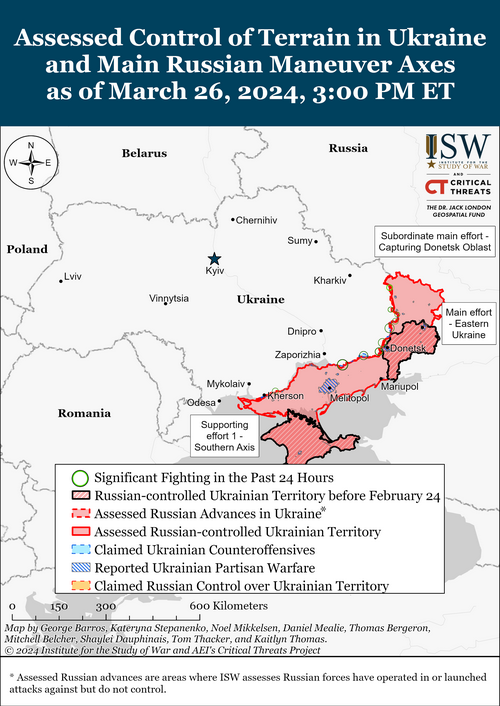
From The Institute for the Study of War:
Russian Offensive Campaign Assessment, March 26, 2024
Karolina Hird, Christina Harward, Grace Mappes, Nicole Wolkov, and Frederick W. Kagan
March 26, 2024, 8:20pm ET
Click here to see ISW’s interactive map of the Russian invasion of Ukraine. This map is updated daily alongside the static maps present in this report.
Click here to see ISW’s 3D control of terrain topographic map of Ukraine. Use of a computer (not a mobile device) is strongly recommended for using this data-heavy tool.
Click here to access ISW’s archive of interactive time-lapse maps of the Russian invasion of Ukraine. These maps complement the static control-of-terrain map that ISW produces daily by showing a dynamic frontline. ISW will update this time-lapse map archive monthly.
Note: The data cut-off for this product was 2:30pm ET on March 26. ISW will cover subsequent reports in the March 27 Russian Offensive Campaign Assessment.
Belarusian President Alexander Lukashenko said that the Crocus City Hall attackers originally fled toward Belarus not Ukraine, directly undermining the Kremlin narrative on Ukraine’s involvement, possibly to head off questions about why the attackers headed toward Belarus in the first place. During a visit to Belarus’ northwestern Ashmyany raion on March 26, Lukashenko reported that the Crocus City Hall attackers may have been planning to escape Russia’s Bryansk Oblast to Belarus, but that Belarus introduced a heightened security regime that forced the attackers to change course towards the Russia-Ukraine border.[1] Lukashenko stated that the attackers “couldn’t enter Belarus” and praised high levels of cooperation between Russian and Belarusian special services for leading to the attackers’ arrests. Lukashenko’s suggestion that the attackers were heading towards Belarus before Belarusian and Russian special services forced them to change direction flatly contradicts Russian President Vladimir Putin’s claims regarding the attackers’ planned escape. Putin addressed the Russian Federation on March 23 following the March 22 Crocus City Hall terror attack and claimed that the attackers had “contacts” who had prepared a “window” for their exfiltration across the border into Ukraine, a claim for which there is no evidence that has become central to the Kremlin’s baseless accusations that Ukraine was involved in or responsible for the attack.[2] Geolocated footage from March 23 shows Russian personnel capturing the four attackers in a forest area along the E101 highway about 20 kilometers southeast of Bryansk City, Bryansk Oblast.[3] The geolocated place of capture is about 95 kilometers from the Ukrainian border at the closest point, or 130 kilometers from where the E101 crosses into Ukraine. This point is notably about 124 kilometers from the Belarusian border, and about 25 kilometers away from the A-240 highway that runs to Gomel, Belarus. Lukashenko’s statement about the activation of Belarusian personnel suggests a scenario in which the attackers were initially traveling along the A-240 highway towards Belarus but saw roadblocks or other deterrents and shifted their course east through forest roads to the E101 route.
Lukashenko has very little evident incentive to lie about the facts of the attack in this way. The suggestion that the attackers were traveling towards Belarus, presumably to seek refuge there, could have damaging political consequences for Lukashenko and his regime as it would raise questions about why they thought they would be safer in Belarus and who they thought might receive them there. Lukashenko may therefore have desired to preempt discussions about the attackers’ hypothetical links to Belarus by saying that Belarusian forces were instrumental in leading to their arrests. While Lukashenko’s claim subverts the standing Kremlin narrative, it reduces his vulnerability to Kremlin efforts to use non-public information about the attackers’ original escape plans to pressure him in the future.
Russian President Vladimir Putin and other senior Kremlin officials appear to be struggling to maintain a consistent rhetorical line about the Crocus City Hall attack, indicating that the Kremlin has not fully figured out how to reconcile its information operations with the reality of its intelligence and law enforcement failure. Putin and other senior officials have not fully coalesced around the false narrative that Ukraine somehow conducted the March 22 attack on the Crocus concert venue for which the Islamic State has claimed responsibility. Putin directly suggested that the attackers were connected to Ukraine in his March 23 address following the attack.[4] Putin then addressed the board of the Russian General Prosecutor’s Office on March 26 and referenced the Crocus attack, calling for the Prosecutor General’s Office to establish all the facts of the case but not implicitly or explicitly blaming Ukraine for the attack.[5] Putin only mentioned the Ukrainian government once during an unrelated part of the address about returning Russia’s “lost” property abroad — a notable change from his March 25 address that claimed Ukraine was the ”customer” of the attack and his March 23 accusation that the attackers were fleeing to Ukraine.[6] Kremlin Spokesperson Dmitry Peskov similarly refused to state outright on March 26 that Ukraine orchestrated the Crocus attack in response to a press question on how Russia would respond if Russia ”confirms” Ukraine’s alleged involvement.[7] Putin’s oscillation between blaming Ukraine outright one day and then avoiding the issue the following day suggests that the Kremlin has not yet established a templated line on how to discuss the attack, likely partially as a result of the shock felt by the Russian elite in its aftermath.
Other senior Russian officials have doubled down on the Kremlin’s baseless narrative accusing Ukraine of conducting the attack, however, while conceding that Russian authorities currently lack critical information about the attack, seemingly contradicting their own statements and statements made by other Kremlin officials. Russian Federal Security Service (FSB) Head Alexander Bortnikov accused the Ukrainian Security Service (SBU) of conducting the attack with involvement from the United States and UK in order to create panic in Russian society — a longstanding Kremlin narrative line attempting to portray the war in Ukraine as an existential war against the collective West — but then stated that Russia has not yet identified the person who ordered the attack.[8] Bortnikov also emphasized that Russian security services conducted every possible measure to prevent the attackers from crossing into Ukrainian territory, aligning with Putin’s March 23 address but contrasting with Lukashenko’s March 26 claims.[9] Russian Security Council Secretary Nikolai Patrushev answered a press question on March 26 about whether the Islamic State (IS) or Ukraine conducted the attack with “Ukraine, of course” then later doubled down on this narrative by claiming “many things point to Ukraine’s involvement” while appearing on Russian state television channel Rossiya-1 and suggested that Russian special services and law enforcement agencies will eventually reach this conclusion.[10]
Russian officials are proposing actionable but likely impractical solutions to the emotional outcries for retribution in response to the Crocus City Hall attack. A Just Russia Party Leader Sergei Mironov called for Russia to abolish the visa-free regime with Central Asian countries in order to regulate migration and counter terrorist attacks.[11] Russian State Duma Deputy from occupied Crimea Mikhail Sheremet and State Duma Deputy Chairperson and recent New People Party presidential candidate Vladislav Davankov also recently proposed harsher measures against migrants in response to the Crocus City Hall attack.[12] Russian ultranationalists have intensified calls for anti-migrant measures since the Crocus City Hall attack, although a prominent Kremlin-affiliated milblogger criticized Mironov’s proposal to introduce a visa regime with Central Asian countries and claimed that a visa regime would damage Russia’s relationship with Central Asian states and Russia’s “compatriots” living there.[13] Russian Liberal Democratic Party (LDPR) Head Leonid Slutsky called for Russia to lift the moratorium on the death penalty in response to the Crocus City Hall attack, and United Russia State Duma Deputy Alexander Spiridonov claimed that Russia should consider lifting the moratorium for charges of terrorism.[14] Mironov claimed that Russia could lift the moratorium on the death penalty through a federal referendum, while Russian State Duma Chairperson Vyacheslav Volodin claimed that the Russian Constitutional Court could lift the mortarium without a referendum.[15] The Russian Constitutional Court announced that it would not comment on issues about the death penalty because the issue may “become a subject of consideration.”[16] Kremlin Spokesperson Dmitry Peskov, conversely, claimed on March 25 that the Kremlin is not discussing lifting the moratorium on the death penalty, despite continued calls by various Russian political leaders.[17] Russian officials are likely struggling to establish a cogent response to domestic calls for retribution following the Crocus City Hall attack, causing various Russian political factions to attempt to address the situation along diverging avenues. Russia is unlikely to introduce a visa regime with Central Asian countries given that Russia continues to heavily rely on Central Asian migrants to offset domestic labor shortages and to target Central Asian migrants for crypto-mobilization efforts.[18] The Russian government is also unlikely to lift the moratorium on the death penalty, which it established in 1996, the same year it officially executed the last death sentence.[19]
The Moldovan Constitutional Court reversed a ruling banning the Kremlin-affiliated Shor Party on March 26, which will likely allow pro-Russian Moldovan actors to reconsolidate around the Shor Party and reverse the impacts of the previous Moldovan ban on the party. Ilan Shor is a US-sanctioned, pro-Kremlin Moldovan politician who founded the Shor Party and whom Moldovan authorities convicted in absentia for massive fraud and money laundering.[20] The Moldovan Parliament declared the Shor Party unconstitutional on July 19, 2023, and amended the Electoral Code on July 31, 2023, to ban members of political parties deemed unconstitutional from running in elections for five years.[21] The Moldovan Constitutional Court declared these July 2023 changes to the Electoral Code unconstitutional on October 3, 2023.[22] The Moldovan Parliament responded on October 4, 2023, by further amending the Electoral Code to stipulate that people suspected of, accused of, or indicted for the crimes that the argument declaring the political party to be unconstitutional mentioned cannot participate in elections.[23] The Moldovan Constitutional Court then decided on March 26, 2024, that the Moldovan Parliament’s amendments to the Electoral Code on October 4, 2023, were also unconstitutional, thereby allowing Shor Party politicians to run in the upcoming Moldovan presidential election in late 2024 and parliamentary elections in the summer of 2025.[24] The Kremlin will likely amend its hybrid operations in Moldova to more directly exploit and promote the Shor Party before the upcoming Moldovan elections as part of the Kremlin’s wider hybrid campaign aimed at destabilizing Moldova from within, about which ISW has extensively reported.[25]
Shor-affiliated actors have consistently aligned themselves with Russian authorities. Russian Liberal Democratic Party (LDPR) leader Leonid Slutsky met with Vasile Bolea and Alexandr Suhodolskii, Moldovan politicians from the Shor-offshoot Revival Party, in Moscow on March 26.[26] Slutsky claimed that he is ready for more cooperation with the Revival Party and reiterated long-standing Kremlin narratives claiming that the current Moldovan government’s policies are antithetical to the interests of the Moldovan population.[27] Slutsky also has previous connections with other Moldovan Shor-affiliated actors. Slutsky met with several Moldovan Shor Party politicians, as well as a Moldovan Socialist Party politician who has links to the Kremlin, in mid-September 2022 just before the outbreak of Shor Party-organized protests in Moldova that demanded the resignation of the current pro-Western government against the backdrop of rising energy prices.[28] Slutsky also endorsed the candidacy of the current governor of Gagauzia, Yevgenia Gutsul, who initially ran for governor in 2023 as a Shor Party candidate before Moldovan authorities banned the party.[29]
Bolea and Suhodolskii also have connections with other Kremlin officials and pro-Russian Gagauzian politicians. Suhodolskii and Victor Petrov, who ran in the 2023 Gagauzian gubernatorial election and is currently Gutsul’s deputy, invited Republic of Tatarstan Head Rustam Minnikhanov to Gagauzia to attend the “Friendship of the Peoples” forum on April 17, 2023, after Suhodolskii and Petrov reportedly visited Minnikhanov in Kazan at an unspecified time.[30] Moldovan authorities denied Minnikhanov entry into Moldova to attend the forum, however. Gutsul won the Gagauzian gubernatorial election on May 14, 2023, and Suhodolskii, Bolea, and Petrov flew to Israel on May 17, 2023, to meet with Shor.[31] Suhodolskii and Bolea then announced on May 22, 2023, that they were joining the then largely defunct Revival Party.[32] Petrov’s pro-Russian “People’s Union of Gagauzia” political movement, which Suhodolskii and Bolea have supported since the organization’s inception in July 2022, then merged with the Revival Party in July 2023.[33]
Ukrainian officials stated on March 26 that Ukrainian forces successfully conducted a strike on the night of March 23 to 24 against a Ukrainian ship that Russian forces had captured in 2014. Ukrainian Navy Spokesperson Captain Third Rank Dmytro Pletenchuk stated that Ukrainian forces conducted a Neptune missile strike on the Ukrainian Kostyantyn Olshanskyi Ropucha-class landing ship that Russian forces captured during Russia’s illegal annexation of Crimea in 2014.[34] Pletenchuk stated that Russian forces had been disassembling the Kostyantyn Olshanskyi at the port in Sevastopol to use it for spare parts but decided to start restoring it in 2024 after concluding that the Black Sea Fleet (BSF) was running out of large landing ships. Ukrainian military officials previously stated that Ukrainian forces successfully struck the Yamal and Azov Ropucha-class landing ships, Ivan Khurs Yury Ivanov–class reconnaissance ship, a BSF communications center, and several unspecified BSF infrastructure facilities in Sevastopol on the night of March 23 to 24.[35] Satellite imagery from March 23 and 24 shows damage to the rear part of the Ivan Khurs docked in occupied Sevastopol, Crimea.[36] ISW continues to assess that Ukrainian strikes against BSF ships and infrastructure will likely continue to deter Russian forces from redeploying ships to Sevastopol and the western Black Sea and complicate the BSF’s ability to maximize its combat capabilities.[37]
Ukrainian State Security Service (SBU) Head Vasyl Malyuk stated on March 26 that Russian forces have not used the Kerch Strait Bridge to transfer weapons and other materiel after two successful Ukrainian operations on the Kerch Strait Bridge, likely referring to an explosion in October 2022 and a strike in July 2023.[38]
Separate investigations conducted by Western media outlets have found that Russian forces may be using Starlink terminals in Ukraine. CNN reported on March 26 that frontline Ukrainian troops have increasingly observed Russian forces using Starlink devices despite US sanctions prohibiting Russia’s use of Starlink.[39] CNN noted that Ukrainian troops’ increased sightings of Russian forces using Starlink coincide with claims from Russian crowdfunders that they successfully purchased Starlink technology in third-party countries. Ukrainian soldiers also told CNN that Starlink’s connection speeds decreased, while connection issues increased in the past several months. ISW previously observed claims in February that Russian forces were using Starlink in occupied Ukraine.[40] Bloomberg reported on March 26 that its own investigation determined that there are “wide-spanning” examples of unspecified actors trading and selling Starlink kits illegally on the black market.[41] An anonymous trader told Bloomberg that recent government crackdowns in Kazakhstan against illegal Starlink terminals “barely” reduced illegal Starlink usage. Bloomberg noted that Starlink‘s operator SpaceX should be able to prevent Russia from using Starlink in occupied Ukraine because SpaceX should be able to identify every Starlink transmitter. ISW cannot independently verify any of these reports.
Key Takeaways:
- Belarusian President Alexander Lukashenko said that the Crocus City Hall attackers originally fled toward Belarus not Ukraine, directly undermining the Kremlin narrative on Ukraine’s involvement, possibly to head off questions about why the attackers headed toward Belarus in the first place.
- Russian President Vladimir Putin and other senior Kremlin officials appear to be struggling to maintain a consistent rhetorical line about the Crocus City Hall attack, indicating that the Kremlin has not fully figured out how to reconcile its information operations with the reality of its intelligence and law enforcement failure.
- Russian officials are proposing actionable but likely impractical solutions to the emotional outcries for retribution in response to the Crocus City Hall attack.
- The Moldovan Constitutional Court reversed a ruling banning the Kremlin-affiliated Shor Party on March 26, which will likely allow pro-Russian Moldovan actors to reconsolidate around the Shor Party and reverse the impacts of the previous Moldovan ban on the party.
- Ukrainian officials stated on March 26 that Ukrainian forces successfully conducted a strike on the night of March 23 to 24 against a Ukrainian ship that Russian forces had captured in 2014.
- Separate investigations conducted by Western media outlets have found that Russian forces may be using Starlink terminals in Ukraine.
- Russian forces recently made confirmed advances near Kreminna and Bakhmut on March 26.
- The Russian military has reportedly started recruiting personnel for elements of the newly reformed Leningrad Military District (LMD).
Go here to read the rest. Putin would love to blame the Ukrainians, but facts, as ever, are stubborn things. He probably also fears that Isis may have another attack against Russia waiting in the wings.

