
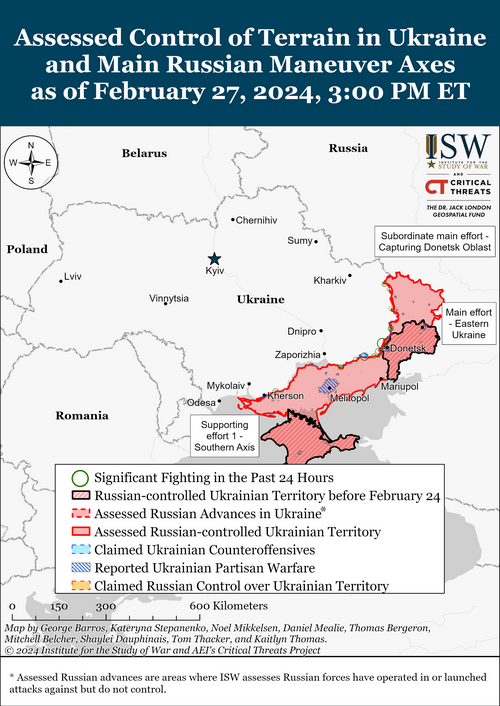
From The Institute for the Study of War:
Russian Offensive Campaign Assessment, February 27, 2024
Riley Bailey, Christina Harward, Karolina Hird, Grace Mappes, and Frederick W. Kagan
February 27, 2024, 9:15pm ET
Click here to see ISW’s interactive map of the Russian invasion of Ukraine. This map is updated daily alongside the static maps present in this report.
Click here to see ISW’s 3D control of terrain topographic map of Ukraine. Use of a computer (not a mobile device) is strongly recommended for using this data-heavy tool.
Click here to access ISW’s archive of interactive time-lapse maps of the Russian invasion of Ukraine. These maps complement the static control-of-terrain map that ISW produces daily by showing a dynamic frontline. ISW will update this time-lapse map archive monthly.
Note: The data cut-off for this product was 1:30pm ET on February 27. ISW will cover subsequent reports in the February 28 Russian Offensive Campaign Assessment.
Russian forces are attempting to exploit tactical opportunities offered by the Russian seizure of Avdiivka and appear to be maintaining a relatively high tempo of offensive operations aimed at pushing as far as possible in the Avdiivka area before Ukrainian forces establish more cohesive and harder-to-penetrate defensive lines in the area. Russian forces temporarily decreased their tempo of operations as they cleared Avdiivka following the Russian seizure of the settlement on February 17, but have since resumed a relatively high tempo of assaults further west and northwest of Avdiivka.[1] Ukrainian Tavriisk Group of Forces Spokesperson Dmytro Lykhovyi stated on February 27 that Russian forces have recently increased the size of their assault groups in the Tavriisk direction (Avdiivka through western Zaporizhia Oblast) from small squad-sized groups to platoon-sized and even company-sized groups.[2] Russian forces are currently focusing assaults west of Avdiivka in the direction of Berdychi, Orlivka, and Tonenke, where Ukrainian forces established immediate defensive positions to cover their withdrawal from Avdiivka and to receive oncoming Russian offensive operations.[3] Lykhovyi and Ukrainian Tavriisk Group of Forces Commander Oleksandr Tarnavskyi stated that Ukrainian forces have stabilized their defensive lines along the Tonenke-Orlivka-Berdychi line as of February 27.[4] Ukrainian military observers characterized Ukrainian fortifications west of Avdiivka as “disappointing” and ”problematic,” however.[5] Russian milbloggers claimed that Ukrainian forces are struggling to hold defensive positions immediately west of Avdiivka and forecasted that Ukrainian forces will concentrate on a defensive line further west that Ukrainian forces began constructing in November 2023.[6]
Russian forces are likely continuing attempts to advance in order to deprive Ukrainian forces of the respite that would allow Ukraine to establish a more cohesive and harder-to-penetrate defensive line in the immediate vicinity of Avdiivka. The seizure of Avdiivka has allowed Russian forces to press on positions that Ukrainian forces have manned for a shorter period than Ukrainian positions in Avdiivka or further west, and Russian forces are likely sustaining a high operational tempo to try to exploit this tactical opportunity. Russian forces may be able to seize settlements immediately west and northwest of Avdiivka in the coming weeks, but terrain and water features further west of Avdiivka, particularly the body of water that runs between Berdychi-Semenivka-Orlivka, will likely slow the already relatively slow rate of Russian advances in the area. This difficult terrain will likely constrain further Russian tactical gains and allow Ukrainian forces to establish prepared defensive positions that will likely prompt the eventual culmination of the current Russian offensive effort in the area at least until or unless the Russians reinforce their attacking elements.[7]
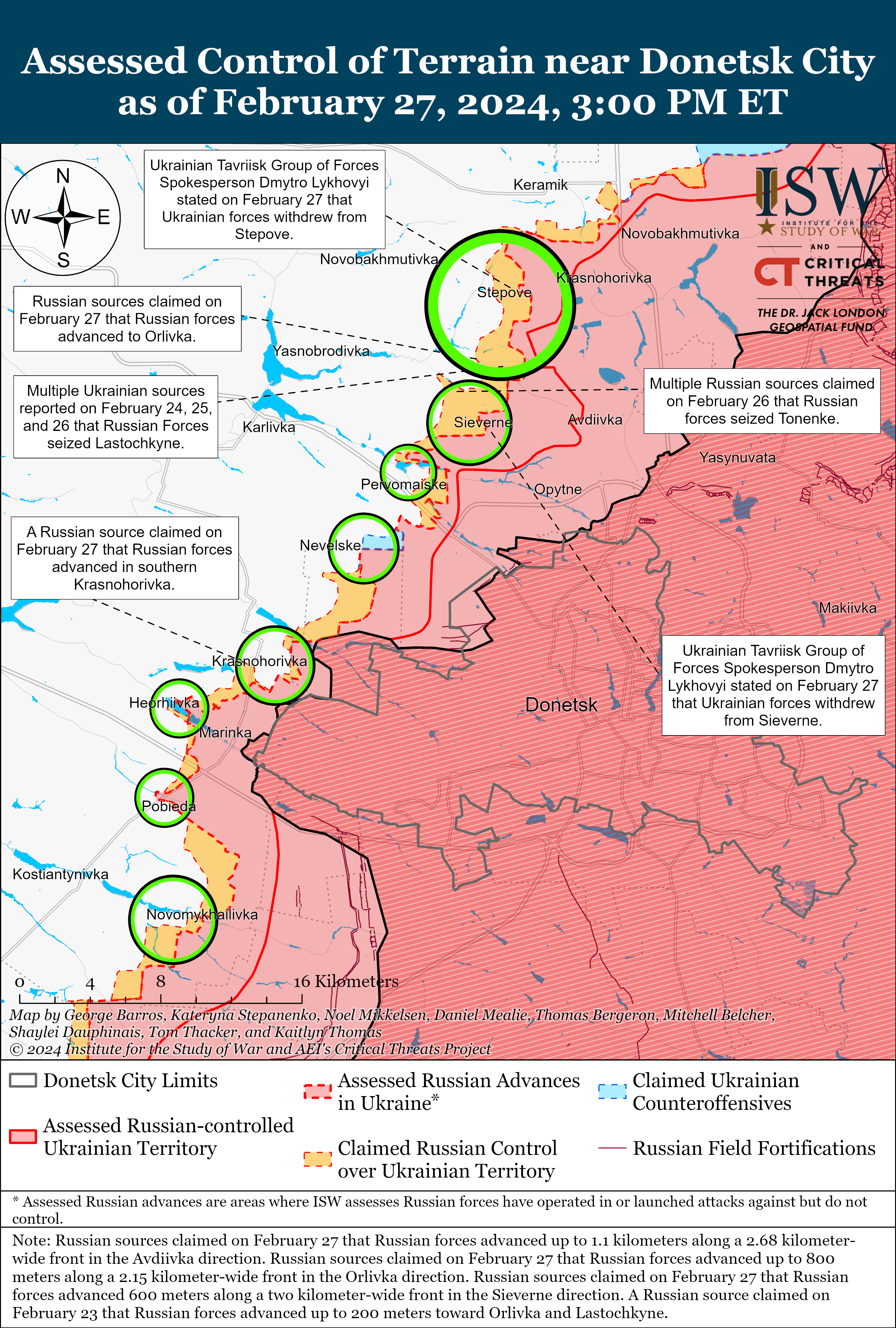
Russian forces are likely attempting to create an operational maneuver force for the exploitation of recent Russian advances in the Avdiivka direction. Ukrainian military observer Kostyantyn Mashovets stated on February 27 that Russian forces have formally transferred responsibility for the Donetsk City-Avdiivka axis to the Russian Central Grouping of Forces and formally transferred the Central Grouping of Forces’ previous area of responsibility (AOR) in the Lyman direction to Russia’s Western Grouping of Forces.[8] Russia’s Western Grouping of Forces (likely comprised almost entirely of elements of the Western Military District [WMD]) assumed responsibility for at least a portion of the Lyman direction in late fall and early winter 2023 after the Russian command transferred the bulk of the committed formations of the Central Grouping of Forces (primarily comprised of elements of the Central Military District [CMD]) to the offensive effort to seize Avdiivka in October 2023.[9] Russian officials have recently praised the Central Grouping of Forces for the seizure of Avdiivka and have notably highlighted CMD Commander Colonel General Andrei Mordvichev and increasingly identified the Avdiivka direction as the AOR of the Central Grouping of Forces.[10] The Russian command may have decided to codify the de facto command structure that has existed in the Avdiivka area since late Fall 2023 to explicitly establish a maneuver force intended to exploit recent Russian advances in the area. The Avdiivka-Donetsk axis is a relatively narrower AOR compared to the AORs of other Russian force groupings in Ukraine, and this focused responsibility suggests that the Russian military command likely intends for CMD elements to continue offensive efforts in the Avdiivka area in the near and medium term.
The Russian command likely hopes that the reorganization of command structures will establish more cohesive Russian grouping of forces throughout the theater in Ukraine. Russian forces recently reorganized the command structure of the Russian grouping of forces in southern Ukraine, abolishing an unnamed grouping of forces that defended against the Ukrainian summer 2023 counteroffensive and distributing its elements between the Russian “Dnepr” Grouping of Forces (AOR in Kherson Oblast and western Zaporzihia Oblast) and the Russian Eastern Grouping of Forces (AOR in the Donetsk-Zaporizhia Oblast border area and western Donetsk Oblast).[11] The Russian Western Grouping of Forces has launched an ongoing multi-axis offensive operation along the Kharkiv-Luhansk Oblast border and has designed elements of that operation based on its control over a cohesive force grouping along a wide AOR.[12] Mashovets noted that the transfer of the Avdiivka-Donetsk City axis to the Central Grouping of Forces bisects the Russian Southern Grouping of Forces, which previously had responsibility for the frontline from the Bakhmut direction through the Marinka direction.[13] It is unclear if this bisection will generate further command and control (C2) difficulties for Russian forces near Bakhmut and west and southwest of Donetsk City beyond the pervasive C2 issues that Russian forces already face writ large in Ukraine.[14] This apparent Russian reorganization effort suggests that the Russian command may be attempting to implement lessons it has learned about organizing command structures in areas in which it intends to prioritize offensive efforts as the more cohesive Russian groupings of forces are engaged in more concerted or broader offensive efforts.
Recent developments in Transnistria, the pro-Russian breakaway region of Moldova, are unlikely to pose a military threat to Ukraine and will more likely impact Moldova’s European Union (EU) integration prospects. Ukrainian officials stated that Russian drones flew into Moldovan airspace on the night of February 26-27 during a Russian strike series targeting Ukrainian rear areas.[15] The Moldovan Ministry of Defense (MoD), however, denied that any drones flew over Moldova.[16] ISW continues to assess that the Russian forces currently in Transnistria are not capable of posing a meaningful military threat to Ukraine without reinforcements, which Russia has no likely way of bringing to Transnistria rapidly or at scale, and ISW has not observed any clear indications of Russian military preparations to intervene in Transnistria or Moldova more generally.[17] The flight of a drone over Moldovan airspace has more direct implications for Moldovan sovereignty than for Ukrainian security.
ISW is amending its warning forecast in light of continued Transnistrian officials’ statements that the upcoming Congress of Transnistrian Deputies will discuss Moldovan economic policies, likely related to changes to Moldova’s Customs Code that went into effect on January 1, 2024.[18] ISW issued a warning forecast on February 22 and assessed that Transnistrian officials may call for a referendum on annexation to Russia during the Congress of Transnistrian Deputies on February 28 to support Russian hybrid operations intent on politically and socially destabilizing Moldova.[19] The last Congress of Transnistrian Deputies was convened in March 2006, at which Transnistrian deputies decided to hold a referendum on Transnistria’s independence and future subsequent annexation into Russia.[20] The 2006 congress similarly occurred a few weeks after Ukraine imposed new customs regulations on Transnistria.[21] While the referendum received overwhelming popular support in 2006, neither Russia nor Transnistria advanced legal mechanisms for annexation at that time.
Moldova’s path towards EU membership required Moldova to change to its Customs Code to align with EU regulations.[22] Moldova had previously exempted Transnistrian businesses from paying duties to the Moldovan government for Transnistrian imports from and exports to the EU and instead allowed Transnistrian businesses to pay duties to the Transnistrian government.[23] Transnistria responded to the January 2024 changes requiring that Transnistrian businesses pay required duties to the Moldovan government by increasing taxes on about 2,000 Moldovan businesses in Transnistria, but Transnistrian President Vadim Krasnoselsky stated on February 24 that customs payments to the Transnistrian budget still decreased by 18 percent since the start of 2024.[24]
Major actors in Transnistria have varying economic and political interests. The American Enterprise Institute’s Critical Threats Project (CTP) previously assessed that Transnistria is a mafia state run by Viktor Gushan, whose company Sheriff Enterprises controls a majority of the Transnistrian economy and receives large portions of Transnistria’s government spending.[25] Gushan’s businesses have been heavily oriented towards the EU after Moldova signed a trade deal with the EU in 2014 that guaranteed tariff-free access to EU markets. Gushan’s businesses would also benefit from the reestablishment of good Ukrainian-Transnistrian relations, as Transnistria imported and exported most of its goods through Ukraine until Ukraine closed those borders in 2022 due to Russia’s full-scale invasion — facts that would give Gushan good reason to oppose Transnistrian annexation into Russia for economic reasons. EU officials have indicated that Moldova could join the EU without Transnistria.[26] Gushan may prefer a Western-oriented Moldova in which Transnistria enjoys special tax exceptions over annexation into Russia or Moldovan EU membership without Transnistria. Moldova, however, is unlikely to reverse its customs code changes given its current commitment to joining the EU. Gushan’s calculus, therefore, is complex, and his preferences are unclear at this time. ISW will provide an update following the Congress of Deputies on February 28.
Russia may also hope to exploit a hybrid play in Transnistria taking advantage of recent developments. Gushan likely competes with the Transnistrian Ministry of State Security (MGB), reportedly a “department” of the Russian Federal Security Service (FSB) that takes orders from the Kremlin.[27] Citizens of both Russian-influenced regions of Moldova — Transnistria and Gagauzia — notably recently protested Moldova’s new Customs Code.[28] Russia may attempt to exploit domestic opposition to Moldovan policies to sow instability in Moldova and delay Moldova’s accession to the EU.
Russian Defense Minister Sergei Shoigu continues to highlight recent Russian tactical successes in Ukraine as substantial battlefield victories for political purposes ahead of the upcoming Russian presidential election. Shoigu addressed the Russian Ministry of Defense (MoD) board on February 27 and reported that Russian forces are continuing efforts to improve their positions in the Donetsk (Avdiivka) and Kupyansk (Kharkiv-Luhansk Oblast border area) directions.[29] Shoigu reported that Russian forces have pushed Ukrainian forces out of Lastochkyne and Sieverne (both west of Avdiivka) and Pobieda (southwest of Donetsk City) and claimed that Russian forces have captured about 327 square kilometers of territory since the beginning of 2024. ISW currently assesses that Russian forces have captured closer to 205 square kilometers since January 1, 2024, and Shoigu likely deliberately overstated Russian territorial gains. Shoigu’s promotion of the Russian capture of very small settlements of limited tactical significance suggests that the Russian MoD is trying to emphasize even such small gains to present an image of a constantly advancing Russian military. All three of the settlements that Shoigu chose to prominently highlight are comprised of small semi-urban areas spanning a few blocks, so Russian forces’ capture of these settlements was a very tactical endeavor. ISW recently assessed that the Russian MoD is likely trying to play up recent tactical gains to generate positive informational effects before the March 2024 presidential election.[30]
Shoigu additionally highlighted Russia’s Central and Eastern Military Districts (CMD and EMD) to posture against supposed anti-Russian activity in Central Asia and the Indo-Pacific.[31] Shoigu discussed security challenges emanating from Central Asia, specifically highlighting threats from Afghanistan, a purported increase in the number of Islamic State fighters in the region, and the spread of “radical ideology and subversive activities” targeted at the southern borders of the Russian-led Collective Security Treaty Organization (CSTO). Shoigu claimed that the CMD will focus efforts on responding to various “crisis situations” in the Central Asian region through military exercises with CSTO member states. Shoigu also emphasized that the CMD is equipped with Iskander-M ballistic missiles and Tornado-G MLRS systems. Iskander-M and Tornado-Gs are not weapons systems particularly appropriate for responding to terrorist threats. Shoigu was more likely highlighting the capabilities of the CMD in this region to posture and project the impression of Russian military power and tacitly to threaten retaliation in the case of any perceived anti-Russian activities in this region. Shoigu also accused the US of fomenting tensions in the Indo-Pacific region and claimed that the EMD is increasing its combat capabilities in response to rising tensions on the Korean Peninsula and around Taiwan. Shoigu also likely intended to project the image of Russian military might into the Indo-Pacific and tacitly threaten the US for its own efforts in this region while also supporting efforts to portray itself as an equal Indo-Pacific security partner for China. The bulk of CMD and EMD personnel, commanders, and military district-level assets are currently heavily committed in Ukraine, and the Russian military command may feel this vulnerability in Russia’s ability to protect its southern and eastern flanks or play the role that the Kremlin desires to play in the geopolitics of both regions.
Ukrainian forces have reportedly shot down two Russian Su-34s on February 27, the tenth downed Russian military aircraft within roughly as many days. The Ukrainian General Staff reported that Ukrainian forces downed two Russian Su-34 fighter jets on February 27, at least one of which was downed in eastern Ukraine.[32] Ukrainian Air Force Spokesperson Colonel Yuriy Ihnat stated on February 21 that Ukrainian forces have downed seven Russian Su-34 and Su-35 fighter jets since February 16.[33] The February 27 Su-34 shoot-downs are likely connected with Russian glide bomb strikes in Donetsk Oblast, particularly near Avdiivka as Russian forces use heavy glide bomb strikes in an attempt to exploit gains in the Avdiivka area. Ukraine’s downing of a Russian A-50 long-range radar detection aircraft on February 23 has likely constrained Russian strategic reconnaissance capabilities. Ihnat stated that Russian forces have not deployed another A-50 over the Sea of Azov since the downing and have increased their use of aerial reconnaissance drones across the theater to compensate.[34]
Ukraine’s Security Service (SBU) reported on February 27 that the ongoing Russian information campaign to demoralize Ukrainian society will intensify between March and May 2024.[35] The SBU reported that the information campaign, which they call “Maidan-3,” intends to sow panic and discontent among the Ukrainian population and drive a wedge between civilians and military and political leadership. The Ukrainian Presidential Intelligence Committee reported that Russia has spent a total of $1.5 billion on this information campaign (including $250 million on information operations on the Telegram messaging app alone) and noted that this spending is on par with Russia’s spending on conventional military activities. The SBU noted that the information campaign will intensify from March to May 20, 2024 to exploit the Ukrainian political situation and foment distrust in and discontent with the Ukrainian government. The March to May timeline is significant—if Russia had not illegally invaded Ukraine, the Ukrainian presidential election would have been scheduled to occur on March 31, 2024 and May 20, 2024 is the fifth anniversary of Zelensky’s inauguration.[36] Russia appears to be pursuing this extremely costly information campaign to undermine trust in Ukrainian leadership and spread discontent with the aim of weakening Ukrainian society.
Russia likely tested an element of its Sovereign Internet on February 27, likely in an effort to strengthen control over individual aspects of the Russian information space. Russian sources reported several widespread outages of prominent social media platforms on February 27, including Telegram, YouTube, VKontakte (VK), Viber, WhatsApp, and Zoom, and later reported that service has since been restored.[37] Russian sources also reported that Russians were able to access some blocked social media platforms, including Instagram, Facebook, and Twitter, during the outage.[38] Russian State Duma Committee on Information Policy Deputy Head Anton Tkachev stated that Russian federal censor Roskomnadzor caused the outage while testing and reconfiguring gateways to identify and close “bottlenecks” to prohibited content.[39] BBC Russian Service quoted Russian organization ”Network Freedoms” as saying that Roskomnadzor may have been adjusting settings related to “technical means of countering threats” (TSPU), a set of tools that Russian federal law obligates Russian telecom providers to possess.[40] “Network Freedoms” told BBC Russian Service that Roskomnazdor is developing procedures and training specialists to use TSPU to centrally manage the Russian internet and develop a service on state-affiliated social media network VK to better censor content on the site.[41] Russia is likely attempting to expand this centralization to other social media sites that are active in Russia given the Kremlin’s tensions with other social media platforms. Russia has declared Facebook, Instagram, and WhatsApp parent company Meta as a “terrorist” organization, and Telegram has refused to comply with some of the Kremlin’s more extensive censorship measures.[42]
Key Takeaways:
- Russian forces are attempting to exploit tactical opportunities offered by the Russian seizure of Avdiivka and appear to be maintaining a relatively high tempo of offensive operations aimed at pushing as far as possible in the Avdiivka area before Ukrainian forces establish more cohesive and harder-to-penetrate defensive lines in the area.
- Russian forces are likely attempting to create an operational maneuver force for the exploitation of recent Russian advances in the Avdiivka direction.
- The Russian command likely hopes that the reorganization of command structures will establish more cohesive Russian grouping of forces throughout the theater in Ukraine.
- Recent developments in Transnistria, the pro-Russian breakaway region of Moldova, are unlikely to pose a military threat to Ukraine and will more likely impact Moldova’s European Union (EU) integration prospects. ISW is amending its warning forecast in light of continued Transnistrian officials’ statements that the upcoming Congress of Transnistrian Deputies will discuss Moldovan economic policies, likely related to changes to Moldova’s Customs Code that went into effect on January 1, 2024.
- Russian Defense Minister Sergei Shoigu continues to highlight recent Russian tactical successes in Ukraine as substantial battlefield victories for political purposes ahead of the upcoming Russian presidential election. Shoigu additionally highlighted Russia’s Central and Eastern Military Districts (CMD and EMD) to posture against supposed anti-Russian activity in Central Asia and the Indo-Pacific.
- Ukrainian forces have reportedly shot down two Russian Su-34s on February 27, the tenth downed Russian military aircraft within roughly as many days.
- Ukraine’s Security Service (SBU) reported on February 27 that the ongoing Russian information campaign to demoralize Ukrainian society will intensify between March and May 2024.
- Russia likely tested an element of its Sovereign Internet on February 27, likely in an effort to strengthen control over individual aspects of the Russian information space.
- Russian forces advanced west of Avdiivka amid continued positional engagements across the theater.
- A Ukrainian official warned that Russia seeks to ramp up force generation efforts in occupied Ukraine following the formal integration of occupied and claimed Ukrainian territories into the Russian Southern Military District (SMD).
- Russian authorities are reportedly systematizing the adoption of deported Ukrainian children in Russia.
Go here to read the rest.
From Strategy Page:
February 26, 2024: Russia was unable to recruit, mobilize or conscript enough Russians to fight in Ukraine. Even before the end of 2023, Russia sought ways to deal with this problem. One solution was recruiting 15,000 Nepalese men to fight in Ukraine. The Nepalese Russia recruited were not from the Gurkha region. Gurkha soldiers are much in demand as mercenaries and battalions of them serve in the British and Indian armies. Gurkhas were not interested in fighting for the Russians in Ukraine, so the Russians turned to non- Gurkha Nepalese who needed a job, any job, even if it was a dangerous one. The Nepal recruits were given little training when they entered Russian service in mid-2023. The Nepal troops were soon in Ukraine where they suffered casualties. At least ten were known to have died and there are probably more dead. Four Nepalese soldiers were captured by Ukrainian forces and held as prisoners of war. Families back in Nepal have appealed to Nepalese politicians to find a way they can contact their men in Ukraine. Russia does not provide any way for their Nepal mercenaries to send or receive mail to anyone in Nepal. That led Nepal to ban any more Russian recruiting in Nepal. Earlier Cuba did the same when Russian tried to recruit Cuban men to fight as mercenaries in Ukraine.
Go here to read the rest. Putin is pulling out all the stops to paint a picture of a victorious War prior to the Russian presidential election next month. The simple truth is that the War is unpopular in Russia and he is unable to get enough trained combat infantry to win the War.

