
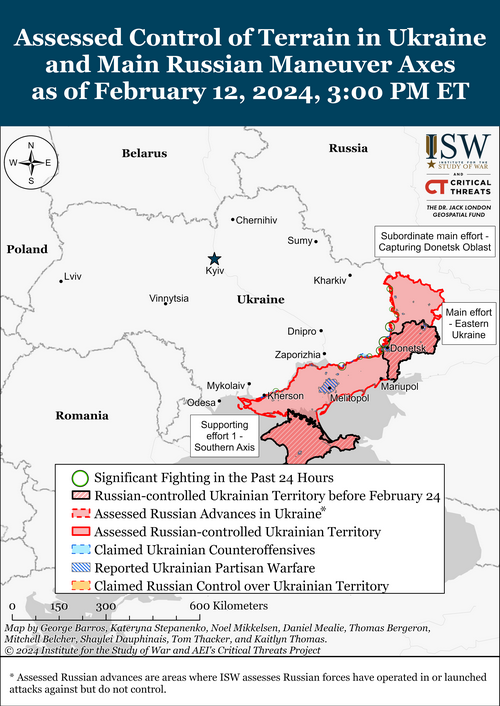
From The Institute for the Study of War:
Russian Offensive Campaign Assessment, February 12, 2024
Karolina Hird, Christina Harward, Nicole Wolkov, Grace Mappes, George Barros, and Frederick W. Kagan
February 12, 2024, 6:10pm ET
Click here to see ISW’s interactive map of the Russian invasion of Ukraine. This map is updated daily alongside the static maps present in this report.
Click here to see ISW’s 3D control of terrain topographic map of Ukraine. Use of a computer (not a mobile device) is strongly recommended for using this data-heavy tool.
Click here to access ISW’s archive of interactive time-lapse maps of the Russian invasion of Ukraine. These maps complement the static control-of-terrain map that ISW produces daily by showing a dynamic frontline. ISW will update this time-lapse map archive monthly.
Note: The data cut-off for this product was 1:15pm ET on February 12. ISW will cover subsequent reports in the February 13 Russian Offensive Campaign Assessment.
Ukraine’s Main Military Intelligence Directorate (GUR) reported that elements of Lebanese Hezbollah (LH) and the Islamic Revolutionary Guard Corps (IRGC) are training Russian drone operators at the Shayrat Air Base in Syria.[1] The GUR stated that LH and IRGC trainers are training Russian operators how to use Shahed-136/-131, Ababil-3, and Qods Raab 85 drones and that LH commander Kamal Abu Sadiq is heading the training effort. Iranian-backed militias and Russian forces are located at Shayrat Air Base, which is the second largest Iranian air base in Syria’s Homs Province after the Tiyas T-4 Air Base.[2] The IRGC and LH previously conducted training for Russian forces on Iranian-made drones at the Russian-controlled Palmyra Military Airport, also in Homs Province.[3] The Israeli Air Force notably struck Shayrat Air Base and other Syrian army Iranian-backed militia sites throughout Homs Province on February 7.[4] The GUR report suggests that Russian forces are expanding drone training to Shayrat Air Base utilizing existing Russian military infrastructure and leveraging relationships with LH and other Iranian-backed militant groups.
The Russian State Duma is considering a bill to restrict actors that the Russian government designates as “undesirable” from entering Russia, likely as part of ongoing efforts to censor opposition media outlets and dismantle ties between Russia and foreign and international non-governmental organizations. Russian State Duma Committee on Security and Anti-Corruption Head Vasily Piskarev announced on February 12 that he and other Duma deputies submitted a bill that would allow the Russian government to designate foreign organizations whose founders or participants are allegedly affiliated with foreign governments as “undesirable.”[5] The bill would also prohibit foreign and stateless individuals who are involved in such “undesirable” organizations from entering Russia.[6] This bill will likely prohibit journalists from Russian opposition outlets based outside of Russia and foreign outlets with Russian-language services (such as the UK’s BBC and Germany‘s Deutsche Welle, among others) from entering Russia, thereby restricting their ability to report on domestic Russian affairs, and will likely further block the work of international and foreign non-governmental organizations in Russia. Russian authorities can also bring criminal charges and revoke acquired Russian citizenship from individuals found guilty of participating in a designated “undesirable” organization.[7] Piskarev recently announced that the Duma is considering another bill that will ban Russian citizens and companies from advertising on platforms owned by organizations designated as “foreign agents,” likely in an effort to use financial coercion to censor Russian opposition media and critical Russian ultranationalist milbloggers.[8] ISW continues to assess that the Kremlin has been attempting to consolidate control over and stifle dissent in the Russian information space ahead of the March 2024 Russian presidential election, although this bill will likely severely restrict opposition media operations in Russia for the long term.
Boris Nadezhdin, the only openly anti-war Russian presidential candidate, filed two lawsuits in the Russian Supreme Court challenging the Russian Central Election Commission’s (CEC) refusal to register him as a candidate as the Kremlin continues efforts to suppress popular opposition while trying to preserve the veneer of legitimacy of Russian presidential elections. Nadezhdin filed lawsuits with the Supreme Court challenging the technicalities the CEC used to deny his registration in the presidential election.[9] Nadezhdin stated that he will likely file a third lawsuit against the CEC before February 16.[10] ISW previously assessed that the Kremlin may have reversed its decision to allow Nadezhdin to run after Nadezhdin demonstrated that he might win too many votes for the Kremlin to credibly portray Putin as winning the election by the Kremlin-desired margin, and by extension frame Putin’s reelection as an overwhelming referendum on his war effort.[11] The CEC is unlikely to reverse its decision. The Russian Ministry of Justice included the Russian Election Monitor, a European non-governmental organization (NGO) that publishes expert analyses on Russian elections and observations from independent civilian election observers in Russia, on the list of “undesirable” NGOs in Russia.[12] Chairperson of the State Duma Committee on Security and Anti-Corruption Vasily Piskarev justified the “undesirable” designation, claiming that a group of unnamed Polish, French, and German “Russophobe” politicians formed the Russian Election Monitor to “prepare foreign audiences to recognize the presidential elections in Russia as illegitimate.”[13]
The European Union (EU) is beginning to take concrete steps towards possibly using frozen Russian assets to aid Ukraine. The European Council adopted a decision and regulation stating that central securities depositaries (CSDs) holding more than one million euros ($1.07 million) in assets from the Russian Central Bank must separate any profits generated from the primary accounts.[14] The European Council stated that this decision could allow the European Council to decide to support Ukraine’s recovery and reconstruction using these profits in the future. Ukrainian Foreign Minister Dmytro Kuleba “welcomed” the European Council‘s decision and called for further “ambitious” and “prompt” steps towards using revenues from frozen Russian assets to aid Ukraine.[15]
Key Takeaways:
- Ukraine’s Main Military Intelligence Directorate (GUR) reported that elements of Lebanese Hezbollah (LH) and the Islamic Revolutionary Guard Corps (IRGC) are training Russian drone operators at the Shayrat Air Base in Syria.
- The Russian State Duma is considering a bill to restrict actors that the Russian government designates as “undesirable” from entering Russia, likely as part of ongoing efforts to censor opposition media outlets and dismantle ties between Russia and foreign and international non-governmental organizations.
- Boris Nadezhdin, the only openly anti-war Russian presidential candidate, filed two lawsuits in the Russian Supreme Court challenging the Russian Central Election Commission’s (CEC) refusal to register him as a candidate as the Kremlin continues efforts to suppress popular opposition while trying to preserve the veneer of legitimacy of Russian presidential elections.
- The European Union (EU) is beginning to take concrete steps towards possibly using frozen Russian assets to aid Ukraine.
- Ukrainian forces recently made confirmed advances near Kreminna and Donetsk City and in western Zaporizhia Oblast, and Russian forces recently made confirmed advances near Kupyansk and Kreminna.
- South Korean news outlet Yonhap News Agency reported on February 12 that North Korea has developed 240mm guided multiple rocket launcher system (MLRS) mortar that North Korea may export to Russia.
- Russian authorities continue to use youth engagement programs to Russify Ukrainian youth.
Go here to read the rest. The Ukrainians are making advances. Probably the new Ukrainian commander attempting to prove he is worthy of the job. I doubt if these make any more military sense than the Russian mini offensives since December do, but politics has its own sense that must be served.


Sobering news from Aaron Amick at Sub Brief on the Ukrainian war effort. I trust his summary more than all the blather from the talking heads on social media and TV, and more than all the bloviating analysis from armchair generals sitting comfortably in their living rooms.
https://youtu.be/XPsCp1ZeRmg?si=mhLIHUqLlVOLWOBl