Donald R. McClarey
Cradle Catholic. Active in the pro-life movement since 1973. Father of three, one in Heaven, and happily married for 43 years. Small town lawyer and amateur historian. Former president of the board of directors of the local crisis pregnancy center for a decade.

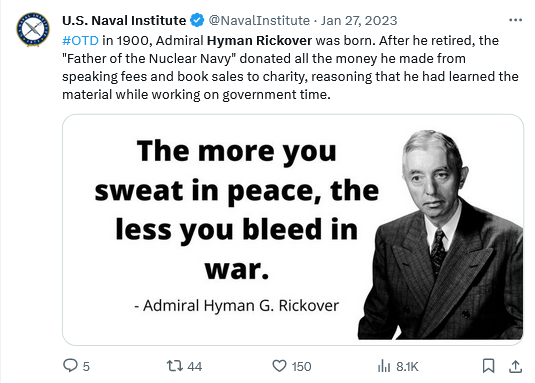


The more time spent woke. The more people die. All real teams practice to win not just look good. Pearl Harbor and 9/11 happen when you are not prepared.
Thank you, Donald. I met Rickover on my old submarine’s initial sea trials. I was the on-watch reactor operator when he came back aft for his engineroom inspection. As he usually did, he entered maneuvering, the enclosed operating space for the electric, reactor, and steam plant control panels. As reactor operator, I sat in center with electrical operator to my right and throttleman to my left and the Engineering Officer of the Watch behind me. He never asked permission to enter as was his custom. Every nuclear ship was his. He reached up to touch the scram switch on my panel. I took his arm and moved it away and asked him if he wanted to conduct a reactor scram drill. Picture that: a Petty Officer Third Class moving an Admiral’s arm away. If I had not done that, then I would have been instantly disqualified as reactor operator for failure to control my panel. It was all a test. I then requested permission to conduct a reactor scram drill from the Engineering Officer of the Watch, and he told me to scram the reactor, to which my response was, “Scram the reactor, aye, aye, Sir.” Everything went fine. Rods went into the core, the submarine rigged for reduced electrical, and we conducted a fast scram recovery, the only time I was allowed to get reactor startup rate above one decade a minute. At the end, Rickover said, “Good reactor operator,” and he left. I never saw him again. That perhaps is the highest praise I have ever gotten in my life. Below is Rickover on atomic power. This is why no one has died from a nuclear accident in the United States. When we lose sight of this kind of attitude about safety, then regardless our industry – aerospace, petrochemical, nuclear, medical – we are doomed.
June 5, 1953
Important decisions about the future development of atomic power must frequently be made by people who do not necessarily have an intimate knowledge of the technical aspects of reactors. These people are, nonetheless, interested in what a reactor plant will do, how much it will cost, how long it will take to build and how long and how well it will operate. When they attempt to learn these things, they become aware of confusion existing in the reactor business. There appears to be unresolved conflict on almost every issue that arises.
I believe that this confusion stems from a failure to distinguish between the academic and the practical. These apparent conflicts can usually be explained only when the various aspects of the issue are resolved into their academic and practical components. To aid in this resolution, it is possible to define in a general way those characteristics which distinguish the one from the other.
An academic reactor or reactor plant almost always has the following basic characteristics: (1) It is simple. (2) It is small. (3) It is cheap. (4) It is light. (5) It can be built very quickly. (6) It is very flexible in purpose (“omnibus reactor”). (7) Very little development is required. It will use mostly “off-the-shelf” components. (8) The reactor is in the study phase. It is not being built now.
On the other hand, a practical reactor plant can be distinguished by the following characteristics: (1) It is being built now. (2) It is behind schedule. (3) It is requiring an immense amount of development on apparently trivial items. Corrosion, in particular, is a problem. (4) It is very expensive. (5) It takes a long time to build because of the engineering development problems. (6) It is large. (7) It is heavy. (8) It is complicated.
The tools of the academic-reactor designer are a piece of paper and a pencil with an eraser. If a mistake is made, it can always be erased and changed. If the practical-reactor designer errs, he wears the mistake around his neck; it cannot be erased. Everyone can see it.
The academic-reactor designer is a dilettante. He has not had to assume any real responsibility in connection with his projects. He is free to luxuriate in elegant ideas, the practical shortcomings of which can be relegated to the category of “mere technical details.” The practical reactor designer must live with these same technical details. Although recalcitrant and awkward, they must be solved and cannot be put off until tomorrow. Their solutions require manpower, time and money.
Unfortunately for those who must make far-reaching decisions without the benefit of an intimate knowledge of reactor technology and unfortunately for the interested public, it is much easier to get the academic side of an issue than the practical side. For a large part those involved with the academic reactors have more inclination and time to present their ideas in reports and orally to those who will listen. Since they are innocently unaware of the real but hidden difficulties of their plans, They speak with great facility and confidence. Those involved with practical reactors, humbled by their experiences, speak less and worry more.
Yet it is incumbent on those in high places to make wise decisions, and it is reasonable and important that the public be correctly informed. It is consequently incumbent on all of us to state the facts as forthrightly as possible. Although it is probably impossible to have reactor ideas labelled as “practical” or “academic” by the authors, it is worthwhile for both the authors and the audience to bear in mind this distinction and to be guided thereby.
Yours faithfully
H. G. Rickover
Naval Reactors Branch
Division of Reactor Development