
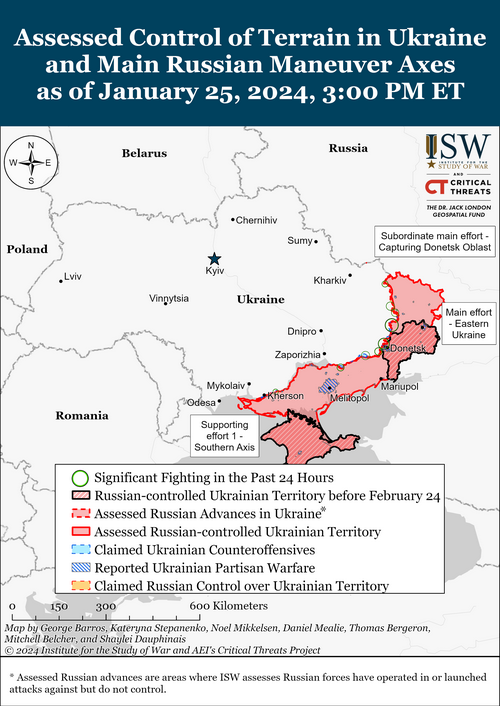
From The Institute for the Study of War:
Russian Offensive Campaign Assessment, January 25, 2024
Riley Bailey, Angelica Evans, Christina Harward, Kateryna Stepanenko, George Barros, and Frederick W. Kagan
January 25, 2024, 9pm ET
Click here to see ISW’s interactive map of the Russian invasion of Ukraine. This map is updated daily alongside the static maps present in this report.
Click here to see ISW’s 3D control of terrain topographic map of Ukraine. Use of a computer (not a mobile device) is strongly recommended for using this data-heavy tool.
Click here to access ISW’s archive of interactive time-lapse maps of the Russian invasion of Ukraine. These maps complement the static control-of-terrain map that ISW produces daily by showing a dynamic frontline. ISW will update this time-lapse map archive monthly.
Note: The data cut-off for this product was 2:00pm ET on January 25. ISW will cover subsequent reports in the January 26 Russian Offensive Campaign Assessment.
Ukrainian and Russian authorities opened criminal investigations into the January 24 Russian Il-76 military transport aircraft crash in Belgorod Oblast. The Ukrainian Security Service (SBU) announced on January 25 that it opened an investigation to clarify the circumstances of the crash, and the Russian Investigative Committee stated that it opened a criminal case on charges of “terrorism” in connection with the Il-76 crash after claiming that an initial investigation determined that a Ukrainian anti-aircraft missile downed the aircraft.[1] Ukrainian and Western media reported that the UN Security Council (UNSC) held an emergency meeting to discuss the Il-76 crash at Russia’s request on the evening of January 25 after Russian sources claimed that France rejected Russia’s request for the meeting in France’s capacity as rotating UNSC Chair.[2] Ukrainian Human Rights Commissioner Dmytro Lubinets warned that Russia intends to co-opt the Il-76 crash to destabilize Ukraine domestically and reduce Western support Ukraine.[3] Ukrainian Main Military Intelligence Directorate (GUR) Spokesperson Andriy Yusov noted that Russia has not provided any evidence of Russian claims that Ukrainian prisoners of war (POWs) were on the aircraft.[4] Russian State Duma Defense Committee Chairperson Andrei Kartapolov claimed that Russian authorities gave Ukraine a 15-minute warning before the Il-76 aircraft entered the area where it was shot down.[5] Ukrainian officials continue to deny that they received a written or verbal Russia request to secure the air space around Belgorod City, however.[6] A Kremlin-affiliated Russian milblogger insinuated that Russia should not provide any data from the crash site or evidence of the claimed presence of Ukrainian POWs on the aircraft because the international community has previously dismissed Russian evidence, referring to the international investigation into the 2014 downing of Malaysia Airlines Flight 17 by Russian-backed proxies in occupied Donetsk Oblast[7] Kartapolov stated that Russia will continue POW exchanges because Russia ”cannot abandon [its] guys,” a notable reversal from Karatpolov’s calls for all POW exchanges to pause indefinitely immediately following the[8] ISW continues to offer no assessment of the circumstances of the Il-76 crash at this time and cannot independently verify Russian or Ukrainian statements on the incident.
Russian forces conducted a series of missile and drone strikes against Ukraine on the night of January 24 to 25. Ukrainian military officials reported on January 25 that Russian forces launched 14 Shahed-136/131 drones from Krasnodar Krai and occupied Crimea, four S-300 missiles from Belgorod Oblast, and another S-300 missile from occupied Donetsk Oblast.[9] Ukrainian air defenses destroyed 11 Shaheds.[10] Ukrainian Southern Operational Command reported that Ukrainian air defenses also intercepted a Kh-59 missile over Mykolaiv Oblast.[11] Ukrainian officials reported that Russian drones struck an enterprise in Kryvyi Rih, Dnipropetrovsk Oblast and an industrial facility and residential buildings in Odesa City, and that Russian S-300 missiles struck civilian targets in Rohan, Kharkiv Oblast and Druzhkivka, Donetsk Oblast.[12]
The Ukrainian Security Service (SBU) reportedly conducted a successful drone strike on a Rosneft oil refinery in Tuapse, Krasnodar Krai on the night of January 24 to 25. Ukrainian outlet Suspilne reported on January 25, citing an unspecified source, that the SBU conducted a drone strike on the refinery and that Ukraine will continue to target economically and militarily important objects in Russia.[13] Geolocated footage published on January 24 shows a fire at the Rosneft oil refinery in Tuapse, and additional footage reportedly shows drones operating in the area before and after residents reported explosions at the refinery.[14] Russian sources claimed on January 25 that the refinery had 112 tons of gasoline and 200 tons of fuel oil at the time of the strike.[15] Russian milbloggers claimed that the SBU strike shows that Ukrainian forces are not ”suckers” and that rear areas are not ”safe place[s]” in modern war.[16]
Russian forces are reportedly increasing their use of chemical weapons in Ukraine in continued apparent violations of the Chemical Weapons Convention, to which Russia is party. Spokesperson for the Ukrainian Center for the Research of Trophy and Prospective Weapons and Military Equipment of the Ukrainian General Staff Captain Andrii Rudyk stated on January 25 that Russian forces began using RG-VO grenades with chloroacetophenone, a type of tear gas used for riot control (also known as a Riot Control Agent [RCA]), in December 2023 and that Ukrainian officials observed 81 instances of Russian forces using the RG-VO grenades in December 2023.[17] The Ukrainian General Staff reported on January 13 that Russian forces began using a new type of special gas grenade containing CS gas (2-Chlorobenzalmalononitrile – also an RCA) on December 14 and that Russian forces have used chemical weapons at least 51 times in the first two weeks of 2024.[18] The Russian 810th Naval Infantry Brigade previously acknowledged on December 22 that the brigade deliberately uses chemical weapons by dropping K-51 grenades with CS gas from drones onto Ukrainian positions near Krynky in the east (left) bank of Kherson Oblast.[19] Rudyk stated that the RG-VO grenades can kill personnel in a dugout or an enclosed room within five minutes and that a study found that a recently used Russian RG-VO grenade was manufactured in an unspecified but likely Russian factory in 2023.[20] Rudyk added that Russia may be trying to gauge international reactions to the Russian use of chemical weapons in Ukraine in order to expand the type of weapons Russian forces are using.[21] Russia is party to the Chemical Weapons Convention (CWC), which prohibits the use of RCAs as a method of warfare.[22]
German Chancellor Olaf Scholz stated that Russia’s war in Ukraine is “directed against the very existence of Ukraine as a sovereign state.”[23] Scholz stated at a press conference with Slovakian Prime Minister Robert Fico on January 24 that Russian President Vladimir Putin “can end this war at any time” and warned that “if Ukrainians stop defending themselves, it will be the end of Ukraine.” Scholz warned against accepting the idea that the lack of negotiations between Russia and Ukraine is prolonging the war, noting that there was “no shortage of discussions” in the run-up to Russia’s full-scale invasion of Ukraine in February 2022. Kremlin officials continue to indicate that Russia is not interested in negotiating with Ukraine in good faith and that Russia’s maximalist objectives — which are tantamount to full Ukrainian and Western surrender — remain unchanged.[24]
Russian authorities issued prison sentences in a number of high-profile cases on January 25, including that of imprisoned Russian ultranationalist and former officer Igor Girkin. A Moscow court sentenced Girkin to four years in prison on “calls for extremism” charges and banned Girkin from administering websites for three years.[25] Donetsk People’s Republic (DNR) “Vostok” Battalion Commander Alexander Khodakovsky stated that despite his disagreements with Girkin, he “would prefer to see him free” and noted Girkin’s “significance for events in Donbas.”[26] A volunteer in a Luhansk People’s Republic (LNR) brigade similarly claimed that his personal issues with Girkin “in no way undid everything [Girkin] did.”[27] A Russian milblogger claimed that there is something “wrong” with the fact that one of the Russian Spring leaders in Donbas from 2014 is in prison and not fighting on the front.[28]
The Second Western District Military Court in St. Petersburg sentenced Daria Trepova to 27 years in prison on charges of commissioning a terrorist attack, illegally trafficking explosive devices, and forging documents in the case of the assassination of Russian milblogger Maksim Fomin (Vladlen Tatarsky).[29] Moscow Duma Deputy Andrei Medvedev claimed that this verdict is a “precedent” that will guide future sentences and that will make “many who want to work with [Ukraine]…wonder if it is worth it.”[30] Kremlin newswire TASS stated that the Izmailovsky Court of Moscow sentenced former Penza Oblast Governor Ivan Belozertsev to 12 years in a maximum-security prison colony for taking bribes worth more than 30 million rubles (about $337,000) from former Russian Senator Boris Shpigel.[31] The court also sentenced Shpigel to 11 years.[32]
The Kremlin is reportedly no longer offering pardons to convict recruits and is significantly changing the terms of their service, likely in response to the reduction of the pool of convicts suitable for recruitment into Russian force generation efforts. The BBC reported that Russian officials likely ended recruitment into “Storm-Z” units in August 2023 and began recruiting convicts into “Storm-V” units based on new contract terms in September 2023.[33] Russian officials previously recruited convicts through promises of pardons and six-month contracts, and “Storm-V” units reportedly provide no promise of pardon or even parole and extend convicts’ contracts indefinitely until the end of the war.[34] Russian officials likely extended the contracts on the basis of Russian President Vladimir Putin’s partial mobilization order as the Russian military does for mobilized personnel. The BBC reported that Russian military registration and enlistment offices formally release convict recruits in a procedure that is no longer legally equivalent to “parole/conditional release,” suggesting that convict recruits are legally still considered prisoners.[35] Russia has heavily relied on convict recruits to maintain a level of force generation that is roughly equivalent to Russian losses in Ukraine, and which is likely helping enable Russian forces to conduct regular operational-level rotations.[36] Russian officials reported that as of October 2023 the Russian prison population was 266,000 people — a notable reduction of 54,000 prisoners from January 2023.[37] The loss of convict recruits to attritional assaults in Ukraine and the relatively short terms of their service contracts may have prompted the Kremlin to enact more restrictive terms of service in order to retain more convict recruits at the front in Ukraine. The contract terms for service in new “Storm-V” units are far less attractive and may dampen efforts to recruit convicts, although Russian officials have routinely used coercive measures to force convicts to sign contracts.[38]
Russian officials may have also changed the status of convict recruits in order to relieve force generation burdens on the Russian federal budget. Russian opposition outlet Vazhnye Istorii reported on January 25 that Storm-Z personnel addressed a letter to Putin asking him to resolve a widespread lack of promised payments, payments for injuries, and documents on the expungement of criminal records for Storm-Z personnel.[39] Vazhnye Istorii reported that a response from a Russian military prosecutor’s office to a Storm-Z fighter stated that Putin’s recent decree promising single payments in cases of injury or death do not apply to Storm-Z fighters.[40]
A Russian insider source claimed that the Russian military command recently replaced the Deputy Commander of the Southern Military District (SMD) and appointed a new SMD Chief of Staff, although ISW cannot confirm this claim. The Russian insider source, who has previously provided accurate reports regarding several other Russian command changes, claimed on January 25 that the Russian command appointed 8th Combined Arms Army Commander (CAA) Colonel General Gennady Anashkin as SMD Chief of Staff and replaced SMD Deputy Commander Lieutenant General Aleksey Zavizion with Lieutenant General Andrey Sychevoy.[41] The change in command positions within the SMD is particularly notable given that several formations of the SMD, particularly elements of the 8th CAA, are committed to ongoing localized offensive operations in Donetsk Oblast.[42] Changes in command do not necessarily translate to battlefield effects, although such changes may present temporary challenges to Russian command and control (C2). The Russian Command previously dismissed Sychevoy as Western Grouping of Forces Commander in late August 2022, following the successful Ukrainian counteroffensive in Kharkiv Oblast, and from an unspecified command position in October 2023 and replaced Zavizion as Chief of Staff of the Western Military District (WMD) in late June 2022.[43]
Key Takeaways:
- Ukrainian and Russian authorities opened criminal investigations into the January 24 Russian Il-76 military transport aircraft crash in Belgorod Oblast.
- Russian forces conducted a series of missile and drone strikes against Ukraine on the night of January 24 to 25.
- The Ukrainian Security Service (SBU) reportedly conducted a successful drone strike on a Rosneft oil refinery in Tuapse, Krasnodar Krai on the night of January 24 to 25.
- Russian forces are reportedly increasing their use of chemical weapons in Ukraine in continued apparent violations of the Chemical Weapons Convention, to which Russia is party.
- German Chancellor Olaf Scholz stated that Russia’s war in Ukraine is “directed against the very existence of Ukraine as a sovereign state.”
- Russian authorities issued prison sentences in a number of high-profile cases on January 25, including that of imprisoned Russian ultranationalist and former officer Igor Girkin.
- The Kremlin is reportedly no longer offering pardons to convict recruits and is significantly changing the terms of their service, likely in response to the reduction of the pool of convicts suitable for recruitment into Russian force generation efforts.
- A Russian insider source claimed that the Russian military command recently replaced the Deputy Commander of the Southern Military District (SMD) and appointed a new SMD Chief of Staff, although ISW cannot confirm this claim.
- Russian forces recently made confirmed advances near Avdiivka amid continued positional engagements along the entire line of contact on January 25.
- Bloomberg reported on January 24 that labor shortages in Russia have increased wages in civilian sectors enough to compete with relatively lucrative military salaries, likely making military service even less appealing to Russian citizens.
- Crimean occupation head Sergei Aksyonov signed a decree on January 25 that introduces a “special regime” for entry and exit between occupied Crimea and occupied Kherson Oblast reportedly in an effort to “localize threats to the security of the population and military and other facilities” in occupied Crimea.
Go here to read the rest. It is interesting that the Russians are opening a criminal investigation into the crash of the military transport. Does that mean that the Russians prefer that it be considered guerilla action rather than the usual culprits in most Russian air crashes, pilot error of very poor maintenance?

