
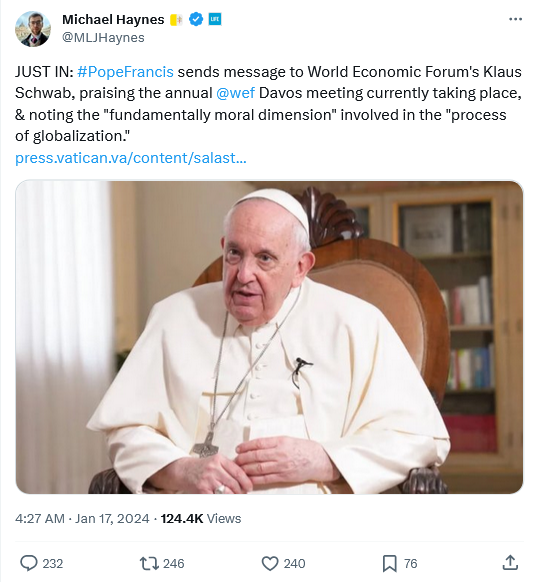
The Pope’s missive to the WEF:
To the Executive Chairman of the World Economic Forum
This year’s annual meeting of the World Economic Forum takes place in a very troubling climate of international instability. Your Forum, which aims to guide and strengthen political will and mutual cooperation, provides an important opportunity for multi-stakeholder engagement to explore innovative and effective ways to build a better world. It is my hope that your discussions will take into account the urgent need to advance social cohesion, fraternity, and reconciliation among groups, communities, and states, in order to address the challenges before us.
Sadly, as we look around, we find an increasingly lacerated world, in which millions of persons – men, women, fathers, mothers, children – whose faces are for the most part unknown to us, continue to suffer, not least from the effects of prolonged conflicts and actual wars. These sufferings are exacerbated by the fact that “modern wars no longer take place only on clearly defined battlefields, nor do they involve soldiers alone. In a context where it appears that the distinction between military and civil targets is no longer respected, there is no conflict that does not end up in some way indiscriminately striking the civilian population” (Address to Members of the Diplomatic Corps accredited to the Holy See, 8 January 2024).
The peace for which the peoples of our world yearn cannot be other than the fruit of justice (cf. Isaiah 32:17). Consequently, it calls for more than simply setting aside the instruments of war; it demands addressing the injustices that are the root causes of conflict. Among the most significant of these is hunger, which continues to plague entire regions of the world, even as others are marked by excessive food waste. The exploitation of natural resources continues to enrich a few while leaving entire populations, who are the natural beneficiaries of these resources, in a state of destitution and poverty. Nor can we disregard the widespread exploitation of men, women and children forced to work for low wages and deprived of real prospects for personal development and professional growth. How is it possible that in today’s world people are still dying of hunger, being exploited, condemned to illiteracy, lacking basic medical care, and left without shelter?
The process of globalization, which has by now clearly demonstrated the interdependence of the world’s nations and peoples, thus has a fundamentally moral dimension, which must make itself felt in the economic, cultural, political and religious discussions that aim to shape the future of the international community. In a world increasingly threatened by violence, aggression and fragmentation, it is essential that states and businesses join in promoting far-sighted and ethically sound models of globalization, which by their very nature must entail subordinating the pursuit of power and individual gain, be it political or economic, to the common good of our human family, giving priority to the poor, the needy and those in the most vulnerable situations.
For its part, the world of business and finance now operates in ever broader economic contexts, where national states have a limited capacity to govern rapid changes in international economic and financial relations. This situation requires that businesses themselves be increasingly guided not simply by the pursuit of fair profit, but also by high ethical standards, especially with regard to the less developed countries, which should not be at the mercy of abusive or usurious financial systems. A farsighted approach to these issues will prove decisive in meeting the goal of an integral development of humanity in solidarity. Authentic development must be global, shared by all nations and in every part of the world, or it will regress even in areas marked hitherto by constant progress.
At the same time, there is an evident need for international political action that, through the adoption of coordinated measures, can effectively pursue the goals of global peace and authentic development. In particular, it is important that intergovernmental structures be able effectively to exercise their functions of control and guidance in the economic sector, since the achievement of the common good is an objective beyond the reach of individual states, even those that are dominant in terms of power, wealth and political strength. International organizations are also challenged to ensure the achievement of that equality which is the basis of the right of all to participate in the process of full development, with due respect for legitimate differences.
It is my hope, then, that the participants in this year’s Forum will be mindful of the moral responsibility that each of us has in the fight against poverty, the attainment of an integral development for all our brothers and sisters, and the quest for a peaceful coexistence among peoples. This is the great challenge that the present time sets before us. And if, in the pursuit of these goals, “our own days seem to be showing signs of a certain regression”, it remains true that “each new generation must take up the struggles and attainments of past generations, while setting its sights even higher… Goodness, together with love, justice and solidarity, are not achieved once and for all; they have to be realized each day” (Apostolic Exhortation Laudate Deum, 34).
With these sentiments, I offer my prayerful good wishes for the deliberations of the Forum, and upon all taking part I willingly invoke an abundance of divine blessings.
From the Vatican, 15 January 2024
Individually there are elements in the message which are unobjectionable. However, this shows an eagerness by the Pope to have an unelected body, in tandem with a world government, play Platonic Guardians to the planet. That such an enterprise is bound to ultimately fail, is perhaps the only good feature of this concept, that has long been a completely fallacious goal in Vatican policy.


😔
Henry II Christmas day 1170
Leave it to the Lord
Two things: First, I would be amazed if he wrote this collectivist word salad himself. In my opinion, he couldn’t if he tried. The pope is a puppet on these issues no less than is the simpleton in the White House. Second, again I search in vain for any mention by this supposed shepherd of his one job, i.e., the salvation of souls. If he ever thinks about it, he manages to hide it well.
Pray for him and the Church.
First, I would be amazed if he wrote this collectivist word salad himself. In my opinion,
Correct. The Pope is pretty inarticulate. I have always assumed that in regard to his writings passages that are very poorly written and illogical are probably his own contribution.
There is not ONE reference to God, His Blessed Mother or the saints in the entirety of this entirely wicked document.
He does, however, quote HIMSELF – twice!
Francis claims to have read Lord of the World. This document makes it seem as though he wants a Julian Felsenburgh to appear?!?
Unity deliberately outside of Christ is worse than an arch without a keystone.
Note the many uses of the word “ethics”. I have long believed that business people with no creed use this term to define the rules “for the but not for me.” Please do not ask me to believe that word salad modernists would use that word in its classical sense. Newspeak on parade.
Althouse: “Nearly 50% of elites believe the U.S. provides ‘too much individual freedom’ — compared with nearly 60% of voters who believe there is too much ‘government control.'”
“Dear Mr. Blofeld:
My congratulations to you and your organization for your work in reducing the number of nuclear weapons in the hands of state actors. We salute your efforts for global stability in this respect….”
‘Nazis, no thank you’; Germans take to streets to call for AfD ban (msn.com)
Interesting to know who organized these demonstrations. Betting the ruling party and sorosphere money. The government’s been sending up trial baloons, like having subcabinet officers call for banning an opposition party which polls better than the Social Democrats. Note, even in the hands of Radio Deutsche Welle, the platform of AfD is bland and commonsensical.
We know logically that there are no parts of the world where weapons are the cause of war. Are there any, today, where hunger is the cause of conflict?
You will own nothing and be happy.
Klaus S. and Bill G. will own everything and be happy.
Why are we objecting to everyone being happy? /sarc
Attainable only by all those peoples submitting to the Prince of Peace, not to the prince of this world.
Believe is was Mark Twain who said something about keeping silent and being thought a fool as being preferable to speaking and removing all doubt.
In today’s world the concentration of power in unelected and unaccountable bureaucracies appears to create incompetent, dysfunctional bureaucracies.
Huh?!
[…] Francis: PopeWatch: Chaplain to Global Elites – Donald R. McClarey, Esq., at The American Catholic Do Christians & Communists Have the […]
Better to let others think you ignorant than open your mouth and prove it. He added nothing of the One, True God and sounds like the gal in meetings who summarizes what everyone else said as a ploy to be heard. Would that he had gone to confession that day and stayed in the chapel.
What exact political power do the people at Davos have, where and what is this “world government” and what is it that is “bound to ultimately fail?”
Money is power John, easily transmuted into political power. The calls for a world authority are constant from the WEF. Ultimately most attempts to impose “solutions” from the top down do fail as a matter of the historical record.
The WEF and Davos derives their power from all the woke DEI, or should that be DIE?, and ESG nonsense that is going on in corporate boardrooms and C-suites. They are great ways to deflect attention away from poor leadership, and allows the effective rule by corporatist oligarchy. It is getting hard to tell the difference between them and the CCP. The idea that the woke themselves could ever make a mistake is anathema to them.