
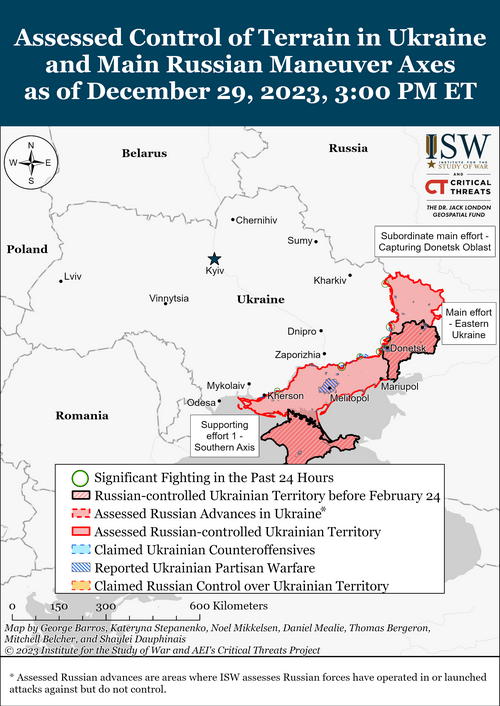
From The Institute for the Study of War:
Russian Offensive Campaign Assessment, December 29, 2023
Christina Harward, Riley Bailey, Angelica Evans, Karolina Hird, and Frederick W. Kagan
December 29, 2023, 6:35pm ET
Click here to see ISW’s interactive map of the Russian invasion of Ukraine. This map is updated daily alongside the static maps present in this report.
Click here to see ISW’s 3D control of terrain topographic map of Ukraine. Use of a computer (not a mobile device) is strongly recommended for using this data-heavy tool.
Click here to access ISW’s archive of interactive time-lapse maps of the Russian invasion of Ukraine. These maps complement the static control-of-terrain map that ISW produces daily by showing a dynamic frontline. ISW will update this time-lapse map archive monthly.
Note: The data cut-off for this product was 12:30pm ET on December 29. ISW will cover subsequent reports in the December 30 Russian Offensive Campaign Assessment.
Russian forces conducted the largest series of missile and drone strikes against Ukraine since the start of the full-scale invasion on the morning of December 29. Ukrainian military sources reported that Russian forces launched 36 Shahed-136/131 drones and over 120 missiles of various sizes at industrial and military facilities and critical infrastructure in Kyiv, Kharkiv, Lviv, Dnipro, Zaporizhzhia, and Odesa cities and Sumy, Cherkasy, and Mykolaiv oblasts.[1] The Ukrainian General Staff reported that Russian forces launched a total of 160 projectiles at Ukraine and that Ukrainian forces downed 27 Shaheds and 88 Kh-101, Kh-555, and Kh-55 missiles.[2] Ukrainian Commander-in-Chief General Valerii Zaluzhnyi reported that Russian forces first launched the 36 Shahed drones from the northern, southeastern, and western directions in the early hours of December 29.[3] Zaluzhnyi reported that Russian strategic aircraft and bombers later launched at least 90 Kh-101, Kh-555, and Kh-55 cruise missiles and eight Kh-22 and Kh-32 missiles.[4] Russian forces also struck Kharkiv City with modified S-300 air defense missiles and launched a total of 14 S-300, S-400, and Iskander-M ballistic missiles from occupied Crimea and Russia.[5] Zaluzhnyi reported that Russian forces also launched five Kinzhal hypersonic air-launched ballistic missiles, four Kh-31P anti-radar missiles, and one Kh-59 cruise missile at unspecified targets in Ukraine.[6] Ukrainian President Volodymyr Zelensky reported that Russian forces struck civilian infrastructure such as a maternity hospital, educational institutions, a shopping center, a commercial warehouse, and residential buildings in cities throughout Ukraine.[7]
The strike package that Russian forces launched on December 29 appears to be a culmination of several months of Russian experimentation with various drone and missile combinations and efforts to test Ukrainian air defenses. Over the past several months, Russian forces have conducted a series of missile and drone strikes of varying sizes, using various combinations of drones, cruise missiles, and ballistic missiles.[8] In most of the more recent strikes, Russian forces notably used either exclusively Shahed-136/131 type drones or a majority of Shahed drones accompanied by a smaller number of missiles.[9] In contrast, the December 29 strike package included 36 Shahed drones and 120 missiles of various sizes.[10] Ukrainian military officials, including Ukrainian Air Force Spokesperson Colonel Yuriy Ihnat, have long noted that Russian forces frequently use Shahed-type drones to probe Ukrainian air defense and determine what strike routes most effectively circumvent Ukrainian air defense clusters.[11] Ukrainian Main Military Intelligence Directorate (GUR) Deputy Chief Major General Vadym Skibitskyi also notably assessed on August 28 that Russian forces were likely employing strike packages comprised of more drones than missiles in order to determine flight paths that bypass Ukrainian air defenses and allow other projectiles to more reliably reach their intended targets.[12] ISW assessed on October 21 that Russian forces were likely diversifying the mix of missiles, glide bombs, and drones used in strike packages in order to determine weaknesses in Ukrainian air defense coverage to optimize a strike package such as the one that Russian forces launched on December 29.[13] Russia was likely deliberately stockpiling missiles of various sizes through the fall and early winter of 2023 in order to build a more diverse strike package and apply lessons learned over the course of various recent reconnaissance and probing missions—namely using Shahed drones to bypass Ukrainian air defenses while utilizing missiles to inflict maximal damage on intended targets.[14] Ukrainian forces notably did not intercept any of the Kh-22/Kh-32 missiles, ballistic missiles (S-300s and Iskander-Ms), Kinzhal hypersonic air-launched ballistic missiles (Kh-47s), Kh-31P anti-radar missiles, or Kh-59 cruise missiles that Russian forces launched on December 29, which suggests that Russian forces have been able to successfully apply some lessons learned about effective strike package combinations and that the Shaheds that preceded the missiles may have distracted Ukrainian air defenses or otherwise enabled the strike.[15]
Russia will continue to conduct strikes against Ukraine at scale in an effort to degrade Ukrainian morale and Ukraine’s ability to sustain its war effort against Russia. Zaluzhnyi stated that Russian forces targeted critical infrastructure and industrial and military facilities in Ukraine on December 29.[16] Ukrainian officials indicated that Russian forces primarily struck residential buildings, transportation infrastructure, and industrial facilities, although this is not a comprehensive list of the Russian target set.[17] Russian sources, including the Russian Ministry of Defense (MoD), claimed that Ukrainian defense industrial base (DIB) facilities and Ukrainian military infrastructure were the primary targets.[18]
Russian forces conducted an initial mass strike campaign in fall 2022 and winter 2022-2023 against Ukrainian energy infrastructure that was aimed at collapsing the Ukrainian energy grid during winter to degrade Ukrainian morale to the point of breaking the Ukrainian will to fight.[19] That effort failed, but Russian forces have conducted a consistent strike campaign in Ukraine that is still aimed at degrading Ukrainian morale and have also focused on inflicting compounding costs on Ukraine.[20]
Ukraine has pursued a concerted effort to expand its defense industrial base (DIB) in the past year, and the reported Russian strikes against industrial facilities likely mean to prevent Ukraine from developing key capacities to sustain operations for a longer war effort.[21] Ukraine has also sought Western partnerships for joint production in Ukraine, and Russian strikes on industrial facilities likely aim to increase risks for Western partners and companies above their current risk tolerance for operating in Ukraine.[22]
Russian forces will likely conduct intensified strikes in the coming days to coincide with the New Year Holiday as they did last year in an effort to degrade Ukrainian morale.[23] Russian forces may still decide to strike Ukrainian energy infrastructure at scale in the coming months, although ISW still assesses that a Russian effort to break Ukraine’s will to fight is very unlikely to succeed. Russian forces likely also intend for strikes on residential areas to stir up societal discontent in connection with routine information operations that aim to exploit and amplify Ukrainian social tensions.[24]
Current Russian missile and drone reserves and production rates likely do not allow Russian forces to conduct regular large-scale missile strikes, but likely do allow for more consistent drone strikes, which can explain the recent pattern of Russian strike packages. Ukrainian Main Military Intelligence Directorate (GUR) Deputy Chief Major General Vadym Skibitskyi stated on November 6 that Russian forces produced 115 long-range high-precision missiles in October 2023, including 30 Iskander-M cruise missiles, 12 Iskander-K cruise missiles, 20 Kalibr cruise missiles, 40 Kh-101 cruise missiles, 9 Kh-32 cruise missiles, and 4 Kinzhal ballistic missiles.[25] Skibitskyi also stated on November 6 that Russian forces had a total of 870 high-precision operational-strategic and strategic missiles in reserve in November and that this number increased by 285 missiles between August and November. Although Ukrainian officials have recently stated that Russian forces have partially restored their cruise missile stockpiles, Skibitskyi’s statements about recent Russian missile reserve totals and monthly production rates indicate that Russian forces are unable to sustain repeated large-scale missile strikes comparable to the December 29 strike series.[26] The December 29 strikes, which included five Kinzhal missiles, for example, used roughly one month’s worth of Russia’s reported production of that system. Russia is able to domestically produce Shahed-136/131 drones at a much higher rate, however, largely due to the creation and expansion of the drone production facility in the Alabuga Special Economic Zone in the Republic of Tatarstan.[27] The Institute for Science and International Security reported on November 13 that even after a one-month delay in production the Alabuga facility planned to produce 1,400 Shahed-136 drones between February and October 2023 and plans to produce a total of 6,000 drones by September 2025.[28] Russian forces will therefore likely be able to conduct more consistent Shahed strikes than missile strikes, as Ukrainian officials have previously indicated.[29]
The Kremlin’s efforts to sufficiently mobilize Russia’s defense industrial base (DIB) in support of its wartime objectives, including large-scale strike series, may been more successful than Western officials previously assessed due in part to Russia’s ability to procure military equipment from its partners and the redistribution of Russia’s resources for military production purposes. Head of the German Ministry of Defense’s Special Staff for Ukrainian Issues Major General Christian Freuding stated during an interview on December 29 that the German Armed Forces did not expect that Russia would succeed in expanding its DIB and increasing its production capacity in the face of Western sanctions.[30] Freuding stated that Germany did not account for Russia’s ability to circumvent Western sanctions by procuring materiel from North Korea, China, and other countries.[31] Ukrainian outlet Ekonomichna Pravda, citing data from Forbes, reported that Russia’s December 29 strike cost Russia at least $1.27 billion, calculating that Russia spent over $720,000 to launch 36 Shahed-136/131 drones, over $5 million to launch five Kh-47 hypersonic missiles, and an estimated $1.17 billion on the over 90 Kh-101 missiles that it launched.[32] Forbes previously reported that Russian Kh-101 cruise missiles cost an estimated $13 million per missile compared to Kh-22 missiles that cost an estimated $1 million each and Iskander-M ballistic missiles that cost roughly $3 million each.[33] Russian forces notably appear to be using larger quantities of the more expensive Kh-101 cruise missiles to overwhelm Ukrainian air defenses and increase the chances of striking targets in Ukraine with smaller quantities of cheaper missile variants.
Russian opposition outlet Meduza estimated on December 29 that Russia’s economy will most likely grow by more than three percent by the end of 2023, largely due to the Russian DIB’s unprecedented levels of production that have bolstered Russian economic output.[34] Meduza, citing the Bank of Finland’s Institute for Emerging Economies, reported that Russia’s DIB generated 40 percent of Russian GDP growth in the first half of 2023 despite only accounting for six percent of Russian GDP.[35] Meduza credited the success of the Russian DIB to Russia’s significantly increased, and still increasing, defense budget and the redistribution of Russia’s civilian sector resources for military production purposes.[36] Meduza highlighted Russia’s Tambov Bakery, a bakery that began assembling 230 to 250 combat drones per month in March 2023, as an example of the Russian economy’s redistribution of money and resources towards military over civilian goods.[37] Meduza noted that the Russian DIB is unlikely to generate the same levels of economic growth in 2024, largely due to personnel shortages, already stretched production capacities, and its dependence on imported components and equipment.[38]
Russian forces have likely routinely attempted to draw and fix limited Ukrainian air defense systems away from the front, and the Russian strikes on December 29 follow recent indications that Ukrainian air defenses may be presenting significant challenges to Russian aviation operations along the frontline. Ukraine lacks the number of air defense systems required to provide even coverage to all of Ukraine, and Russian forces have likely conducted a consistent series of strikes, even if at a low intensity, in part to force Ukrainian forces to concentrate those air defense systems on protecting larger population centers far from the front instead of providing coverage for military operations.[39] Russian forces reportedly decreased their aviation activity after Ukrainian forces shot down three Russian Su-34s in southern Ukraine between December 21 and 22, which was subsequently followed by a notable decrease in the tempo of Russian ground operations on the east (left) bank of Kherson Oblast.[40] Russian forces had been relying on the mass use of glide bombs dropped from manned aircraft to support operations in Kherson Oblast and in eastern Ukraine, likely due to the reported Ukrainian ability to suppress long-range Russian artillery and shoot down Russian rotary wing aircraft.[41] A Ukrainian capability to suppress Russian aviation activity even in limited areas of the front would likely pose significant operational constraints on Russian forces.
Ukrainian forces have recently expanded their use of mobile air defense strike groups in an effort to avoid expending air defense missiles on routine Russian strikes with Shahed-136/131 drones.[42] The recent months of Shahed-heavy strikes and the relatively smaller number of Russian missile strikes may have eased pressure on Ukrainian air defenses in rear areas and allowed Ukrainian forces to strengthen air defense coverage along the front. Ukrainian Air Force Spokesperson Colonel Yuriy Ihnat stated on December 24 that Ukrainian forces can deploy air defense systems in any direction and not only in those where Russian forces have recently suffered aviation losses.[43] The Russian military’s increased use of missiles in the December 29 strike likely intends in part to reapply pressure on Ukraine’s limited air defense umbrella and prevent the Ukrainian command from redeploying air defense systems from the rear towards the front.
Western aid remains vital for Ukraine’s ability to defend against Russian strikes, and the end of such aid would likely set conditions for an expanded Russian air campaign In Ukraine. Ukrainian air defenses, in part buttressed by Western-provided systems and missiles, are crucial for Ukraine’s ability to intercept Russian missiles and drones throughout Ukraine, especially as Ukrainian officials have indicated that Ukraine lacks enough air defenses to evenly cover the country. Ukrainian air defenses have proven successful at pushing Russian aircraft and glide bombs away from Ukrainian cities and even the frontline in some areas. Western–provided air defense systems have thus kept Ukraine’s cities safe from bombing raids, which the Russian military would almost certainly begin to devastating effect in the absence of such systems.[44] Russia’s inability to establish air superiority has helped Ukrainian forces prevent large-scale Russian advances along the entire line of contact. United Kingdom (UK) Defense Secretary Grant Shapps stated on December 29 that the UK would send about 200 air defense missiles to Ukraine following Russia’s large-scale strike.[45] Western aid packages have in part focused on air defense systems and missiles recently, and the continuation of such aid is vital for continued Ukrainian defense of its people and its territory. ISW continues to assess that the collapse of Western aid would likely lead sooner or later to the advance of Russian forces far to the west and likely all the way to western Ukraine along the border with NATO member states.[46]
Western leaders largely viewed the massive Russian strike as evidence that Putin’s maximalist goals in Ukraine remain unchanged, in line with ISW’s long-standing assessment that Putin is not genuinely interested in a ceasefire or any sort of negotiated settlement in Ukraine. US President Joe Biden stated that the large-scale Russian strikes on Ukraine are a reminder that Putin’s objective – to “obliterate Ukraine” and “subjugate its people” – remains unchanged.[47] Biden also stated that the stakes of the war in Ukraine affect the entirety of NATO and European security, as ISW has previously suggested.[48] United Kingdom (UK) Prime Minister Rishi Sunak and Estonian Prime Minister Kaja Kallas stated that the Russian strikes demonstrate that Putin intends to achieve his maximalist war aims of “eradicating freedom and democracy” and destroying Ukraine.[49] ISW has consistently assessed that, despite reports of Putin’s backchannel signals about his interest in ceasefire negotiations, Russia’s goals in Ukraine – which are tantamount to full Ukrainian and Western surrender and which have been clearly stated in Kremlin public rhetoric – remain the same.[50]
Key Takeaways:
- Russian forces conducted the largest series of missile and drone strikes against Ukraine since the start of the full-scale invasion on the morning of December 29.
- The strike package that Russian forces launched on December 29 appears to be a culmination of several months of Russian experimentation with various drone and missile combinations and efforts to test Ukrainian air defenses.
- Russia will continue to conduct strikes against Ukraine at scale in an effort to degrade Ukrainian morale and Ukraine’s ability to sustain its war effort against Russia.
- Current Russian missile and drone reserves and production rates likely do not allow Russian forces to conduct regular large-scale missile strikes, but likely do allow for more consistent drone strikes, which can explain the recent pattern of Russian strike packages.
- The Kremlin’s efforts to sufficiently mobilize Russia’s defense industrial base (DIB) in support of its wartime objectives, including large-scale strike series, may been more successful than Western officials previously assessed due in part to Russia’s ability to procure military equipment from its partners and the redistribution of Russia’s resources for military production purposes.
- Russian forces have likely routinely attempted to draw and fix limited Ukrainian air defense systems away from the front, and the Russian strikes on December 29 follow recent indications that Ukrainian air defenses may be presenting significant challenges to Russian aviation operations along the frontline.
- Western aid remains vital for Ukraine’s ability to defend against Russian strikes, and the end of such aid would likely set conditions for an expanded Russian air campaign In Ukraine.
- Western leaders largely viewed the massive Russian strike as evidence that Putin’s maximalist goals in Ukraine remain unchanged, in line with ISW’s long-standing assessment that Putin is not genuinely interested in a ceasefire or any sort of negotiated settlement in Ukraine.
- Russian forces made recent confirmed advances northeast of Bakhmut and south of Avdiivka as positional engagements continued across the entire line of contact.
- The Russian Ministry of Defense (MoD) announced on December 29 that it has completed Russia’s autumn 2023 conscription cycle, which began on October 1.
- Russia continues the forced integration of occupied areas of Ukraine into the Russian system using social services and infrastructure restoration projects.
Go here to read the rest. Putin continues his effort to convince the Russian people, in advance of the March presidential election, that his war is a glorious success instead of a bloody debacle.

