
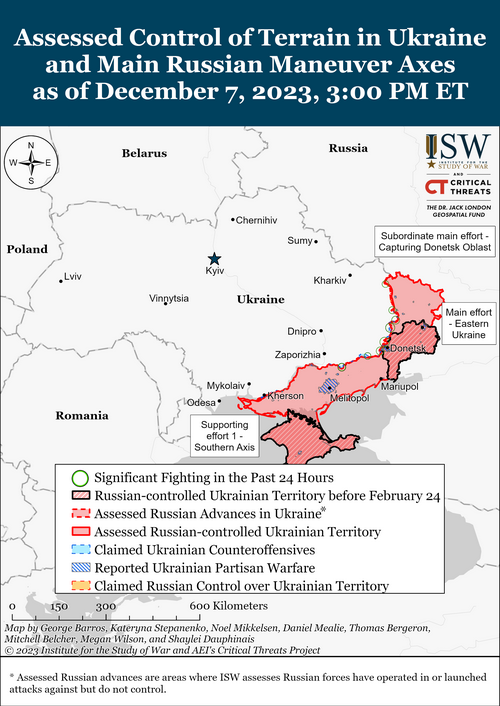
From The Institute For The Study of War:
Russian Offensive Campaign Assessment, December 7, 2023
Riley Bailey, Grace Mappes, Nicole Wolkov, Angelica Evans, George Barros, and Frederick W. Kagan
December 7, 2023, 6:45pm ET
Click here to see ISW’s interactive map of the Russian invasion of Ukraine. This map is updated daily alongside the static maps present in this report.
Click here to see ISW’s 3D control of terrain topographic map of Ukraine. Use of a computer (not a mobile device) is strongly recommended for using this data-heavy tool.
Click here to access ISW’s archive of interactive time-lapse maps of the Russian invasion of Ukraine. These maps complement the static control-of-terrain map that ISW produces daily by showing a dynamic frontline. ISW will update this time-lapse map archive monthly.
Note: The data cut-off for this product was 1pm ET on December 7. ISW will cover subsequent reports in the December 8 Russian Offensive Campaign Assessment.
Russian forces may be suffering losses along the entire front in Ukraine at a rate close to the rate at which Russia is currently generating new forces. Ukrainian Ground Forces Command Spokesperson Lieutenant Colonel Volodymyr Fityo stated on December 7 that Russian forces lost almost 11,000 personnel (presumably killed or rendered hors de combat by injury) in the Kupyansk, Lyman, and Bakhmut directions in November 2023.[1] The operational tempo in the Kupyansk, Lyman, and Bakhmut directions is currently lower than in the Avdiivka direction. These reported losses suggest that the Russian casualty rate in the Avdiivka area may be even higher given the higher operational tempo there. Ukrainian officials previously reported that Russian forces lost 5,000 personnel killed and wounded near Avdiivka and Marinka (west of Donetsk City) between October 10 and 26, when Russian forces launched two waves of heavily mechanized assaults to capture Avdiivka.[2] Russian forces are currently conducting mass infantry-led assaults to capture Avdiivka in an apparent effort to conserve armored vehicles despite the risk of even greater manpower losses.[3] Ukrainian officials have notably indicated that Russian defensive efforts are resulting in significant casualties as well, with Ukrainian forces reportedly killing over 1,200 Russian personnel and wounding over 2,200 on the east (left) bank of Kherson Oblast between October 17 and November 17.[4] Ukrainian forces continue counteroffensive operations in western Zaporizhia Oblast and are likely inflicting similar losses on defending Russian forces in this sector of the front. ISW cannot confirm Ukrainian-provided Russian casualty figures, and reliable figures for Russian casualties in Ukraine are not available. If the Ukrainian-provided figures are generally accurate they suggest that Russian operations in Ukraine are highly attritional overall and that high Russian losses are not just the result of the costliest Russian offensive operations near Avdiivka.
Russian and Ukrainian officials have reported that Russian crypto-mobilization efforts produce roughly 20,000 to 40,000 personnel a month, a rate that could be lower than Russia’s current casualty rate in Ukraine.[5] Ukrainian officials reported in spring and summer 2023 that Russia recruits roughly 20,000 personnel through crypto-mobilization efforts per month.[6] Ukrainian officials have reported that the Russian force grouping along the Kharkiv-Luhansk Oblast front has roughly not changed since summer 2023, suggesting that the commitment of new personnel to the area is offsetting Russian losses but not increasing the strength of that grouping.[7] Russian Security Council Deputy Chairperson Dmitry Medvedev previously claimed that the Russian military recruited 42,000 personnel between November 9 and December 1.[8] Ukrainian figures for Russian casualties along the front suggest that Russian monthly casualties could exceed the 20,000 monthly recruitment figure and may be even close to Medvedev’s much higher figure. Russian operations in Ukraine recently prompted the Russian military command to rush newly created and understrength formations to Ukraine to reinforce sectors of the front, impeding longer-term efforts to form operational and strategic reserves and restructure the Russian ground forces.[9] Both recruiting and casualty figures likely fluctuate over the course of the year, and all available figures are likely exaggerated. The reported numbers match observed battlefield conditions, however, as well as other Ukrainian reports that the Russian military has only been able to sustain its current manning level in Ukraine despite its reportedly high numbers of new recruits. High Russian casualties will likely prevent Russian forces from fully replenishing and reconstituting existing units in Ukraine and forming new operational and strategic reserves if Russian force generation efforts continue at current rates while the Russian military continues operations. Russia does appear able to continue absorbing such losses and making them good with new recruits, however, as long as President Vladimir Putin is willing and able to absorb the domestic consequences.
Russian forces conducted another series of drone strikes against Ukraine on the night of December 6 to 7. Ukrainian military sources reported on December 7 that Ukrainian forces downed 15 of 18 Russian-launched Shahed-131/136 drones that primarily targeted Khmelnytskyi and Odesa oblasts.[10] Ukrainian officials reported that Russian drones struck port infrastructure in Izmail Raion, Odesa Oblast, damaging a warehouse and a grain elevator.[11] Russian milbloggers claimed that Russian drones also struck the Starokostyantyniv airfield, Khmelnytskyi Oblast and other targets in Odesa Oblast.[12] Ukrainian Main Military Intelligence Directorate (GUR) Spokesperson Andriy Yusov stated that Russian forces do not have enough resources to strike Ukrainian energy infrastructure on a larger scale than last winter.[13]
The US Department of Defense (DoD) announced a new security assistance package and joint weapons production pledge to Ukraine against the backdrop of the International Forum for Defense Industries (DFNC1) in Washington, D.C. on December 6-7. The DoD announced a new aid package on December 6 that is valued at up to $175 million and includes: AIM-9M and AIM-7 missiles; High-speed Anti-radiation (HARM) missiles; Tube-Launched, Optically-Tracked, Wire-Guided (TOW) missiles; Javelin and AT-4 anti-armor systems; artillery ammunition; and additional unspecified equipment.[14] The DoD also announced that the US and Ukraine signed a statement of intent regarding the joint production of critical weapons and the priority exchange of technical data.[15] US Defense Secretary Lloyd Austin stated that the partnership will allow Ukraine to produce spare parts for US-provided military equipment and return repaired equipment to the front lines faster.[16] The White House stated that the US will send an advisor to Ukraine’s Ministry of Strategic Industries to help accelerate Ukraine’s interoperability with NATO, combat corruption, and attract foreign investment in critical industries.[17] Ukrainian Defense Minister Rustem Umerov met with Austin on December 7 and advocated for continued US support for Ukraine in 2024.[18]
Russian President Vladimir Putin discussed developing Russian-Iranian economic relations with Iranian President Ibrahim Raisi in Moscow on December 7. Putin stated that trade between Russia and Iran grew by 20 percent in 2023 and reached over five billion dollars.[19] Putin reported that Russia and Iran are constructing a railway line along an unspecified section of the North-South Corridor (a planned railway route that will connect Russia to the Indian Ocean via Iran).[20] Putin also announced that he and Raisi intend to sign an agreement establishing a free trade zone between Iran and the Eurasian Economic Union (EAEU) at the end of December 2023.[21] The continued progress on the North-South Corridor and the planned establishment of an EAEU-Iranian free trade zone are likely part of continued Russian efforts to procure Iranian materiel support for Russian operations in Ukraine while facilitating both Russian and Iranian sanctions evasion efforts. Putin also noted the “importance [for him and Raisi] to exchange views on the situation in the region, especially in Palestine” and commended Iranian-Russian energy and education cooperation.[22] Putin met with Omani Crown Prince and Minister of Culture, Sports, and Youth Theyazin bin Haitham bin Tariq Al Said on December 7 on the sidelines of the “Russia Calling!” investment forum in Moscow, likely a continuation of bilateral meetings with Persian Gulf State leaders after Putin’s December 6 meetings in the United Arab Emirates and Saudi Arabia.[23]
Attacks on public figures in Russia have prompted officials to propose increased security measures for Russian political and public figures and some ultranationalists to call for the resurrection of Soviet security organizations. Russian Federation Council Deputy Speaker Konstantin Kosachev announced on December 7 that the Federation Council will prepare proposals on the protection of Russian and political figures by December 13.[24] Kosachev’s announcement comes immediately after the assassination of former pro-Russian Ukrainian Verkhovna Rada deputy Ilya Kiva in Moscow Oblast on December 6, and Kosachev claimed that Russia and the international community need to prepare “much more systemic actions” to protect prominent Russians from Ukrainian attacks.[25] Kiva’s assassination is the latest in a series of attacks targeting high profile pro-Russian figures, including the assassinations of Russian milblogger Maxim Fomin (Vladlen Tatarsky) in April 2023 and Daria Dugina, the daughter of Russian political commentator Alexander Dugin in August 2022.[26]
Some prominent ultranationalist voices have begun calling for Russia to bolster its counterintelligence agencies with powers reminiscent of SMERSH, the umbrella organization for three Soviet military counterintelligence agencies formed in the wake of the German invasion of Russia in 1941. Russian State Duma Deputy and former Southern Military District Commander Lieutenant General Andrei Gurulev has consistently claimed since August 2022 that Russia needs to “recreate” SMERSH within the bounds of existing counterintelligence organizations.[27] Gurulev claimed on December 3 that Russia has instituted an unspecified organization that “operates approximately in the same way [as SMERSH]” in occupied Ukraine but claimed that Russia still needs a similar organization to protect Russia itself.[28] Some prominent Russian milbloggers issued similar calls for Russia to recreate SMERSH and criticized Russian counterintelligence services for allowing attacks in Russia, including Kiva’s assassination, to occur.[29] Reestablishing SMERSH as it existed during the Soviet era would be a technically challenging undertaking, as the governmental structure of the contemporary Russian Federation is not comparable with that of Stalinist Russia. The reestablishment of SMERSH would require the Russian state to develop a pervasive Soviet-style counterintelligence and internal policing system that currently does not exist in Russia. Although the reestablishment of a Soviet-style SMERSH organization in Russia remains unlikely, the ultranationalists’ calls for reestablishing SMERSH is significant, as they demonstrate the ultranationalists’ advocacy for reestablishing elements of totalitarian Soviet-style governance that has not existed in Russia for decades.
The Russian Federation Council adopted a resolution confirming that the upcoming Russian presidential elections will occur on March 17, 2024, amid continued Kremlin efforts to legitimize the elections.[30] Russian state-owned polling institution All-Russian Public Opinion Research Center (VTsIOM) released a poll on December 7 detailing Russians’ interests in participating in the upcoming Russian presidential elections. VTsIOM claimed that 78 percent of total respondents stated that they will vote in the presidential elections, including 61 percent who stated “with full confidence“ that they will vote, while only eight percent of participants indicated that they are “not yet ready to vote.”[31] VTsIOM claimed that 36 percent of Russians could name the exact date, month, or time of year in which upcoming elections will occur, despite the recency of the Federation Council’s confirmation of the election date.[32] Independent Russian polling organization Levada Center published the results of a similar poll on December 7. The Levada Center reported that only 33 percent of participants “absolutely“ intend to vote in the upcoming Russian presidential elections, while 33 percent would “most likely vote.“[33] The Levada Center also reported that 20 percent of respondents stated that they would not vote.[34] The Russian government is likely attempting to set conditions to legitimize the upcoming presidential elections by reporting an inaccurately high percentage of voter interest that will likely correspond with a similarly fabricated high voter turnout.
Russian security organs conducted mass arrests targeting high-profile gangs in Moscow and St. Petersburg, including members and co-conspirators within the Ministry of Internal Affairs (MVD) and other internal security organs. The MVD announced on December 6 that it detained MVD and Rosgvardia personnel who are members of a high-profile gang that had been committing crimes, including murders, kidnappings, and robberies, in Moscow and Kaluga oblasts and Krasnoyarsk Krai since 1998.[35] The MVD claimed that those arrested include Special Rapid Reaction Squad (SOBR) “Lynx” detachment Chief of Staff Alexey Alpatov and that the Moscow gang’s leader previously lived in Ukraine and would visit Russia to coordinate activities until his arrest in spring 2023.[36] A Russian source claimed on December 7 that SOBR forces conducted a search of the 59th MVD Department in Vyborg Raion, St. Petersburg, as part of an investigation into MVD patronage of an ethnic-based gang.[37] The source claimed some MVD personnel in the 59th Department were protecting members of an Azerbaijani criminal gang operating in St. Petersburg.[38] Russian milbloggers have expressed increasing hostility towards alleged Azerbaijani criminal gangs and other ethnic groups during a general period of heightened ethnic tensions within Russia. Both the Moscow and St. Petersburg raids allow Russian security organs to consolidate internal control against dissidents and corruption while setting informational conditions to portray foreigners – including those from Ukraine, the south Caucasus, and Central Asian states – as threats to Russian internal security that Russia must extinguish.
Key Takeaways:
- Russian forces may be suffering losses along the entire front in Ukraine at a rate close to the rate at which Russia is currently generating new forces.
- Russia does appear able to continue absorbing such losses and making them good with new recruits, however, as long as President Vladimir Putin is willing and able to absorb the domestic consequences.
- The US Department of Defense (DoD) announced a new security assistance package and joint weapons production pledge to Ukraine against the backdrop of the International Forum for Defense Industries (DFNC1) in Washington, D.C. on December 6-7.
- Russian President Vladimir Putin discussed developing Russian-Iranian economic relations with Iranian President Ibrahim Raisi in Moscow on December 7.
- Attacks on public figures in Russia have prompted officials to propose increased security measures for Russian political and public figures and some ultranationalists to call for the resurrection of Soviet security organizations.
- The Russian Federation Council adopted a resolution confirming that the upcoming Russian presidential elections will occur on March 17, 2024, amid continued Kremlin efforts to legitimize the elections.
- Russian security organs conducted mass arrests targeting high-profile gangs in Moscow and St. Petersburg, including members and co-conspirators within the Ministry of Internal Affairs (MVD) and other internal security organs.
- Russian forces continued offensive operations along the Kupyansk-Svatove-Kreminna line, near Bakhmut, near Avdiivka, west and southwest of Donetsk City, and in the Donetsk-Zaporizhia Oblast border area and marginally advanced near Avdiivka.
- Russian authorities continue to rebuff appeals from the relatives of mobilized Russian military personnel.
- Ukrainian partisans and residents in occupied territories continue to provide Ukrainian officials with targeting information.
Go here to read the rest.
From Strategy Page:
December 7, 2023: The Russian war in Ukraine has been a disaster for Russia’s economy, military, and global reputation. It is a war Russia is losing, although the Russian government has declared it illegal to discuss or criticize the mess in Ukraine. The problems Russia is having in Ukraine increase the longer they remain there.
For example, Russia is having some unique problems in the part of Ukraine they still occupy. There Russia is seeking to Russianize the Ukrainians. This is a difficult process and often takes a generation or two of effort to make it work. Ultimately Russia wants to do this throughout Ukraine, but the Ukrainians are resisting. To speed up the process the Russians are concentrating on the children in Russian occupied Ukraine, in some cases the children are sent to Russia for medical care or purportedly to protect them. Ukraine complained to the UN, which agreed it was wrong and declared Russian leader Vladimir Putin a war criminal because of this policy. Putin continued with his Russification program and only the expulsion of Russian troops from Ukraine will stop it.
Ukraine is in the process of pushing the Russians out. Putin is resisting despite the damage economic sanctions have done to the Russian economy. Even though over half of Russian military personnel are now volunteers serving on contracts, or career officers, the ability of the military to hold onto those contract (“contrakti”) soldiers is always weakened if there are a lot of casualties or too much chance of being sent to a combat zone. Volunteering to be a contract soldier used to be considered a smart move because the Russian economy had been increasingly weak over the last decade. After the fighting began in Ukraine, the contract soldiers suffered as much as the conscripts and junior officers did. The result of this was contract troops refusing to renew contracts. Most of the combat units sent into Ukraine were composed of contract troops who, once in combat, were killed in large numbers. When the survivors got back to Russia, either because of wounds or because many combat battalions returned because of heavy losses, there was a sudden shortage of contract soldiers. That was because many contract troops were near the end of two-to-three-year contracts and refused to renew. The army had signed up many soldiers for the new (since 2016) short term (six to twelve month) contracts for former soldiers, or conscripts willing to try it, and found that there were far fewer vets willing to sign these short contracts because, so few recent short-term contract soldiers had survived service in Ukraine.
The government tried to solve this reluctant contract soldier problem by changing the contracts so that contract soldiers had to remain in the army for as long as the fighting continued. Realizing that it was a death sentence if they were sent back to Ukraine, many contract soldiers simply refused to go. There were so many men refusing to go that the government backed off from threats to prosecute the reluctant contrakti. Soldiers with time left on their contracts were a liability because they told anyone who would listen that the Ukraine operation had been a disaster for Russian troops because they were confronted by determined and well-armed Ukrainians who had numerous anti-tank weapons and were regularly ambushing columns of Russian armored vehicles and quickly destroying most of them. While Russian troops were forbidden to take cell phones with them into Ukraine, the Ukrainians still had them to take photos and videos of the aftermath of these battles, and these were getting back to Russia where Russian veterans of the fighting confirmed they had seen the same grisly evidence of Russian losses or even survived one of these battles.
Russia played down these losses, but the Ukrainian military maintained and published daily updates of Russian losses in terms of soldiers killed, wounded, or captured as well as equipment losses. After thirty days of fighting the Ukrainians were claiming that over a third of Russian troops sent into Ukraine had been killed, wounded, or captured with even larger quantities of vehicles and weapons lost. After six weeks the Russian military admitted that losses were heavier than previously acknowledged but would not give exact figures.
One of the many economic impacts of the war in Ukraine is the decline in the value of the Russian versus the dollar. During 2023 the value of the ruble reached a record low of 100 rubles per dollar. After the Soviet Union dissolved in 1991, most of the 1990s were spent with the new Russian economy getting used to the real world. By the late 1990s the Russian currency had reached a realistic value of about 30 rubles per dollar. In 2017 it was 60 rubles per dollar. In 2016 it hit 80 rubles to buy a dollar. In 2023 it took 100 rubles. All of these declines are because of low oil prices and sanctions.
More sanctions were imposed in 2018 as the U.S. unilaterally sanctioned about a hundred Russian business and government officials for their role in various illegal activities. While the travel and banking sanctions applied to these people is a minor inconvenience, being named and having your misdeeds explained is embarrassing and could cause long-term problems. After the 2022 Russian invasion began in early 2022, the sanctions multiplied and remained a problem for the ruble, which briefly hit 134 rubles per dollar. After a few months that came down to 65 rules. Since then, the ruble has continually lost its value versus the dollar. This causes problems for Russian oil exports because the primary currency for international trade is the dollar. China has been trying to change that, but without much success. This is partially due to the current problems the Chinese economy is suffering from. Russia wanted to help itself and China by building pipelines for its natural gas and oil exports that used to go to Europe. Those stopped when Russia invaded Ukraine. Europe coped with the loss of Russian oil and gas, something Russia did not believe possible. The Chinese pipelines may be equally improbable because of the cost and time required to make it happen. Meanwhile the value of Russian oil and natural gas exports declined from $49 billion a month just before the 2022 Ukraine invasion to about 60 percent of that currently.
The 2022 invasion of Ukraine had multiple negative effects on the Russian economy. One of the less obvious ones was a labor shortage. As Russia mobilized more and more young men, it deprived many manufacturing or maintenance facilities of key staff. Military-age men who had manufacturing or equipment maintenance skills were forced into the military even though their employers warned that this would disrupt production of items needed by the military. Such exemptions were granted during World War II, but now the government has decided that additional soldiers were more important than production of weapons and military equipment.
What the Russian government did not consider was that, since the war began, nearly a million military-age Russians have left the country. This continued even after the government outlawed the migration of military-age men from Russia. Corruption in the government and military made it possible for military-age men to get out of Russia. The government was told by employers that unless the government acted on the problems, production of key military items would continue to decline. Sanctions led to the loss of key components normally imported from Western suppliers. It took nearly a year for Russia to line up alternative suppliers as well as smuggling routes to get banned items to Russian factories or existing equipment like armored vehicles, warplanes and warships.
There was little success in dealing with the labor shortage. Ukraine has identified Russian plants that produced key electronic components and recently began attacking them with armed UAVs, severely disrupting or halting production of key electronic components. Now Russia has to devote air defense systems to many of these plants. This is what the Ukrainians did for their own defense manufacturing plants after the war began. That led Russia to concentrate on urban areas and infrastructure targets like power plants and water distribution facilities. Western sanctions plus Ukrainian attacks have reduced the number of land-attack missiles Russia can produce and use against the Ukrainian military. That led to Russia shifting its missile attacks to less well prepared and defended civilian targets
Go here to read the rest. Russian manpower can barely keep up with the casualties in Ukraine. The Russian effort will last as long as Putin lives or is in power, and not a month thereafter.

