
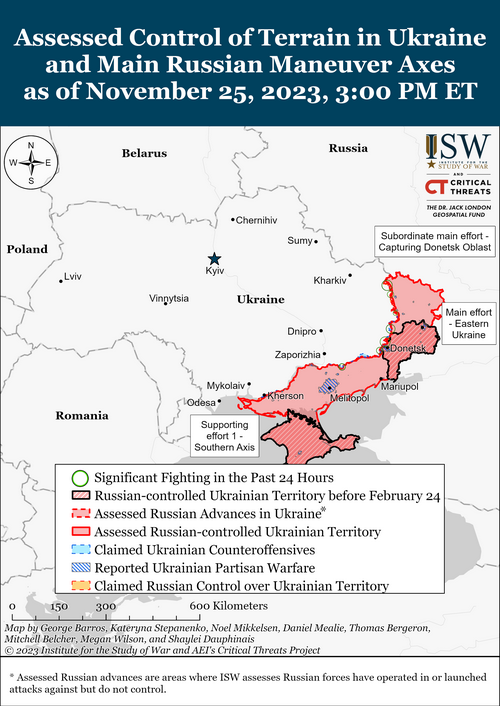
From The Institute For The Study of War:
Russian Offensive Campaign Assessment, November 25, 2023
Angelica Evans, Christina Harward, Grace Mappes, Kateryna Stepanenko, and Frederick W. Kagan
November 25, 2023, 6:45pm ET
Click here to see ISW’s interactive map of the Russian invasion of Ukraine. This map is updated daily alongside the static maps present in this report.
Click here to see ISW’s 3D control of terrain topographic map of Ukraine. Use of a computer (not a mobile device) is strongly recommended for using this data-heavy tool.
Click here to access ISW’s archive of interactive time-lapse maps of the Russian invasion of Ukraine. These maps complement the static control-of-terrain map that ISW produces daily by showing a dynamic frontline. ISW will update this time-lapse map archive monthly.
Note: The data cut-off for this product was 2:45pm ET on November 25. ISW will cover subsequent reports in the November 26 Russian Offensive Campaign Assessment.
Russian forces launched the largest drone strike against Ukraine since the start of the full-scale invasion overnight on November 24 to 25 using a new modification of the Iranian Shahed 131/136 drones.[1] Ukrainian military officials reported that Russian forces launched 75 Shahed drones that mainly targeted Kyiv City from the southeast (Primorsko-Akhtarsk) and northeast (Kursk Oblast) and that Ukrainian forces shot down 74 drones.[2] Ukrainian military officials also reported that Ukrainian forces shot down a Russian Kh-59 cruise missile over Dnipropetrovsk Oblast and that air defenses activated in at least six regions, including Kyiv, Sumy, Dnipropetrovsk, Zaporizhia, Mykolaiv, and Kirovohrad oblasts.[3] Ukrainian Air Force officials stated that mobile fire groups enabled Ukrainian forces to shoot down a significant number of drones.[4] Ukrainian President Volodymyr Zelensky observed that Russian forces launched the drone attack on the Ukrainian remembrance day of the 1932-1933 Holodomor man-made famine.[5]
Ukrainian Air Force Spokesperson Colonel Yuriy Ihnat reported that Russian forces attacked Kyiv with a new modification of Shahed drones and noted that these drones were black in color and contained a material that absorbs radar signals, making them more difficult to detect.[6] Russian milbloggers similarly claimed that Russian forces used “black Geran” or “Feran” (the Russian name for Shaheds) drones for the first time and claimed that these drones are more challenging to detect in the night sky.[7] Iranian media published footage on November 19 showing the Iranian Ashura Aerospace University of Science and Technology presenting the new Shahed-238 jet-powered modification of the Shahed-136 drone.[8] The presented Shahed-238 appeared to be black in color, but it is unknown if Russian forces used the Shahed-238 modification during the November 25 strike.
Ukrainian and Russian forces continue to grapple with the challenges electronic warfare (EW) systems pose on the front. The Economist reported on November 23 that superior Russian EW systems are impeding Ukrainian reconnaissance, communication, and strike capabilities.[9] The Economist, citing Western experts, stated that Russia has placed a “huge focus” on producing and developing superior EW capabilities and that Ukraine is struggling to produce equivalent EW systems and EW-resistant weapons domestically. Ukrainian Commander-in-Chief General Valerii Zaluzhnyi assessed in his essay “Modern Positional Warfare and How to Win It” that Ukrainian forces need to introduce necessary command and control (C2) processes for EW complexes, increase EW production capabilities, streamline engagements with volunteer organizations that provide smaller EW complexes to Ukrainian forces, improve Ukraine’s counter-EW measures, and develop new drones with EW in mind.[10] The Ukrainian Ministry of Defense (MoD) reported on November 25 that it is working to develop drone variants more resistant to Russian EW systems and produce successful variants at scale.[11] Center for Security and Emerging Technology (CSET) Deputy Director of Analysis Margarita Konaev and CSET Fellow Owen Daniels reported on September 6, 2023, that Russian adaptations to the deployment of EW systems continue to present challenges for Ukrainian drones transmitting targeting information and securing Ukrainian signals.[12] Russian sources previously credited superior Russian EW capabilities for aiding Russian forces’ defense against Ukrainian counteroffensive operations in southern Ukraine in June 2023.[13]
Russian sources have also repeatedly expressed concerns and complaints about perceived inadequacies in Russian EW systems, however.[14] Russian sources credited superior Ukrainian EW and aerial reconnaissance systems for Ukrainian advances south of Bakhmut in September 2023 and claimed that Ukrainian EW systems were significantly disrupting Russian communications in western Zaporizhia Oblast in August 2023.[15] ISW reported on November 25 that the effectiveness of Russian EW systems is inconsistent across the front, allowing the Ukrainians to continue to use drone-based reconnaissance-strike complexes to disrupt Russian offensive operations.[16] Russian milbloggers have been inconsistent in their assessments of which side has “superior” EW systems, indicating that neither Russia nor Ukraine currently has a decisive advantage over the other.[17] Western aid in support of Ukrainian efforts to destroy, disrupt, or bypass Russian EW systems would increase Ukraine’s ability to strike targets near the front precisely, disrupting Russian advances, and setting conditions for further Ukrainian offensive operations.[18]
Ukrainian President Volodymyr Zelensky announced on November 25 that Ukraine’s Western partners agreed to transfer warships to Ukraine to protect Ukraine’s grain corridor in the Black Sea.[19] Zelensky stated during a speech at the “Grain from Ukraine” conference in Kyiv that Ukraine and unspecified international partners reached an agreement to enable Ukraine to provide sea escorts for merchant ships transporting grain from Ukrainian ports in the near future. Zelensky added that Ukraine’s partners also agreed to provide “very powerful” air defense systems to defend Odesa Oblast. Zelensky noted that the “Grain from Ukraine” initiative has delivered more than 170,000 tons of grain to Somalia, Ethiopia, Kenya, and Yemen in the past year.[20] Latvian President Edgars Rinkevics, Swiss President Alain Berset, and Lithuanian Prime Minister Ingrida Simonyte also attended the conference and expressed their support for the initiative.[21]
Armenian Prime Minister Nikol Pashinyan stated that Russia has not fulfilled arms export deals to Armenia and offered an alternative arrangement that would allow Russia to keep the weapons against the backdrop of recent deteriorating Russian-Armenian relations. Pashinyan stated on November 24 that Armenia has paid Russia for arms shipments but that Russia has not delivered the weapons or returned the money to Armenia.[22] Pashinyan offered the reduction of Armenia’s outstanding debt to Russia in the amount of the arms purchase as a solution, possibly as a means to decrease Armenia‘s economic ties to Russia. The Defense Ministry of India similarly reported a delay in Russia’s delivery of an S-400 missile system due to the war in Ukraine in 2022.[23] The head of the Russian Federal Service for Military-Technical Cooperation, Dmitry Shugaev, stated on August 14 that Russia will deliver the S-400 system to India on time by the end of 2024, however.[24]
Infighting among Russian ultranationalist milbloggers, likely exacerbated by ethnic tensions, has compelled a prominent milblogger to close his Telegram channel. The milblogger announced on November 25 that he is temporarily closing his Telegram channel on November 25, and another milblogger claimed that supporters of Chechen “Akhmat” Spetsnaz forces subordinate to Chechen Republic Head Ramzan Kadyrov threatened the first milblogger’s parents and admonished the “full-time military bloggers and journalists” for making the threats.[25] The second milblogger later claimed that readers began threatening him to avoid repeating the “fate” of the first milblogger and that he will apologize “sooner or later,” and the milblogger also claimed that he is confident that Akhmat commanders are not behind the attacks but mid-level “sheep.”[26] A third milblogger responded in support of the other two milbloggers, claiming that another user offered him money to take down his post in support of the first milblogger but to “think hard” because he is a “good person.” The milblogger disdained the request as “dishonorable.”[27] The first milblogger first drew the wrath of the “public relations people of Akhmat and Kadyrov” in early November when he criticized rumors that Wagner Group personnel were transferring to Akhmat units, drawing some support from other milbloggers when the Akhmat-affiliates targeted this milblogger in a defamation campaign.[28] These attacks allegedly from supporters of Kadyrov come during a period of especially high ethnoreligious tensions in Russia and as Kadyrov is increasingly attempting to curry and display Russian Vladimir Putin’s favor.[29]
Other milbloggers attributed increased infighting among ultranationalist voices about the war in Ukraine to Russian politics and the coming 2024 Russian presidential elections. One milblogger claimed that the “war” on Telegram and in the Russian media will temporarily end as Russian political “towers” – or political officials financing Telegram channels to advance their political goals – temporarily stop feuding until after the Russian presidential elections in March 2024.[30] The milblogger claimed that the “towers” may sacrifice some overzealous “pawns” as bargaining chips and noted that milbloggers and other prominent voices will either need to stop fighting or move to the sidelines.[31] Another milblogger claimed that this infighting is the result of Russian leadership playing politics and that Russia is fighting an enemy that wants to win the war at any cost.[32]
Key Takeaways:
- Russian forces launched the largest drone strike against Ukraine since the start of the full-scale invasion overnight on November 24 to 25 using a new modification of the Iranian Shahed 131/136 drones.
- Ukrainian and Russian forces continue to grapple with the challenges electronic warfare (EW) systems pose on the front.
- Ukrainian President Volodymyr Zelensky announced on November 25 that Ukraine’s Western partners agreed to transfer warships to Ukraine to protect Ukraine’s grain corridor in the Black Sea.
- Armenian Prime Minister Nikol Pashinyan stated that Russia has not fulfilled arms export deals to Armenia and offered an alternative arrangement that would allow Russia to keep the weapons against the backdrop of recent deteriorating Russian-Armenian relations.
- Infighting among Russian ultranationalist milbloggers, likely exacerbated by ethnic tensions, has compelled a prominent milblogger to close his Telegram channel.
- Other milbloggers attributed increased infighting among ultranationalist voices about the war in Ukraine to Russian politics and the coming 2024 Russian presidential elections.
- Russian forces conducted offensive operations along the Kupyansk-Svatove-Kreminna line, near Bakhmut, near Avdiivka, west and southwest of Donetsk City, in the Donetsk-Zaporizhia Oblast border area, and in western Zaporizhia Oblast on November 25 and advanced in some areas.
- Russian military commanders are reportedly ignoring frontline units’ requests for drones.
- Ukraine’s Ministry of Reintegration reported on November 24 that over 13,500 Ukrainians returned to Ukraine from Russia via a humanitarian corridor in Sumy Oblast since its establishment in July 2023.
Go here to read the rest. Western transfer of warships into the Black Sea to allow Ukraine to protect Ukrainian grain ships sailing out of the Black Sea is a telling indication of how weakened Russian naval power has become. Of course, unless strong aid defense assets are also deployed, those warships would be vulnerable to Russian air power.


I’d add N. Korea to that axis.
I thought Turkey wasn’t letting any warships into the Black Sea?
CAG:
Romania may have ships it will let Ukraine use. Other NATO countries with access to the lower Danube have armed patrol boats, although that would hardly be “blue-water”.
Despite Soviet success against the Germans in WW II winter campaigns, several reports have indicated that the troops are not especially interested in attempting to repeat that operation this winter since the preservation of “Mother Russia” is not at stake this time.
Correct. Plus the Soviet had a free hand with executions of their own troops, some 400,000. As Stalin opined, it took a brave man not to be a hero in the Red Army. Some 427,000 Soviets were sentenced to penal battalions. Few of them survived the War.