
Americanism was an imaginary heresy, largely the result of Pope Leo XIII being ill-informed about conditions in America and paying too much heed to idiots among American clerics who delighted in attempting to stir up trouble over nothing. Pope Leo wrote a letter to Cardinal Gibbons about all this in 1899. Go here to read it.
Cardinal Gibbons and the rest of the American hierarchy responded that no one among them taught these propositions that were condemned:
1.undue insistence on interior initiative in the spiritual life, as leading to disobedience.
2.attacks on religious vows, and disparagement of the value of religious orders in the modern world.
3.minimizing Catholic doctrine.
4.minimizing the importance of spiritual direction.
They were really scratching their heads on this one and had a hard time figuring out why the Pope was concerned with a non-problem in this country.
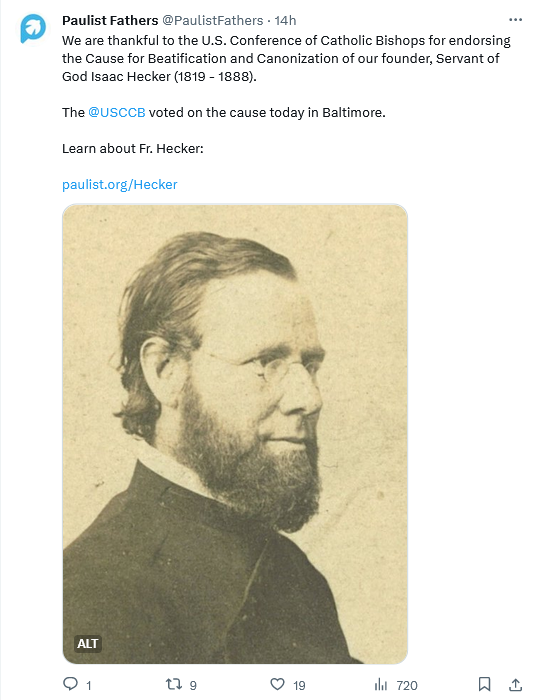
This tempest in a papal tea pot had more to do with the French Church. A biography of Father Isaac Hecker, founder of the Paulists and now a Servant of God, was mistranslated into French and portrayed Father Hecker as some sort of flaming radical which he was not. This book became popular among liberal Catholics in France. As usual the relationship
between the French Church and the Vatican was turbulent at this time. Pope Leo XIII’s concern about “Americanism” could have better been labeled a concern about “Frenchism”. Purportedly Leo XIII was reluctant to attack the Church in America, which he had often praised, and made his rebuke of “Americanism” as soft as possible.
http://www.papalencyclicals.net/Leo13/l13teste.htm
The statements of loyalty from the American hierarchy were sufficient for the Pope and “Americanism” vanished from history as quickly as it appeared.


I’m not entirely sure that there was no fire underneath the “Americanism” smoke at that time, even if it was exaggerated or mischaracterized in some ways. I doubt anyone was literally preaching “Active Virtues” to the detriment of “Contemplative Virtues” (supposedly one of the hallmarks of Americanism).
However, there is no doubt that greed, or more politely, an excessive desire for material prosperity, and incipient indifferentism were afoot in the U.S. Church at the time. This indifferentism was often marked by a distorted estimation of the Constitution as the best possible form of government. It’s relatively easy to find examples in writings by American clerics of the time. There was a vaunting of the secular ideal of the U.S. federal system, with its supposed tolerance for all religions. This rightly alarmed wiser churchmen in the Vatican and elsewhere.
Fr. j: No doubt novel situations may give rise to novel temptations, and a society such as the US had in the 19th century was novel: hostile to the Faith culturally, but completely open to its operations legally. However, atmosphere is not organized thought and there is scant evidence of any organized body of thinking that could be tagged with a label like “Americanism”. To complain that poor peasants or laborers who have a chance to advance their material status for the first time are “greedy” seems overwrought. On the other hand, when someone has a liberty he never had before it can be intoxicating (of which college frosh are a dreary example). A gentle warning that even the best-run kingdom of man is not the Kingdom of God can be salutary.
I would also note that charges of “Americanism” were fueled by a necessary tolerance for ALL churches in a constitution that was quite unusual in the European world beset by religious and political differences that often erupted in wars. One would think a Pope would be thankful for such large island of peace for the Church but, in the tradition of Italian Popes, viewed the rest of the world with a suspicious gaze.
If those four items were of such concern that Pope Leo addressed them directly, it would be interesting to see what he’d do about his current successor as that list looks like a pretty accurate synopsis.
“However, there is no doubt that greed, or more politely, an excessive desire for material prosperity, and incipient indifferentism were afoot in the U.S. Church at the time.”
Greed and clerics have been kissing cousins since the time of Judas using the common purse for his own ends. Vatican financial scandals are a hardy perennial. Warnings against love of money are always needed, but should not be restricted to a particular nationality, especially one that has been historically quite generous to the papacy.
One can never discount the disdain many have for the nouveau riche, and that is exactly what many Europeans (and many Americans) felt about Americans…all money and no class. Even Fr. J’s comment about “excessive desire for material prosperity” could be read in that light. Remaining poor and in keeping to your station in life is virtuous, especially coming from the land of aristocracy and social immobility, of which the Curia remains an outstanding example.
Tom Byrne, you could well be right. However, it nags at my opinion-forming faculty that the Jansenists said the exact same thing about Cum occasione and Unigenitus, namely that neither Jansen nor his followers ever taught the errors condemned in those documents. And if I recall correctly, the early twentieth-century Modernists said the same thing about Pius X’s condemnation. (None of that is proof, I know.) The fact remains that the greed condemned already by the American bishops in the early 19th century has been a constant in the American Church. And the indifferentism decried by Rome (at the urging of the French and German bishops within the U.S. at the time, among others) has kept pace with our love of money. Not offered as proof necessarily, just food for thought.
Fr. J:
I would point out that in Jansenius’ last testament, he humbly submitted his writings to Rome, for the Pope’s approval. His followers (and I have read Palmer’s “Catholics and Unbelievers in 18th Century France”) proved different. On the subject of “greed” some of those bishops seemed to think “greed” meant leaving the family homestead to seek advancement elsewhere, as if because God had made you a farmer’s son, that was your destiny. I can quote a line from Baltimore Catechism #3 (1870s), in which the young person is admonished to prepare for the career “for which our parents have wisely destined us”. There seemed an almost Amish expectation in some cases that young Catholics stay in rural areas and small towns to work at handcrafts. Nothing I’ve read in Vatican II (or even Trent or Vatican I) says you can’t improve your economic position. Surely every desire to escape rural or slum poverty can’t flagged as “greed”.