
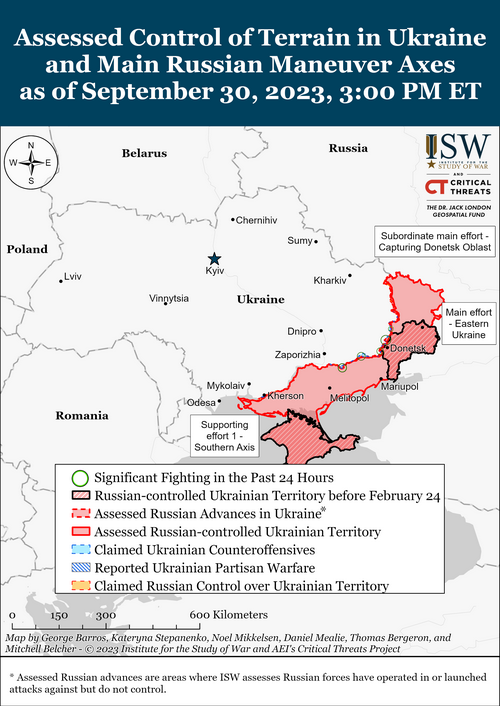
From The Institute For The Study of War:
Russian Offensive Campaign Assessment, September 30, 2023
Nicole Wolkov, Christina Harward, Angelica Evans, Riley Bailey, and Frederick W. Kagan
September 30, 2023, 5:15pm ET
Click here to see ISW’s interactive map of the Russian invasion of Ukraine. This map is updated daily alongside the static maps present in this report.
Click here to access ISW’s archive of interactive time-lapse maps of the Russian invasion of Ukraine. These maps complement the static control-of-terrain map that ISW produces daily by showing a dynamic frontline. ISW will update this time-lapse map archive monthly.
Note: The data cut-off for this product was 12:15pm ET on September 30. ISW will cover subsequent reports in the October 1 Russian Offensive Campaign Assessment.
Ukrainian forces continued counteroffensive operations in western Zaporizhia Oblast and near Bakhmut on September 30. The Ukrainian General Staff reported that Ukrainian forces continued offensive operations in the Melitopol direction (western Zaporizhia Oblast) and near Bakhmut.[1] Russian milbloggers claimed that Ukrainian forces conducted unsuccessful ground attacks near Klishchiivka (7km southwest of Bakhmut), Andriivka (10km southwest of Bakhmut), Robotyne (10km south of Orikhiv), Novoprokopivka (13km south of Orikhiv), and Verbove (18km southeast of Orikhiv).[2] A fringe Russian milblogger reportedly affiliated with the Russian Airborne (VDV) forces implicitly recanted claims from September 24 that Ukrainian forces occupy half of Verbove (18km southeast of Orikhiv).[3] The fringe milblogger claimed on September 29 that elements of the 7th Guards VDV Division still hold Verbove despite suffering losses.[4]
The Kremlin has seemingly not yet clarified what Ukrainian territories it claims that Russia has annexed, leading to continued confusion among Russian government and occupation officials a year after the illegal annexation of occupied territories. Russian President Vladimir Putin gave a speech in honor of the so-called “Day of Reunification of the Donetsk People’s Republic, Luhansk People’s Republic, Zaporizhia, and Kherson Oblasts with Russia” on September 30 in which he reiterated boilerplate rhetoric about the international legitimacy of the illegal Russian annexation referenda, the West’s alleged role in starting the war in Ukraine, and the unity between Russia and occupied Ukraine.[5] Sevastopol occupation governor Mikhail Razvozhaev posted a map on his Telegram channel in honor of the holiday that showed the entirety of Crimea and Luhansk, Donetsk, Zaporizhia, and Kherson oblasts as Russian territory.[6] The Kherson Oblast occupation administration posted a different map that showed Russian territory roughly extending to the current frontlines in the four most recently annexed territories.[7] Russian Security Council Deputy Chairperson Dmitry Medvedev, a notable nationalist and extreme voice in the Russian government, ambiguously claimed that the war in Ukraine will continue until “the original Russian territories are liberated.”[8] Medvedev’s unclear statement and occupation officials’ disparate maps indicate that the Kremlin has yet to clarify what territories it claims to have annexed or intends to annex.
Russian forces conducted a series of drone strikes primarily targeting Vinnytsia Oblast on the night of September 29 to 30. Ukrainian military sources reported on September 30 that Ukrainian forces downed 30 out of 40 Shahed-131/136 drones that Russian forces launched from occupied Crimea.[9] Ukrainian Southern Operational Command Spokesperson Captain First Rank Nataliya Humenyuk stated that Russian forces struck an infrastructure facility in Vinnytsia Oblast.[10] Russian milbloggers claimed that Russian drones struck a Ukrainian military arsenal near Kalynivka (22km north of Vinnytsia) in Vinnytsia Oblast.[11] Russian sources also claimed that Russian drones struck Ukrainian port infrastructure in Odesa and Mykolaiv oblasts on the night of September 29 to 30.[12] The Romanian Ministry of Defense (MoD) stated that its radar systems indicated a possible unauthorized entry into Romanian airspace during the Russian strike series on the night of September 29 to 30.[13] The Romanian MoD stated that Romanian authorities have not yet identified any objects that may have fallen into Romanian territory.[14]
Russian milbloggers claimed on September 30 that the Russian military command removed the commander of the Russian 205th Motorized Rifle Brigade following recent outrage from milbloggers about the brigade’s command.[15] The same group of Russian milbloggers extensively amplified reports about elements of the 205th Separate Motorized Rifle Brigade (49th Combined Arms Army, Southern Military District) suffering significant losses due to inadequate artillery support and poor leadership in the Kherson direction in late August.[16] One of the Russian milbloggers stated on September 30 that the removal of this commander is a “rare case” in which truth and justice prevailed.[17] The removal of the commander suggests that Russian ultranationalist outrage may still be able to pressure the Russian military command despite the apparent decline in such reactions in the wider Russian information space since the Wagner Group‘s June 24 rebellion.
An organization with alleged ties to Russian First Deputy Presidential Chief of Staff Sergey Kiriyenko is reportedly categorizing Russian internet user data in an effort to disseminate tailored information to specific domestic populations as part of a wider attempt to control the Russian information space. Independent Belarusian outlet Vot Tak reported on September 29 that Russian non-profit organization Dialog is gathering Russian internet user data and information from Russian government agencies in order to categorize Russian media consumers and then feed tailored narratives to specific categories of users.[18] A former employee of Dialog told Vot Tak that Dialog’s database categorizes internet users by profession, interests, and political beliefs and specifically orients false news about the war in Ukraine and pro-war narratives toward Russian military personnel, relatives of military personnel, and civil servants.[19] The former Dialog employee also claimed that Dialog categorizes internet users as “loyal” and “disloyal” and shares its information with Russian security services.[20] The former Dialog employee claimed that Dialog has failed to make a significant ideological impact on the Russian information space because Dialog could not produce unified and clear narratives.[21] Dialog’s efforts to promote narratives to specific Russian populations are likely a more subtle part of the Kremlin’s effort to control the Russian information space and commensurate with the Kremlin’s more overt efforts to promote self-censorship.
Key Takeaways:
- Ukrainian forces continued counteroffensive operations in western Zaporizhia Oblast and near Bakhmut on September 30.
- The Kremlin has seemingly not yet clarified what Ukrainian territories it claims that Russia has annexed, leading to continued confusion among Russian government and occupation officials a year after the illegal annexation of occupied territories.
- Russian forces conducted a series of drone strikes primarily targeting Vinnytsia Oblast on the night of September 29 to 30.
- Russian milbloggers claimed on September 30 that the Russian military command removed the commander of the Russian 205th Motorized Rifle Brigade following recent outrage from milbloggers about the brigade’s command.
- An organization with alleged ties to Russian First Deputy Presidential Chief of Staff Sergey Kiriyenko is reportedly categorizing Russian internet user data in an effort to disseminate tailored information to specific domestic populations as part of a wider attempt to control the Russian information space.
- Russian forces conducted offensive operations near Kupyansk, Kreminna, Bakhmut, along the Avdiivka-Donetsk City line, and in the Donetsk-Zaporizhia Oblast border area and marginally advanced along the Avdiivka-Donetsk City line.
- Russian authorities have started to conscript citizens in occupied Ukraine who have Russian passports.
- Russian authorities continue to forcibly deport children from occupied Ukraine to Russia in order to assimilate Ukrainian children into Russian culture.
Go here to read the rest. The Russians have been taking Ukrainian children into Russia throughout the conflict. That would not seem to be a move that makes any sense if the Russians truly believed they were there to stay.


The map hasn’t changed at all in almost a week … Either the Ukrainians are completely bogged down, or they’re playing their cards pretty close to the vest regarding their troop movements and successes.