Donald R. McClarey
Cradle Catholic. Active in the pro-life movement since 1973. Father of three, one in Heaven, and happily married for 43 years. Small town lawyer and amateur historian. Former president of the board of directors of the local crisis pregnancy center for a decade.
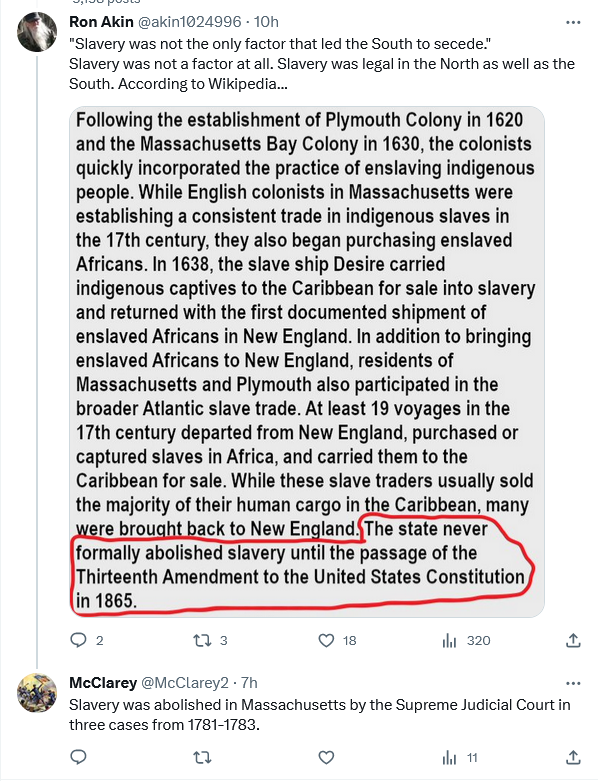



I love it when knowledgeable people refute the false narrative!
As discussed in an episode of Liberty’s Kids…
People are failing to distinguish final and agent causality. As De Tocqueville warned in his observations of Ohio and Kentucky: free and slave labor economies were pulling the North and South in very different directions and creating very different societies. The South had multiple elements in its distinct identity in 1861 and certainly individual Southerners had diverse reasons for secession. But the driver (final cause) of all those reasons was the slave economy, without which the distinctions would never have passed the critical point. Slavery was the (final) cause of the Civil War, even if there were other (agent) causes in the minds of individuals.
This seems to be where the last part of the quote comes from:
Commonwealth v. Jennison
In September 1781, a third case was filed by the Attorney General against Jennison, Commonwealth v. Jennison, for criminal assault and battery of Walker. In his charge to the jury, Chief Justice William Cushing stated, “Without resorting to implication in constructing the constitution, slavery is … as effectively abolished as it can be by the granting of rights and privileges wholly incompatible and repugnant to its existence.” This has been taken as setting the groundwork for the end of slavery in the state.[50][51] On April 20, 1783, Jennison was found guilty and fined 40 shillings.[citation needed]
Aftermath of the trials
While Chief Justice Cushing’s opinion in effect should have ended slavery in Massachusetts, the state never formally abolished slavery until the passage of the Thirteenth Amendment to the United States Constitution in 1865. Some possible reasons for this are that state legislators were either unable or unwilling to address slave-owners’ concerns about losing their financial “investment”, and non-slave owning white citizens’ concerns that if slavery were abolished, the freed slaves could become a burden on the community. Some even feared that escaped slaves from other states would flood Massachusetts.[52]
A Wiki article on slavery in Massachusetts. The reference #52 being this book:
Rose, Ben Z. (2009). Mother of Freedom: Mum Bett and the Roots of Abolition. Waverley, Massachusetts
As Tom Byrne points out, differing laws about fundamental principals cause different societies to develop.
Currently, the widening cultural gap between red and blue states on important issues like abortion, guns and law enforcement is definitely causing different cultures to develop in those states. If the allowance for individual states to control their own affairs is neglected, it will result in conflict.
Federalism is, in part, allowing your neighboring state to live in ways that would be unacceptable to your own state. (So long as all states are republics.)
The libs want one size fits all and it is leading nowhere good.