

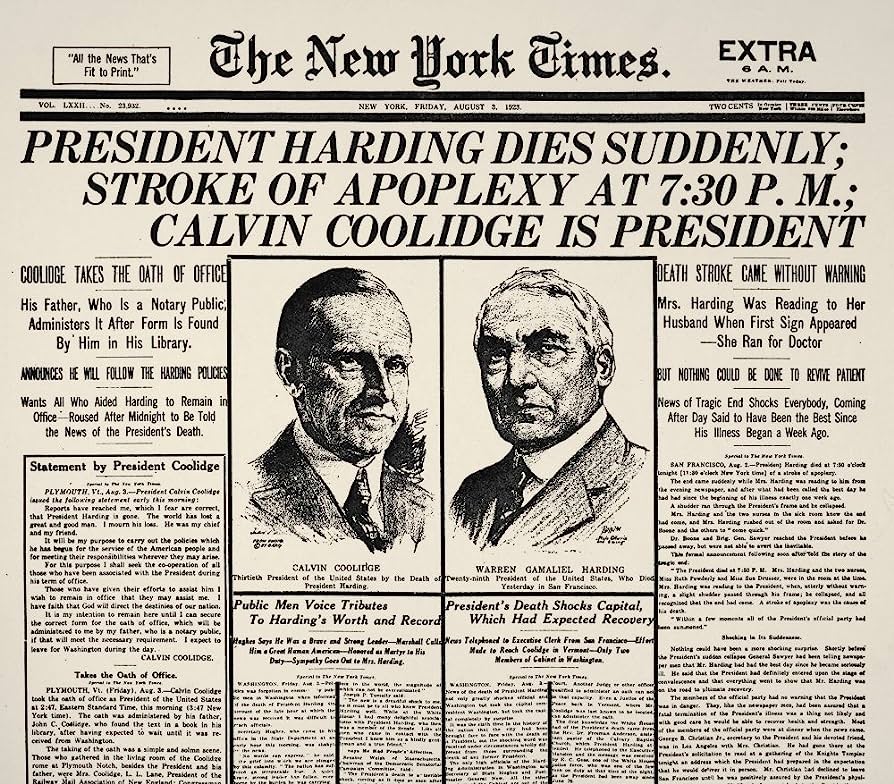
Harding had been on bed rest since July 29, 1923 at the Palace Hotel and it seemed to be doing him good. By August 2 his doctors were allowing him to sit up in bed. Around 7:30 PM on August 2 his wife Florence was reading a positive assessment of him in an article in The Saturday Evening Post: A Calm Assessment Of a Calm Man. Harding, naturally enough, liked the article and said to Florence: That’s good. Go on, read some more. A few seconds later he collapsed in the bed. Immediately his wife called for the doctors in attendance. They tried to administer stimulants to no avail. Harding was pronounced dead a few minutes later. He was 57 years old.
A tidal wave of grief nationally greeted Harding’s death. The last president to die of natural causes in the White House had been Zachary Taylor seventy-three years before. The nation in the interim had seen three presidents assassinated, but natural death seemed most unnatural. Cardiac science was still in its infancy, and it was long erroneously thought that Harding, who had a long history of heart problems, had been felled by a stroke.
After Harding’s death the corruption scandals of his Cabinet came to light, and the media, which usually protected presidents from rumors of marital infidelity, could not do so after Nan Britton, Harding’s mistress, published a lurid book in 1927, The President’s Daughter. Lurid it was, but also essentially true. DNA tests in 2015 established that Harding had fathered Britton’s daughter Elizabeth. (It should be noted that Harding had been voluntarily paying child support of 500 a month for his daughter, the equivalent of around 8,921.00 in today’s currency. His daughter grew up, married and had three children. By all accounts she led a happy life, dying in 2005. She adamantly refused all requests for interviews.)
Conspiracy theorists began having a field day with Harding’s sudden death. In 1930 a book was published claiming that Florence had poisoned her errant husband. By that time Florence Harding was dead, dying of renal failure, she had long had kidney problems, in November 1924.
Harding’s historical reputation was shot in the head by all this, and it certainly did not help that presidential historians, after the advent of The New Deal, tended to be liberal Democrats. Lately a reassessment has begun about Harding, noting his solid accomplishments as President. James D. Robenalt wrote in The Washington Post in 2015:
Among his more important accomplishments was stabilizing the country and the world after the catastrophic war in Europe, a true Armageddon that left most “civilized” nations in economic, political and social chaos. The United States alone was capable of steadying the world. Harding started by lifting our country out of a sharp postwar depression and then placed the federal government on a budget for the first time — establishing the Office of the Budget (the forerunner of the modern OMB).
He addressed severe racial tensions that the war stirred up, in part because of the great migration of African Americans to the North to work in war industries. Harding traveled to Birmingham, Ala., in his first year in office to deliver a courageous civil rights speech. “Democracy is a lie,” he said, without political equality for black citizens. He also supported a federal anti-lynching law.
Harding oversaw the first world arms limitation treaty, the Washington Conference, aimed at reducing the number of battleships in the world. He formally ended the war with Germany and its allies.
And he cooled anarchist and labor violence, the height of which included bombs exploding across the country at the homes of top political officials. Symbolically, during his first Christmas in the White House, Harding commuted the sentence of Eugene Debs, the tremendously popular socialist labor leader who had been imprisoned for 10 years merely for speaking out against the war in a workers’ rally in Canton, Ohio. (President Wilson had routinely denied a pardon for Debs, and Oliver Wendell Holmes, the paragon of justice, wrote the Supreme Court opinion affirming the Debs’s conviction.)
Over time Harding freed hundreds of political prisoners, repairing the severe wounds wrought by the Espionage and Sedition acts of 1917 and 1918. Free speech was the victor.
Go here to read the rest. Harding wasn’t a great president, but he was a good one, hard working and honest, who kept the country at peace and prosperous. I wish he had been granted the opportunity to serve at least a full term.




Thank you for this post and the link
There was a pop economics book that mentioned the “fact” that Harding dressed as a klansman while in the White House. How incongruous. He was a Republican, the party the Democrat Klan was determined to destroy because of their opposition to slavery and the ensuing Jim Crow injustices. Harding, meanwhile, was trying to integrate American institutions. He was rumored to have been biracial, which he never directly denied, but that’s been debunked by DNA testing of his relatives. It would have been interesting if a Republican was in fact the first biracial president.
Like Senator Joe McCarthy, I believe history will reassess Harding and conclude that he was a personally flawed man who nonetheless worked in his county’s best interests.
There were a number of scuzzy characters in the Harding Administration. IIRC, he was not personally implicated in their chicanery. Around about 1981, I saw one of those presidential rankings compiled by polling faculty historians. These rankers put Harding on the bottom and Coolidge 3d from the bottom. Nonsense historiography.
Harding was a much better President than his character flaws. He took the US out of the post WW I recession by reversing Wilson’s terrible economic policies of meatless days and wheatless days during the war. Harding stressed economic activity and productivity and thus helped start the roaring twenties. It was carried on by his successor Coolidge. Unfortunately, he was succeeded by Hoover who, though well meaning, essentially dropped the ball.
Harding was a much better President than his character flaws. He took the US out of the post WW I recession by reversing Wilson’s terrible economic policies of meatless days and wheatless days during the war.
==
The war was over, and the country underwent a rapid demobilization in 1918-20. The fiscal and monetary retrenchment which generated the economic recession was complete by the time Harding took office.
AD; Scarcely complete. The rate of increase from 1921 t0 1922 far outstripped the increase from 1920 to 1921. Probably due in part to recovery from the flu epidemic but also a more favorable policy environment by the government and a fledging Fed.