
From The Institute For The Study of War:
Russian Offensive Campaign Assessment, June 21, 2023
Riley Bailey, Karolina Hird, Kateryna Stepanenko, Nicole Wolkov, Angelica Evans, and Mason Clark
June 21, 2023, 6:30pm ET
Click here to see ISW’s interactive map of the Russian invasion of Ukraine. This map is updated daily alongside the static maps present in this report.
Click here to access ISW’s archive of interactive time-lapse maps of the Russian invasion of Ukraine. These maps complement the static control-of-terrain map that ISW produces daily by showing a dynamic frontline. ISW will update this time-lapse map archive monthly.
Note: The data cutoff for this product was 1pm ET on June 21. ISW will cover subsequent reports in the June 22 Russian Offensive Campaign Assessment.
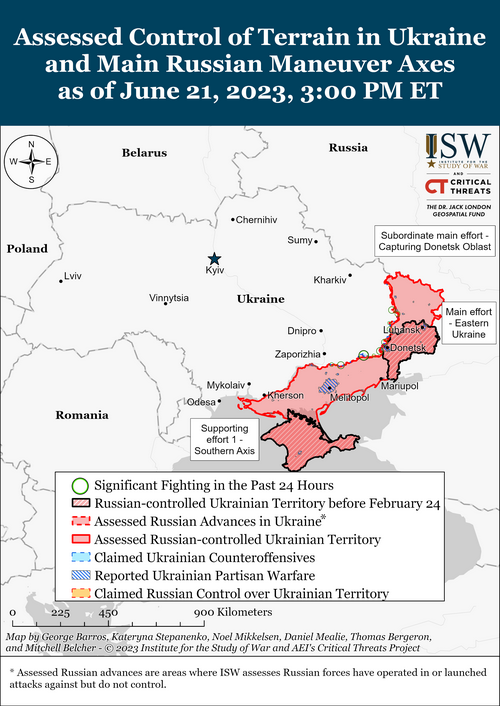
Ukrainian forces conducted counteroffensive operations on at least three sectors of the front on June 21. Ukrainian Deputy Defense Minister Hanna Malyar stated on June 21 that Ukrainian troops had partial success during offensive operations in the Bilohorivka-Shypylivka direction (about 10km south of Kreminna in Luhansk Oblast).[1] A Russian milblogger additionally claimed that Ukrainian forces are counterattacking in the areas south and west of Kreminna.[2] The Ukrainian General Staff reported that Ukrainian forces continued offensive operations in the western Donetsk-eastern Zaporizhia Oblast border area on the Vilne Pole-Makarivka line, and Russian milbloggers continued to discuss Ukrainian attacks in this area, particularly south of Velyka Novosilka.[3] Ukrainian and Russian sources reported that Ukrainian troops continued offensive operations in western Zaporizhia Oblast, both south and southwest of Orikhiv and that Russian forces are counterattacking to regain lost positions in this direction.[4] Russian sources noted a relatively slower pace of Ukrainian offensive operations in both western Donetsk and western Zaporizhia oblasts compared to the previous days.[5]
Ukrainian President Volodymyr Zelensky acknowledged that the progress of Ukrainian counteroffensives has been slower than expected, likely due to effective Russian defenses. Zelensky stated that Ukrainian counteroffensive progress has been “slower than desired” and will take time.[6] Zelensky noted that Ukrainian advances are not easy because Russian forces have mined 200,000 square kilometers of frontline territory.[7] Russian President Vladimir Putin also addressed ongoing Ukrainian counteroffensives and preposterously claimed that Russian forces have destroyed 244 tanks and 679 armored vehicles since these operations began on June 4.[8] Russian forces’ doctrinally sound defense in western Zaporizhia Oblast and prepared defensive positions throughout southern Ukraine are likely slowing Ukrainian advances, as ISW has previously assessed.[9] A Russian milblogger claimed that Russian defensive positions in southern Ukraine, dubbed the “Surovikin Line” after former overall theater commander Army General Sergei Surovikin, consist of several defensive zones between lines along dominant elevated positions up to 30km into Russian held territory.[10] The milblogger claimed that the “Surovikin Line” consists of a forward line of defense with several dozen platoon and company strongholds, and a main defensive line roughly 25km back with minefields, anti-tank ditches, and other defensive structures in between, though the extent of these defenses along the entire front line is unclear.[11] These Russian defensive lines are likely arrayed to enable a first echelon of Russian forces, deployed to the forward defensive line, to slow advancing Ukrainian forces while a second echelon of forces deployed closer to the main defensive line launch counterattacks against any Ukrainian breakthroughs, as well as providing prepared fallback positions for frontline Russian units.[12] Localized Ukrainian territorial gains are unlikely to immediately disrupt these Russian defensive lines and localized Ukrainian attempts at rapid breakthroughs are less likely to degrade these lines than a wider concerted operational effort, one which may be focused on degrading Russian defenders and fixing reserves rather than the immediate liberation of territory.
The overall slower than expected pace of Ukrainian counteroffensive operations is not emblematic of Ukraine’s wider offensive potential, and Ukrainian forces are likely successfully setting conditions for a future main effort despite initial setbacks. Ukrainian officials have long signaled that the Ukrainian counteroffensive would be a series of gradual and sequential offensive actions and have more recently offered the observation that currently ongoing operations do not represent the main thrust of Ukraine’s counteroffensive planning.[13] Ukrainian Deputy Defense Minister Hanna Malyar emphasized on June 20 that it is not useful to gauge the success of military actions based “solely by kilometers or the number of liberated settlements.”[14] Malyar’s statement echoes Ukrainian President Volodymyr Zelensky’s observation that war is not a ”Hollywood movie” that will deliver immediate and tangible results.[15]
The observation that current Ukrainian operations may have objectives that are not simply territorial is an important one. Ukrainian forces may be conducting several offensive operations across the entire theater in order to gradually attrit Russian forces and set conditions for a future main effort. Losses are inevitable on both sides, but careful operational planning on the Ukrainian side likely seeks to mitigate and balance this reality with the equally important observation that the degradation of Russian manpower is a valuable objective. Wagner Group Yevgeny Prigozhin voiced his concern that Russian forces are suffering major manpower and equipment losses as a result of ongoing Ukrainian attacks, especially in southern Ukraine.[16] The success of Ukrainian counteroffensives should not be judged solely on day-to-day changes in control of terrain, as the wider operational intentions of Ukrainian attacks along the entire frontline may be premised on gradually degrading, exhausting, and expending Russian capabilities in preparation for additional offensive pushes.
Ukrainian defense industry conglomerate “Ukroboronprom” announced on June 20 that Ukraine built and successfully tested a 1,000km-range drone, indicating Ukraine’s intent and ability to target Russian military infrastructure in Russian-occupied territories and Russia with Ukrainian-made drones.[17] Ukroboronprom Spokesperson Nataliya Sad stated that Ukrainian forces successfully used the new Ukrainian-made drone but did not provide information on whether this drone was already used for strikes. Ukroboronprom previously announced its development of the 1,000km range drone in October 2022. Ukrainian Main Military Intelligence Directorate (GUR) Head Kyrylo Budanov told The Economist that Ukraine is at war and that drones over the Kremlin show that Russian defenses are “Potemkin villages” – an expression referring to the purported construction of fake settlements by a historical Russian minister to hide the true state of the Empire from the Tsar.[18] While Budanov did not confirm that the Ukrainian forces previously launched drones over the Kremlin on May 3, US intelligence officials previously assessed that the Ukrainian special military or intelligence units are behind a series of covert actions against Russian targets including the May 3 strike.[19] ISW had previously incorrectly assessed the May 3 attack on the Kremlin may have been a Russian false flag.[20] Ukraine’s focus on development of long-range drones alongside US intelligence indicates that Ukraine will likely continue to pursue Russian rear targets with Ukrainian-made drones. International law allows Ukrainian forces to strike legitimate targets even in Russian territory, especially targets from which Russian forces are launching attacks on Ukrainian civilian infrastructure.[21]
Russian occupation authorities continue to codify legal mechanisms for forcible deportations from occupied areas of Ukraine. Donetsk People’s Republic (DNR) Head Denis Pushilin signed an order on June 20 that creates a working group to regulate and oversee the creation of “temporary detention facilities for foreign citizens and stateless persons” in occupied Donetsk Oblast and designates these individuals as subject to expulsion or deportation from territory considered to be Russian under Russian law.[22] Russian President Vladimir Putin signed a decree on April 27 that presaged Pushilin’s order by defining those living in occupied areas who refuse to accept Russian passports as “foreign citizens and stateless persons currently residing in the Russian Federation.”[23] The establishment of the new DNR working group essentially sets formal conditions for the DNR government to detain residents of occupied Donetsk Oblast who are classified as “foreign citizens and stateless persons” under the April 27 law and officially designate them as subject to deportation from occupied Donetsk Oblast. The working group will also likely serve as a coercive tool aimed at forcing residents of occupied areas to obtain Russian passports out of fear of arbitrary detention and potential deportation. ISW continues to assess that all lines of effort aimed at codifying and formalizing the deportation of Ukrainians may constitute a violation of the Geneva Convention on the Prevention and Punishment of the Crime of Genocide, as well as a potential deliberate ethnic cleansing campaign.
Key Takeaways
- Ukrainian forces conducted counteroffensive operations on at least three sectors of the front on June 21.
- Ukrainian President Volodymyr Zelensky acknowledged that the progress of Ukrainian counteroffensives has been slower than expected, likely due to effective Russian defenses.
- The overall slower than expected pace of Ukrainian counteroffensive operations is not emblematic of Ukraine’s wider offensive potential, and Ukrainian forces are likely successfully setting conditions for a future main effort despite initial setbacks.
- Ukrainian defense industry conglomerate “Ukroboronprom” announced on June 20 that Ukraine built and successfully tested a 1,000km-range drone, indicating Ukraine’s intent and ability to target Russian military infrastructure in Russian-occupied territories and Russia with Ukrainian-made drones.
- Russian occupation authorities continue to codify legal mechanisms for forcible deportations from occupied areas of Ukraine.
- Russan and Ukrainian forces continued to engage in positional battles along the Kupyansk-Svatove line.
- Ukrainian forces continued counteroffensive operations near Kreminna.
- Russian and Ukrainian forces continued limited ground attacks in the Bakhmut area and along the Avdiivka-Donetsk City line.
- Ukrainian forces conducted limited ground attacks along the administrative border between western Donetsk and eastern Zaporizhia oblasts.
- Russian and Ukrainian forces conducted limited ground attacks in western Zaporizhia Oblast.
- The Russian military command is reportedly forming a new Azov Naval District as part of the Russian Black Sea Fleet.
- The Russian State Duma passed a law in the third reading raising age limits for Russian contract personnel and officer, likely to keep personnel currently due to retire in the force.
- Russian occupation authorities continue to deport children from occupied Luhansk Oblast to Russia under the guise of medical necessity.
Go here to read the rest. The Ukrainians have not yet put in their break through units, indicating that the Russians are holding thus far.

