
From The Institute For The Study of War:
Russian Offensive Campaign Assessment, May 21, 2023
Kateryna Stepanenko, Riley Bailey, George Barros, and Frederick W. Kagan
May 21, 2023, 6:30pm ET
Click here to see ISW’s interactive map of the Russian invasion of Ukraine. This map is updated daily alongside the static maps present in this report.
Click here to access ISW’s archive of interactive time-lapse maps of the Russian invasion of Ukraine. These maps complement the static control-of-terrain map that ISW produces daily by showing a dynamic frontline. ISW will update this time-lapse map archive monthly.
Note: The data cutoff for this product was 12:30pm ET on May 21. ISW will cover subsequent reports in the May 22 Russian Offensive Campaign Assessment.
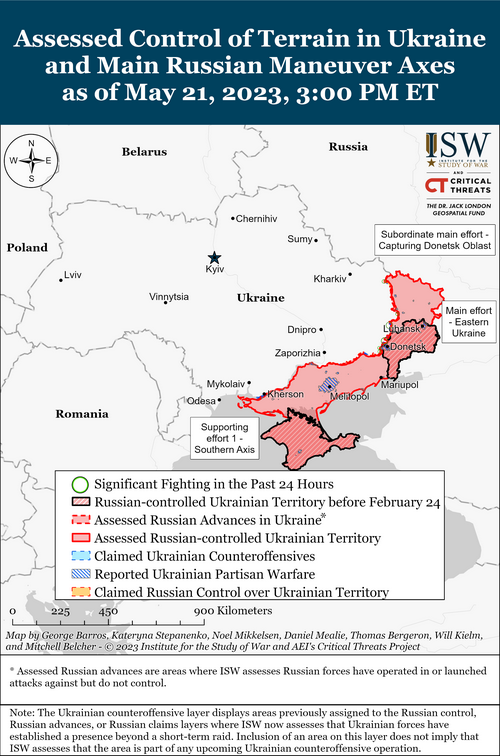
Wagner Group mercenaries likely secured the western administrative borders of Bakhmut City while Ukrainian forces are continuing to prioritize counterattacks on Bakhmut’s outskirts. Ukrainian military officials reported that Ukrainian forces control an “insignificant” part of southwestern Bakhmut City around the T0504 highway — a tacit acknowledgement that Russian forces have secured the rest of western and northwestern Bakhmut, if not all of it.[1] These officials’ statements indicate that Ukrainian forces withdrew from the remaining areas in Bakhmut except those adjacent to the two highways into the city. Geolocated footage published on May 21 showed Wagner forces raising Russian and Wagner flags over a residential building in westernmost Bakhmut.[2] The Wagner Group’s likely capture of the last remaining small area of western Bakhmut does not impact ongoing Ukrainian counterattacks north or south of Bakhmut, nor does it impact Ukrainian control over the ground lines of communications (GLOCs) around Bakhmut that exhausted Wagner forces would need to reach in order to conduct further offensive operations. Russian forces will likely need additional reinforcements to hold Bakhmut City and its flanks at the expense of operations in other directions. ISW has observed artillery units of the 132nd Separate Guards Motorized Rifle Brigade (which was previously observed in the Avdiivka area) operating in the Bakhmut direction.[3]
Ukrainian military sources reported that Russian forces lost part of the dominant heights around Bakhmut and noted that sustained Ukrainian advances could lead to a tactical encirclement of Wagner forces in Bakhmut.[4] The Ukrainian 3rd Separate Assault Brigade stated on May 20 that the brigade’s counterattacks have expanded the Ukrainian salient in the Bakhmut area to 1,750 meters wide by 700 meters deep in an unspecified area.[5] Geolocated footage showed the Ukrainian 3rd Separate Assault Brigade striking unspecified Russian forces south of Klishchiivka (7km southwest of Bakhmut), and engaging with the Russian 200th Separate Guards Motorized Rifle Brigade of the 14th Army Corps (Northern Fleet) northeast of Bohdanivka (5km northwest of Bakhmut).[6] Russian conventional forces such as the 72nd Separate Motorized Rifle Brigade are unsuccessfully attempting to regain lost positions and respond to Ukrainian counterattacks on Bakhmut’s flanks, actions that are consistent with ISW’s assessment that Ukrainian forces regained the tactical initiative around Bakhmut.[7] The Ukrainian General Staff reported that Russian conventional forces conducted unsuccessful offensive operations south of Ivanivske (6km west of Bakhmut), in the direction of Hryhorivka (about 6km northwest of Bakhmut), and in the direction of Bila Hora (12km southwest of Bakhmut), and Russian milbloggers also noted the failed Russian assaults on Bakhmut’s flanks.[8]
ISW previously forecasted that Wagner offensive operations would likely culminate after months of attritional urban combat, and it is unlikely that Wagner will continue fighting beyond Bakhmut at its current depleted state. ISW assessed that Wagner forces were nearing culmination when they decided to fight though Bakhmut City. Wagner forces were enabled to continue offensive operations past that culmination point as Russian regular forces took responsibility for Bakhmut’s flanks, allowing Wagner to concentrate on the urban fight. Wagner forces began showing signs that they would be unable to pursue offensive operations beyond Bakhmut City from at least late December 2022.[9] A Russian milblogger claimed on May 21 that Wagner forces have not directly attacked Khromove and Ivanivske — settlements immediately west and southwest of Bakhmut — since capturing Bakhmut.”[10] Commander of the Vostok Battalion Alexander Khodakovsky stated that, “driven in [their] head by the inertia of the offensive, [Russian forces] did not want to promptly recognize the depletion of [Russian] offensive potential and did not take care to set up necessary defenses” in captured areas.[11] Former Russian officer Igor Girkin stated that all Russian forces are now exhausted after decisively committing to win an unnecessary battle for Bakhmut and claimed that exhausted Wagner mercenaries stopped immediately at the outskirts of Bakhmut “as they crawled” to the city’s administrative border.[12] Russian regular forces situated on Bakhmut’s northern and southern flanks are also unlikely to push west towards Kostyantynivka or north towards Slovyansk amid Ukrainian counterattacks in the Bakhmut area any time soon. Russian conventional forces will be even more unlikely to pursue offensive operations if Wagner Group financier Yevgeny Prigozhin delivers on his stated intent to withdraw Wagner personnel from Bakhmut City on May 25.[13] It is currently unclear if Prigozhin will actually withdraw his forces from Bakhmut, but some milbloggers are speculating that Prigozhin will commit Wagner to a different “critical” frontline at the end of the month.[14] Russian forces faced a similar culmination following highly attritional infantry attacks in Severodonetsk and Lysychansk in June–July 2022.
Russian President Vladimir Putin congratulated the Wagner Group and the Russian military on May 21 for capturing Bakhmut.[15] Putin directly attributed the capture of the city to Wagner mercenaries, while noting that Russian regular forces provided “necessary support and flank protection” for the Battle of Bakhmut. The Russian Ministry of Defense (MoD) similarly announced that Russia captured Bakhmut because of Wagner assaults in the city and aviation and artillery support from the Russian Southern Grouping of Forces.[16] Putin and the MoD likely directly acknowledged Wagner’s responsibility for the capture of Bakhmut to avoid a repetition of the backlash that followed their immediate failure to do so when Wagner captured Soledar on January 12.[17] Putin’s acknowledgement of Wagner’s role in Bakhmut is the first time that he himself has directly credited Wagner with a battlefield victory. Putin likely took this step because Prigozhin has thoroughly established Wagner’s responsibility for operations in Bakhmut within the Russian information space. Putin and the MoD likely sought to mitigate Prigozhin’s ability to claim sole responsibility for the capture of Bakhmut by emphasizing that regular Russian forces aided in the effort.
Wagner Group financier Yevgeny Prigozhin predictably claimed the victory over Bakhmut City entirely for himself and his forces. Prigozhin stated on May 21 that “it is a total lie” that Russian Airborne Forces (VDV) helped Wagner capture the city and said that no one from the Russian MoD was in Bakhmut.[18] Prigozhin claimed that Wagner practically received no help from the Russian military except from former overall theater commander Army General Sergey Surovikin and Russian Deputy Minister of Defense for Logistics-turned-Wagner-Group-deputy-commander Colonel General Mikhail Mizinstev.[19] Prigozhin claimed that that the 305th Artillery Brigade (5th Combined Arms Army, Eastern Military District) helped Wagner after being subordinated to Wagner’s command. Prigozhin also acknowledged that the 57th Motorized Infantry Brigade (5th Combined Arms Army, Eastern Military District) played a ”satisfactory” role in controlling one of the flanks around Bakhmut.[20] Prigozhin argued that the Russian command will attempt to claim the victory over Bakhmut when Wagner transfers the city to regular Russian forces and stated that the situation will be similar to how the MoD took much of Wagner’s alleged credit for capturing Palmyra, Syria, in 2016.[21]
Prigozhin is likely attempting to solidify Wagner as solely responsible for Bakhmut’s capture before the Kremlin and the MoD can craft a response. Russian sources widely congratulated Wagner for the capture of Bakhmut and accepted Prigozhin’s May 20 claim — rather than Putin’s statement — as the official announcement of the city’s capture.[22] Russian sources also amplified footage of Wagner forces placing a Wagner Group flag — not a Russian flag — at the highest point in Bakhmut, likely an intentional snub of the MoD.[23] Prigozhin will likely use Wagner’s perceived responsibility for Bakhmut’s alleged capture to advocate for more supplies, responsibilities, and privileges for Wagner as he did following Wagner’s involvement in the capture of Popasna in May 2022.[24] Prigozhin will also likely use Wagner’s role in the alleged capture of Bakhmut to intensify his efforts to establish himself as the central figure of the Russian ultranationalist community.
Russian reactions to the claimed capture of Bakhmut illustrate an increasingly growing divide between the Kremlin’s domestic presentation of the war and the ultranationalist milblogger community’s coverage of Russian operations in Ukraine. Russian state television portrayed the alleged capture of Bakhmut as a seminal historic event and claimed that the city’s capture would facilitate Russian operations to capture Slovyansk (41km northwest of Bakhmut) and Kramatorsk (35km northwest of Bakhmut) and even Dnipro City (roughly 215km west of Bakhmut).[25] The Kremlin likely attempted to oversell the significance of the capture of Bakhmut as a historical victory due to the continued lack of tactical success in Ukraine, with one Russian state media outlet outrageously commenting that Wagner personnel in Bakhmut must feel like “their grandfathers in Berlin.”[26]
Russian ultranationalist milbloggers celebrated the alleged capture of Bakhmut but emphasized that “Bakhmut is not Berlin” and that the capture of the city would be simply another step in ongoing difficult operations to achieve Russian objectives in Ukraine.[27] Russian milbloggers responded to the alleged capture of Bakhmut by discussing more immediate possible Russian operations to capture Khromove (immediately west of Bakhmut), Ivanivske (6km west of Bakhmut), and Chasiv Yar (12km west of Bakhmut).[28] Other prominent Russian milbloggers responded to the capture of Bakhmut by focusing on possible imminent Ukrainian counteroffensive operations instead of possible future Russian offensive operations.[29] Russian milbloggers shifted to more conservative expectations of Russian operations as the attritional offensive to capture Bakhmut continued from winter into spring of 2023, and they have largely abandoned their previous high expectations that the capture of Bakhmut would lead to a collapse of Ukrainian lines in the area and Russian advances up to Slovyansk and Kramatorsk.[30] Russian milbloggers’ more realistic views about both Russian capabilities in Ukraine and the relevance of the Bakhmut offensive highlight the divergence between two very different segments of the pro-war Russian information space: the more optimistic presentation of the war offered by the Kremlin and the more informed presentation of the war offered by milbloggers. These growing differences will likely continue to undermine the Kremlin’s ability to shape the Russian information space.
US President Joe Biden stated on May 21 that the US will train Ukrainian pilots on fourth-generation aircraft, including F-16s, to augment Ukraine’s defense capabilities in the long term. Biden stated that Ukrainian President Volodymyr Zelensky gave him a “flat assurance” that Ukrainian forces will not use Western-provided F-16s to strike Russian territory.[31] Biden reiterated that Ukraine will not use F-16s in its anticipated counteroffensive and framed the provision of F-16s as part of a longer-term effort to augment Ukraine’s defensive capabilities as Ukraine’s operational needs evolve.[32] Biden expanded on this argument, stating that the US did not pledge to send Ukraine tanks earlier because Ukraine did not need tanks earlier.[33] ISW has assessed that the need to send Ukraine Western tanks, including M1s, became apparent in June 2022.[34]
ISW previously assessed in January 2023 that delays in the provision to Ukraine of Western long-range fires systems, advanced air defense systems, and tanks have limited Ukraine’s ability to take advantage of opportunities for larger counter-offensive operations presented by flaws and failures in Russian military operations.[35] The inevitable delay between the pledge to send such systems and the Ukrainians’ ability to use them calls for the provision of such systems at the earliest indications that they will be required, not when the situation becomes dire.[36] Had Western leaders started setting conditions for Ukraine to use Western tanks in June 2022, when the first clear indicators appeared that Western tanks would be needed, Ukrainian forces would have been able to start using them in November or December. The continual delays in providing Western materiel when it became apparent that it is or will soon be needed have thus contributed to the protraction of the conflict.[37]
Former Russian officer Igor Girkin’s “Club of Angry Patriots” social movement opened a St. Petersburg chapter with an inaugural event on May 21. The event’s speakers discussed their dissatisfaction with the way elements of Russia’s “military-political elite” are not trying to decisively defeat Ukraine and instead are focusing efforts on maintaining current Russian gains in Ukraine and holding negotiations with the West.[38] They also discussed how the Club of Angry Patriots is creating an “alternative center of power” that should help achieve the final destruction of the Ukrainian state and the further mobilization of the Russian nation to that end.[39] Speakers also discussed how the Russian elite that formed against the backdrop of the 1990s period of privatization and “the post-Soviet catastrophe” has “rotted.”[40]
The opening of the club in St. Petersburg is likely a continuation of Igor Girkin’s political feud with Prigozhin and the Wagner Group. The Wagner Group opened its first official national headquarters in St. Petersburg in November 2022.[41] The Angry Patriots Club accused Wagner Group financier Yevgeny Prigozhin of supporting efforts to freeze the war in Ukraine in April 2023.[42] Girkin launched the “Club of Angry Patriots” social movement as a new effort in April 2023 likely aimed at protecting the influence of the Russian pro-war faction within the Kremlin.[43]
Key Takeaways
- Wagner Group mercenaries likely secured the western administrative borders of Bakhmut City while Ukrainian forces are continuing to prioritize counterattacks on Bakhmut’s outskirts.
- ISW previously forecasted that Wagner offensive operations would likely culminate after months of attritional urban combat, and it is unlikely that Wagner will continue fighting beyond Bakhmut at its current depleted state.
- Russian President Vladimir Putin congratulated the Wagner Group and the Russian military on May 21 for capturing Bakhmut.
- Wagner Group financier Yevgeny Prigozhin predictably claimed the victory over Bakhmut City entirely for himself and his forces
- Russian reactions to the claimed capture of Bakhmut illustrate an increasingly growing divide between the Kremlin’s domestic presentation of the war and the ultranationalist milblogger community’s coverage of Russian operations in Ukraine.
- US President Joe Biden stated on May 21 that the US will train Ukrainian pilots on fourth-generation aircraft, including F-16s, to augment Ukraine’s defense capabilities in the long term.
- Former Russian officer Igor Girkin’s “Club of Angry Patriots” social movement opened a St. Petersburg chapter with an inaugural event on May 21.
- Russian forces continued limited offensive operations northeast of Kupyansk and south of Kreminna.
- Russian forces continued offensive operations on the Donetsk City-Avdiivka frontline but have not made any verifiable territorial gains.
- Ukrainian forces reportedly conducted a deep strike against a Russian headquarters at an airfield in Berdyansk, Zaporizhia Oblast, with a Storm Shadow missile.
- Chechen Republic Head Ramzan Kadyrov claimed that seven regiments and four battalions from Chechnya are operating in Ukraine as of May 20.
- Russian occupation authorities are reportedly intensifying filtration measures in occupied Ukraine to find Ukrainian partisans.
Go here to read the rest. The upcoming week should be interesting. Stay turned.

