
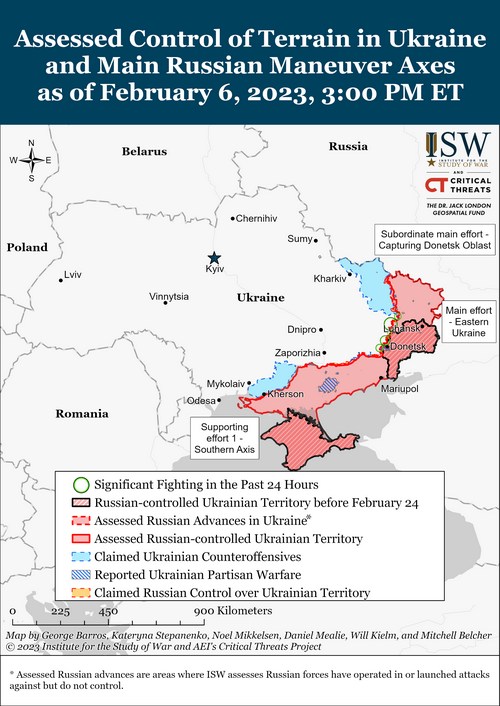
From The Institute For The Study of War:
Kateryna Stepanenko, Karolina Hird, Grace Mappes, George Barros, Layne Philipson, Nicole Wolkov, and Frederick W. Kagan
February 6, 9:00 pm ET
Click here to see ISW’s interactive map of the Russian invasion of Ukraine. This map is updated daily alongside the static maps present in this report.
Ukrainian officials assess that Russian forces are preparing to launch a large-scale decisive offensive in eastern Ukraine in mid-to-late February. Ukrainian Defense Minister Oleksiy Reznikov stated on February 5 that the Ukrainian military is expecting Russia to start its decisive offensive around February 24 to symbolically tie the attack to the first anniversary of the Russian full-scale invasion of Ukraine.[1] Reznikov also clarified that the Ukrainian military has not observed the formation of Russian offensive groups in the Kharkiv and Chernihiv directions or Belarus; Ukrainian Southern Operational Command Spokesperson Nataliya Humenyuk noted that Russian forces are likely concentrating on launching offensive operations in the east rather than in southern Ukraine.[2] An unnamed advisor to the Ukrainian military told Financial Times that Russia intends to launch an offensive in the next 10 days (by February 15), a timeline that would allow Russian forces to strike Ukrainian positions before the arrival of Western tanks and infantry fighting vehicles.[3] Luhansk Oblast Administration Head Serhiy Haidai stated that Russian forces are continuing to deploy reserves to Luhansk Oblast to strike after February 15.[4]
Select Russian nationalist voices continued to express skepticism towards Russia’s ability to launch a successful offensive past late February. A Wagner-affiliated milblogger noted that Chief of the Russian General Staff Army General Valery Gerasimov (who currently commands Russian forces in Ukraine) has a limited time window to launch a large-scale offensive operation in Ukraine before it is entirely impossible to execute.[5] Another ultra-nationalist voice, former Russian officer Igor Girkin, forecasted that the Russian decisive offensive will not be successful until Russia mobilizes more manpower, industry, and economy.[6] Girkin claimed that an attack without such mobilization would shortly culminate. Both observations highlight that the Russian military command appears to be in a rush to launch the decisive offensive, likely ahead of the arrival of Western military aid and the muddy spring season in Ukraine around April that hindered Russian mechanized maneuvers in spring 2022.
German Chancellor Olaf Scholz undermined Russian President Vladimir Putin’s false narrative that the provision of German tanks to Ukraine threatens Russian security. Putin stated on February 2 that German tanks are again threatening Russia, drawing a false parallel with World War II.[7] Scholz stated that Putin’s remarks are “a part of a series of abstruse historical comparisons that he uses to justify his attack on Ukraine.”[8] Scholz added that the West and Ukraine have a “consensus” that Ukrainian forces will only use Western-provided weapons to liberate its territories from Russian occupation. Germany’s provision of Leopard tanks does not differ from Western military provisions of Soviet tanks and kit to Ukraine throughout the war, and Putin’s February 2 reaction is likely a continuation of Russian information operation to discourage Western military aid to Ukraine ahead of Russia’s decisive offensive. Kremlin information agents are amplifying similar rhetoric that Ukrainian forces will use Ground Launched Small Diameter Bombs (GLSDM) – which increase the range of HIMARS to 151km from roughly 80km – to target Russian territory alongside occupied Ukrainian territories.[9] Ukrainian Defense Minister Oleksiy Reznikov confirmed on February 5 that Ukraine agreed to not use Western long-range weapons to strike Russian territories, however.[10]
Kremlin-appointed Russian and occupation officials continue to implement social benefit schemes that target children and teenagers in occupied areas of Ukraine to consolidate social control and integration of these territories into Russia. Russian Commissioner on Children’s Rights, Maria Lvova-Belova (appointed by Russian President Vladimir Putin) met with a slate of Russian occupation officials on February 6 to discuss various issues relating to children and youth in occupied regions of Ukraine. In a meeting with occupation head of Crimea Sergey Aksyonov, Lvova-Belova noted that the Crimean occupation government has been instrumental in “accepting” children from Donetsk, Luhansk, Zaporizhia, and Kherson oblasts.[11] Lvova-Belova also reported that the “Day After Tomorrow” organization will begin conducting “rehabilitation” tours in Crimea to work with children who need special psychological assistance.[12] ISW has previously reported on numerous instances of Russian occupation officials using the guise of psychiatric and medical rehabilitation to remove Ukrainian children further into Russian-controlled territory within Ukraine or deport them to Russia.[13] Sevastopol occupation head Mikhail Razvozhaev similarly announced that he met with Lvova Belova on February 6 to discuss “new formats of social work” on behalf of Putin and remarked that most of the children who require social support are not orphans.[14] Luhansk People’s Republic (LNR) Head Leonid Pasechnik stated that Lvova-Belova proposed that children whose personal data is in the regional data bank will be “able to find a family in other regions of the Russian Federation.”[15] Pasechnik also reported that LNR authorities are working with Novosibirsk Oblast and Khanty-Mansi Okrug to secure “methodological assistance” in resolving issues regarding children in occupied Luhansk Oblast.[16] Lvova-Belova additionally met with Donetsk People’s Republic (DNR) Head Denis Pushilin to develop programs “for the socialization of adolescents” and with Zaporizhia occupation head Yevgeny Balitsky to discuss social institutions for children in occupied Zaporizhia Oblast.[17]
Lvova-Belova is likely working directly on Putin’s orders to institute several social institutions and programs in occupied areas of Ukraine to collect personal data on children, carry out various social programming functions aimed at integrating occupied areas using pseudo-humanitarian organizations, and set conditions to legitimize and institutionalize the deportation and adoption of Ukrainian children into Russian families. Putin signed a list of instructions on January 3 that directed Lvova-Belova and directed the occupation heads of Kherson, Zaporizhia, Donetsk, and Luhansk oblasts to “take additional measures to identify minors…left without parental care” in occupied areas to provide them with “state social assistance” and “social support.”[18] Lvova-Belova’s February 6 meetings with occupation heads are likely the manifestation of Putin’s list of instructions and represent an escalation in efforts by Kremlin-appointed officials to consolidate social integration of occupied territories by targeting children.[19] The implementation of “rehabilitation centers” and the tabulation of children’s personal data through these social programs will likely enable Russian occupation officials to facilitate the forced deportation and adoption of Ukrainian children to Russian families. Occupation officials continue to execute social control measures in occupied areas according to directives provided by Putin’s list of instructions. ISW continues to observe that efforts to deport and forcibly adopt Ukrainian children may constitute a violation of the Convention on the Prevention and Punishment of the Crime of Genocide.[20]
Russian President Vladimir Putin continues to open the door for further institutionalized corruption in Russia through legislative manipulations. Putin signed a decree on February 6 allowing Russian deputies and senators to not publish their incomes in the public domain.[21] The law will allow deputies and senators to publish their incomes in an anonymized form that does not contain their personal data. The law will also apply to regional and municipal deputies.[22] Kremlin spokesperson Dmitry Peskov claimed that the new law will not affect anti-corruption measures and stated that “the conditions of the [special military operation] bring their own specifics.”[23] Putin previously approved a decree on December 29, 2022, that exempted all Russian officials, including members of the military and law enforcement, from making public income declarations.[24] These two decrees are likely efforts by the Kremlin to appease the political actors who comprise Putin’s domestic support base and will likely continue to contribute to the institutionalization of corruption in Russia.
The Kremlin continues to deny Wagner Group financier Yevgeny Prigozhin legitimacy and authority in Russia. A Moscow court refused to recognize Prigozhin as the owner and founder of Wagner private military company (PMC) after revisiting Prigozhin’s lawsuit against Russian journalist Alexei Venediktov on February 6.[25] Prigozhin sued Venediktov in June 2021 for accusing him of being the “owner of Wagner,” and the Moscow court concluded that information about Prigozhin’s ownership of Wagner was “unreliable.”[26] Prigozhin attempted to reverse the court’s decision on January 19, claiming that Venediktov did not lie about Prigozhin’s ownership of Wagner—likely in an ongoing effort to overcompensate for his declining influence following the replacement of war-torn Wagner forces around Bakhmut with Russian conventional units.[27] ISW previously assessed that the Russian military’s decreasing reliance on Wagner forces around Bakhmut is likely reducing Prigozhin’s influence within the Kremlin inner circle.[28]
Prigozhin’s appeal in the Russian nationalist information space may also be declining as he continues to overcompensate for the culmination of Wagner’s attack around Bakhmut. A prominent Kremlin-affiliated milblogger commented on a video showing Prigozhin piloting an Su-24M bomber aircraft supposedly over Bakhmut on February 6.[29] The milblogger stated that Prigozhin became the main player in Russian information space rather than the traditional Russian military command which “lacked creativity.”[30] Prigozhin also “declared” the US, UK, and Canadian governments to be illegitimate states that sponsor terrorism according to the “Wagner Charter.”[31] The milblogger stated that Prigozhin’s manipulation of the information space – specifically his skill in trolling – had allowed him to gain more political influence than a Russian Defense Minister.[32] ISW assessed on October 25 that Prigozhin weaponized the Russian information space and Russian President Vladimir Putin’s reliance on his forces to gain political leverage in Russia.[33] The milblogger’s acknowledgment of Prigozhin’s flashy tactics may indicate that the non-Wagner-affiliated nationalist information space may be awakening to Prigozhin’s efforts to use the war in Ukraine for personal benefit. Wagner-affiliated milbloggers, in turn, continued to celebrate Prigozhin and previous theater commander Army General Sergey Surovikin as the only two leaders who have “confirmed their high qualifications and enjoy the trust of the political leadership of the country and the people.”[34]
Failures of Western sanctions efforts against the provision of arms components to Iran have likely contributed to Russia’s ability to bypass Western sanctions to acquire components for combat drones through military cooperation with Iran. US officials stated on February 5 that Russia and Iran are moving ahead with plans to build an Iranian drone factory on Russian soil, the second such international Iranian drone factory.[35] Iran opened a drone production factory in Tajikistan – a Collective Security Treaty Organization (CSTO) member state and Eurasian Economic Union (EAEU) candidate – in May 2022.[36] Russia may leverage its significant economic ties to Tajikistan through the CSTO and EAEU to launder drone components or procure manufactured drones for use in Ukraine to bypass international sanctions.[37]
UK investigative group Conflict Armament Research (CAR) reported in November 2022 that 82% of Iranian Shahed-131, Shahed 136, and Mohajer-6 drones downed in Ukraine had chips, semiconductors, and other components that came from the US despite high import and export control restrictions on such components to Iran.[38] CAR also noted that the downed drones contained higher-end technological capabilities and have a “significant jump in capabilities” compared to other systems previously observed in the Middle East.[39] Most Western-manufactured components in the downed Iranian drones were produced between 2020 and 2021, following the expiration of United Nations Security Council heavy arms sanctions against Iran in 2020.[40] Most Western companies whose components were found in downed Iranian drones in Ukraine denied directly selling components to Russia, Iran, or Belarus since the start of the war.[41] However, the representative of a Swiss manufacturing company noted that it is impossible to be completely sure that distributors of arms components do not sell components to sanctioned entities, implying that Russia, Iran, or other sanctioned states can exploit loopholes allowing them to acquire Western-produced arms components via proxy actors.[42]
Key Takeaways
- Ukrainian officials assess that Russian forces are preparing to launch a large-scale decisive offensive in eastern Ukraine in mid-to-late February.
- Select Russian nationalist voices continued to express skepticism toward Russia’s ability to launch a successful offensive past late February.
- German Chancellor Olaf Scholz undermined Russian President Vladimir Putin’s false narrative that the provision of German tanks to Ukraine threatens Russian security.
- Kremlin-appointed Russian and occupation officials continue to implement social benefit schemes that target children and teenagers in occupied areas of Ukraine to consolidate social control and integration of these territories into Russia.
- Russian President Vladimir Putin continues to open the door for further institutionalized corruption in Russia through legislative manipulations.
- The Kremlin continues to deny Wagner Group financier Yevgeny Prigozhin legitimacy and authority in Russia.
- Prigozhin’s appeal in the Russian nationalist information space may also be declining as he continues to overcompensate for the culmination of Wagner’s attack around Bakhmut.
- Failures of Western sanctions efforts against the provision of arms components to Iran have likely contributed to Russia’s ability to bypass Western sanctions to acquire combat drones through military cooperation with Iran.
- Russian forces likely made tactical gains northeast of Kupyansk between February 4 and February 6, and Russian sources claimed that Russian forces advanced west of previous positions on the Svatove-Kreminna line on February 5 and February 6.
- Ukrainian forces maintain positions in Bilohorivka in Luhansk Oblast as of February 6 despite Russian claims that Russian forces captured Bilohorivka on February 3.
- Russian forces continued ground attacks northeast and south of Bakhmut but still have not encircled the settlement as of February 6.
- Russian forces conducted limited ground attacks in the Avdiivka-Donetsk City area.
- Ukrainian forces continued limited attempts to cross the Dnipro River.
- Russian conventional and irregular forces may be increasingly struggling to recruit from Russian penal colonies due to high casualties among prior penal colony recruits.
- Russian forces continue to struggle with ethnic tensions and tensions between irregular forces.
- Russian officials and occupation authorities may be intensifying operational security to conceal new Russian force deployments in Donbas.
Go here to read the rest.
From Strategy Page:
February 6, 2023: On January 18th Vladimir Putin went to St Petersburg and gave several speeches for various groups, including Russian and foreign media. The speeches were all about admitting that Ukraine was a war, not a “special military operation” to liberate Ukraine from NATO control. Putin now says his war in Ukraine is a war and one that must be one to rescue Russia from Western efforts to destroy Russia as a country. While many Eastern Europeans considered that a fine idea, it was also seen as impractical and never seriously considered by any European government. To deal with that reality, Putin describes the Western effort as unpublished in the West and part of a very real conspiracy that Vladimir Putin recognized and is now exposing.
While Putin’s state-controlled mass media helped maintain the support of most Russians for the war, that approval did not apply to being in the army and sent to Ukraine. Putin has not yet declared a full mobilization of Russian military age men for this war because the opinion surveys continue to show opposition to serving in the army. The economy is already mobilized for war as much as Putin’s fragile and corrupt regime can accomplish, but is crippled by the heavy Western sanctions imposed after the invasion, especially in anything requiring advanced electronics. That covers most everything from radios to tank and artillery fire control systems. Putin calling his war in Ukraine what it really is but that has not changed anything.
By not initially calling Ukraine a war, Putin avoided embarrassing questions about Russian troops attacking Ukraine and then getting beaten by the Ukrainians in several critical battles. That wasn’t the reason at the time but was an unexpected benefit. Since it was not a war, Putin could not declare a general mobilization of the nation’s resources, including manpower. In the last eleven months it has been forced to mobilize as much of Russia’s resources as Putin can manage just to hang onto Ukrainian territory Russia still occupies.
One resource Putin had trouble mobilizing was new troops. He declared several partial mobilizations that were unsuccessful because so many Russian men did not want to fight in Ukraine. Putin tried to cope with that reluctance but was unsuccessful. A month ago, he increased the legal maximum number of its active-duty military personnel from 1,013,628 to 1,150,628 personnel. The million-man force was never achieved and Putin soon discovered that this increase was an empty gesture. For example, just before the invasion began the Russian military had 700,000 personnel on duty. The ground forces had about 400,000 men while the navy and air force each had about 150,000. About a third of air force personnel were paratroopers or air mobile infantry. The navy had about 12,000 marines, who guarded naval bases in peacetime. That means that heavy Russian losses since the invasion began, and failure to mobilize many replacements, reduced the army to about 250,000 personnel. Ukraine’s ground forces now outnumber the Russian army by about three to one, and Russia’s total ground forces by about two to one. Not just in Ukraine, but in all of Russia and Ukraine.
Russia’s airborne forces and marines also suffered heavy losses but more of them are still in service. Heavy combat losses reduced personnel strength so sharply because the Russian army has far fewer soldiers providing logistic and transportation services. These are provided by government or private contractors who assemble and move supplies close to the combat zone, where military trucks and drivers move the supplies to army-maintained collection points or the combat units. This works inside Russia where the state-controlled railroads are equipped for operation by civilians who are trained for such support. For a major war against Russia, civilian trucks and drivers are mobilized for military transportation. Such a mobilization would disrupt the entire economy but is seen as necessary t0 defend Russia. During World War II Russia received lots trucks, combat vehicles, ammunition food and other much needed items. This is why the Ukrainian invasion was not called a war but an “internal operation” in what Russia declared was Russian territory controlled by rebels who were receiving the military aid in quantities to what Russia received in World War II. This time the Russians are playing the invaders and not going as well as the Nazis.
Russia did not expect the Ukrainians’ massive resistance or their destruction of so many Russian trucks and supply collection points. This dramatically weakened Russian supply capabilities inside Ukraine, especially after Ukraine received guided GMLRS rockets that hit Russian supply depots using information supplied by Ukrainian and NATO aerial and satellite surveillance. Russian forces inside Ukraine are chronically short of ammunition, food, fuel and much else because of these Ukrainian tactics. Resorting to looting civilian supplies in occupied areas only partially replaces the supplies destroyed in transit or stored inside Ukraine.
Mobilizations of new conscripts and men who had served the one year of conscript service failed to replace all the losses, in part because the mobilized men knew that the war in Ukraine was not going well and most men sent there had little training, equipment or leadership. Most of the trained and experienced junior officers were killed or disabled during the first months of the war and replacements take months to train to minimal standards. Peacetime officer training takes years and now there is a shortage of trainers for troops and officers because most of the existing ones were sent to Ukraine as replacements for the catastrophic losses the Ukrainians were inflicting.
Ukraine had 250,000 active-duty troops in early 2022 and within months had half a million more in the form of volunteers and conscripts. Normally Ukrainian troops receive a lot more training than their Russian counterparts but in the first months of the war, untrained Ukrainians were used to halt the invasion. Since then, Ukrainian troops get more training and are led by experienced officers and NCOs in combat. Ukrainian troops don’t suffer from supply shortages and suffer relatively fewer casualties than the Russians.
Shortly after Putin’s “we are at war” speech the American military finally accepted Ukrainian estimates of Russian losses. While the Ukrainians believe Russia has lost 180,000 troops in Ukraine, the Americans will only acknowledge 100,000 as well enough documented to accept. The Ukrainians also point that their “troops lost” total does not mean only dead, but those no longer serving in the Russian military because they were captured or deserted. Ukraine considers the deserters a real plus for Ukrainian success because the deserters will often return home or get in touch and provide a more accurate account of what is really happening in Ukraine. The deserter version is far more glum than the official government reports. The high actual losses have led to an increase of active opposition to the war. This is especially true with young men likely to be conscripted soon.
Putin reinterpreting his war in Ukraine as something similar to the German invasion of 1941 is difficult to use as a legitimate reason for more Russians to join the military. This is not 1941 Soviet (communist) Russia. Soviet rule and the Soviet Union itself disappeared in 1991. Russian attitudes towards the military and the government changed, and so did the public’s means of obtaining information about the war. Before Putin gained power in 1999, the government had been compelled by popular opinion to reduce the conscription service to only one year and work towards eliminating conscription entirely, as most of Europe did after 1991. Eliminating conscription was another effort to carry out some fundamental reforms in the Russian army.
The most popular reform effort was directed towards eliminating often fatal interactions between and against new recruits. This hazing developed after World War II, when Russia deliberately avoided developing a professional NCO Corps. They preferred to have officers take care of nearly all troop supervision. The NCOs that did exist were treated as slightly more reliable enlisted men, but given little real authority. Since officers did not live with the men, slack discipline in the barracks gave rise to vicious hazing and exploitation of junior conscripts by senior ones. This led to very low morale and a lot of suicides, theft, sabotage and desertions that made military life something to be feared, especially by conscripts.
Go here to read the rest. Normally an attacker needs a three to one superiority in manpower to prevail, at least if the technology on both sides is similar. In Ukraine the Russians face a foe with larger forces, and a growing tech superiority. That spells ultimate defeat for the Russians.


And still the pro-Russian voices (and/or bots) online continue to insist that Ukrainian losses in manpower and equipment have been extreme and crippling, such that the mighty Russian army is winning the war of attrition despite NATO, and total defeat of Ukraine will occur by the end of this year.
You have to wonder what they think they know, that we don’t. Or maybe this is normal and we’re only aware of the stark contrast because of modern communications technology.
Difficult to see how Russia can expect to integrate with the civilized world when all of this ends regardless of the result. They have had two revolutions so far, the first, 1917, a disaster and the second, 1991, that couldn’t hold. Not to forget that China has never stopped eying the Russian Far East.
RUSSIA’S PRIVATE ARMY. this may explain the war crimes in the Ukraine.Headline: “Fugitives were cut locally and 40,000 soldiers of former thugs disappeared… Civil strife erupts over Russian “atrocities committed by private military companies”.
On January 23, the independent media outlet Medusa reported that the damage to Russia’s private military company “Wagner” in Ukraine is growing. Of the total 50,000 soldiers, only 10,000 are fighting on the front lines, and the remaining 40,000 have either died, surrendered to the Ukrainian military, or fled.
The “Wagner” group calls itself a non-elite group and was founded by Prigozhin, a close friend of President Putin’s. “The nature of the group is brutal and cruel. The nature of the group is brutal and cruel. Mr. Prigogine personally goes to prisons and recruits thugs who have committed murder and rape as soldiers. They join “Wagner” under a contract of about six months. When some of the thugs returned from the front lines this past January, Wagner released a video of them shaking hands with a senior officer.
The executive congratulates the thugs, saying, “You guys have been on adrenaline for six months. You guys have been on adrenaline for six months, so you won’t have an incident for a month. Don’t drink too much. Don’t use drugs. No more rapes. On the other hand, he is also brutally punishing fugitives by amputating their private parts to make an example of them.