
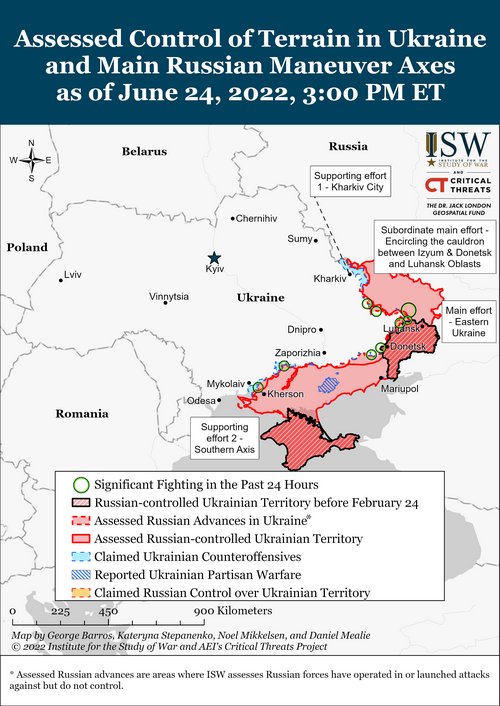
From The Institute For The Study of War:
Kateryna Stepanenko, Mason Clark, George Barros, and Grace Mappes
June 24, 7:15 pm ET
Click here to see ISW’s interactive map of the Russian invasion of Ukraine. This map is updated daily alongside the static maps present in this report.
Ukrainian officials ordered a controlled withdrawal of troops from Severodonetsk on June 24. Luhansk Oblast Administration Head Serhiy Haidai announced that Ukrainian forces are withdrawing from “broken positions” in Severodonetsk to prevent further personnel losses and maintain a stronger defense elsewhere.[1] Severodonetsk Regional Military Administration Head Roman Vlasenko stated that several Ukrainian units remain in Severodonetsk as of June 24, but Ukrainian forces will complete the full withdrawal in “a few days.”[2] An unnamed Pentagon official noted that Ukrainian withdrawal from Severodonetsk will allow Ukrainian troops to secure better defensive positions and further wear down Russian manpower and equipment.[3] The Pentagon official noted that Russian forces pushing on Severodonetsk already show signs of “wear and tear” and “debilitating morale,” which will only further slow Russian offensive operations in Donbas. Russian forces have been attempting to seize Severodonetsk since at least March 13, exhausting their forces and equipment over three months.[4]
Ukrainian forces will likely maintain their defenses around Lysychansk and continue to exhaust Russian troops after the fall of Severodonetsk. Ukrainian forces will occupy higher ground in Lysychansk, which may allow them to repel Russian attacks for some time if the Russians are unable to encircle or isolate them. Russian forces in Severodonetsk will also need to complete river crossings from the east, which will require additional time and effort. Luhansk People’s Republic (LNR) Head Leonid Pasechnik claimed that Russian forces will completely encircle Lysychansk in the next two or three days after fully interdicting Ukrainian ground lines of communications (GLOCs).[5] Russian forces have successfully secured access to Ukrainian GLOCs along the Hirske-Lysychansk highway by breaking through Hirske on June 24, but Russian forces will need to cut Ukrainian logistics routes from Bakhmut and Siversk to fully isolate Lysychansk. Russian forces are likely to face challenges completing a larger encirclement around Lysychansk due to a failed river crossing in Bilohorivka, northwest of Lysychansk, in early May. Ukrainian forces will likely conduct a deliberate withdrawal from Lysychansk if Russian forces threaten Ukrainian strongholds in the area.
Ukrainian intelligence warned that Russian forces will carry out false-flag attacks in Belarus to draw Belarusian forces into the Russian invasion of Ukraine. The Ukrainian Military Intelligence Directorate (GUR) reported that Russian sabotage groups and mercenaries arrived in Mozyr, Belarus, to detonate apartment buildings and civilian infrastructure around the city.[6] The GUR noted that Russian saboteurs will follow a pattern similar to apartment bombings in Chechnya in the early 2000s. Ukrainian officials have previously reported on possible false-flag attacks in Belarus throughout the past four months.
Unidentified assailants resumed attacks against Russian military recruitment centers on June 24, indicating intensifying discontent with covert mobilization. Russian outlet Baza reported two incidents where unknown attackers threw Molotov Cocktails at military recruitment offices in Belgorod City and Perm on June 24.[7] Baza also reported that Belgorod Oblast Police started a search for four contract servicemen—one sergeant and three ordinary soldiers–who have deserted their military unit stationed in Belgorod Oblast.[8]
Key Takeaways
- Russian forces continued to drive north to Lysychansk and have likely encircled Ukrainian troops in Hirske-Zolote.
- Ukrainian officials announced that Ukrainian forces are fighting their last battles in the industrial zone of Severodonetsk before withdrawing from the city.
- Russian forces conducted unsuccessful offensive operations west of Izyum and north of Slovyansk. Russian forces will likely prioritize encircling Ukrainian troops in Lysychansk and interdicting remaining GLOCs northwest of the city before resuming a full-scale offensive operation on Slovyansk.
- Ukrainian forces are continuing to launch counteroffensive operations along the Kherson-Dnipropetrovsk Oblast border and are threatening Russian forces in Kherson City.
- Ukrainian partisans continued to attack Russian collaborators in Kherson City.
Go here to read the rest.
From Strategy Page:
June 24, 2022: Russia’s invasion of Ukraine in February has failed so far, with enormous losses to Russia in terms of combat personnel, military equipment and the reputations for quality/reliability/effectiveness of Russian weapons and forces. Even the Ukrainians were surprised at how unprepared the invaders were for combat and dealing with Ukrainian superiority in weapons (often Western), leadership (all Ukrainian) and tactics. Russia’s leadership, especially supreme leader Vladimir Putin, was delusional about the continuing lack of military progress in Ukraine. Even Russians who thought restoring independent (since 1991) Ukraine to Russian control was a good thing and worth fighting for, began losing confidence in Putin’s ability to make that happen. Each time failure in Ukraine became obvious, Putin would come up with a new reason why Russia was winning, and each of these was soon shown to be false. Their currently alleged key to Russian victory is the disagreements among NATO members about whether Ukraine can win a military victory. NATO is in agreement about the Russia’s inability to win in Ukraine but many politicians in some of the larger, and more distant from the fighting NATO nations (United States, Germany, France and Italy) are openly doubting the Ukrainian ability to regain control of lost territory. Putin supports this attitude by continuing to threaten use of nuclear weapons if Russia is faced with losing all its seized territory in Ukraine.
One thing nearly all Russians agree on is that using nukes to avoid defeat in Ukraine is not going to happen. A majority of Russians now openly oppose the war even though Putin quickly created a law to make such public dissent illegal. That law’s failure soon became obvious in many ways. First, there are a growing number of anti-war demonstrations and physical attacks on military facilities, especially recruiting stations. Refusing to report when conscripted became more common. Another form of defiance is veterans of the Ukraine fighting providing details, based on personal experience, of why Russian forces are failing.
Many of these veterans are no longer in the military because they refused to renew their contracts. Many more soldiers remained in the army but refused to return to Ukraine and got away with it. Putin ordered that these soldiers be officially described, in their military records and military ID, as unreliable and unwilling to fight. In any other country a soldier who refuses to fight during wartime is subject to severe punishment, often execution. That still happens to reluctant Russian soldiers inside Ukraine where officers have the authority to shoot reluctant troops. Initially, as Russian casualties grew and progress was nonexistent, some officers did shoot troops refusing to fight. That soon changed as the troops threatened to, and sometimes did, shoot back (or, and ran over one officer with a tank). Ukrainian forces have provided additional confirmation of this violence and collapsing morale within Russian units. Many Russian troops will surrender to the Ukrainians at the first opportunity and admit it to Ukrainian, Russian and foreign journalists.
The number of Russian military personnel is declining because of the combat losses and veterans refusing to stay in, even though being a contract (volunteer) soldier is one of the few jobs Russians can get because of Western sanctions. The Russian economy is shrinking and unemployment, along with poverty, is increasing.
The Russian government responded by lowering their recruiting standards and accepting recruits or conscripts with physical, mental, legal or psychological problems that would normally make them ineligible for military service. Russia has also dropped age limits for volunteers and is willing to accept non-Russians as long as they can speak some Russian and are willing to fight. These efforts are not producing enough new troops to be immediately useful because most of them have no military training and at least two months are required to produce useful troops for combat. Conscripts, who cannot be sent into combat, require less training and are used for support operations outside Ukraine during their one year in uniform.
Reports from Ukrainian forces and recently captured Russian troops indicate that most BTG (Battalion Task Groups) are sent into action understrength by up to 50 percent. A larger percentage of the BTGs armored vehicles are in action but most of these are IFVs (Infantry Fighting Vehicles) with just the vehicle crew of three men to drive and operate the heavy weapons. Only some carry a few infantrymen as well.
This approach was supposed to provide a force that could advance after the Ukrainians had been weakened or wiped out by a heavy barrage of shells and unguided rockets. This has not worked because the Ukrainian dig in and enough survive to stop the understrength BTGs that withdraw if they encounter opposition. The Ukrainians also have shortages, but not of personnel willing to fight. The Ukrainians have at least 50 percent more troops than the Russians in Ukraine. The Ukrainians are more innovative and have lower casualty rates than the Russians. The innovation has given the Ukrainians better communications (Starlink, which works in moving vehicles) and the ability to prevent the (on paper) superior Russian air force from controlling the air space. This provides the Ukrainians with the ability to provide aerial surveillance as needed using UAVs and light aircraft. This makes it possible to use another innovation; ATVs (All Terrain Vehicles) and light trucks carrying anti-tank or other heavy weapons, troops or supplies held in reserve and able to quickly move to where needed to block a Russian threat.
Go here to read the rest. Russia is ruining its military for small advances in Ukraine. For minor tactical advances they are burning the seed corn of any army: trained veterans willing to fight.


The info war continues: The ISW summary above says “Ukrainian forces are likely encircled in [the area of] Hirske-Zolote,” but Ukrainian sources say these forces in this and other advance sectors around Severodonetsk actually already conducted and completed a stealth withdrawal two days ago, which is why the regional administrative chief Vlasenko now was cleared to speak publicly on the matter.
One way to know for sure: If the Russians actually encircle and force the surrender of Ukrainian troops, you can bet they will have news cameras all over that development, just as at Mariupol, for the propaganda victory. It has become painfully clear the Russians know how to discourage weak Western allies, like Germany France and Italy, who never were really “into” a Ukraine fighting back.