
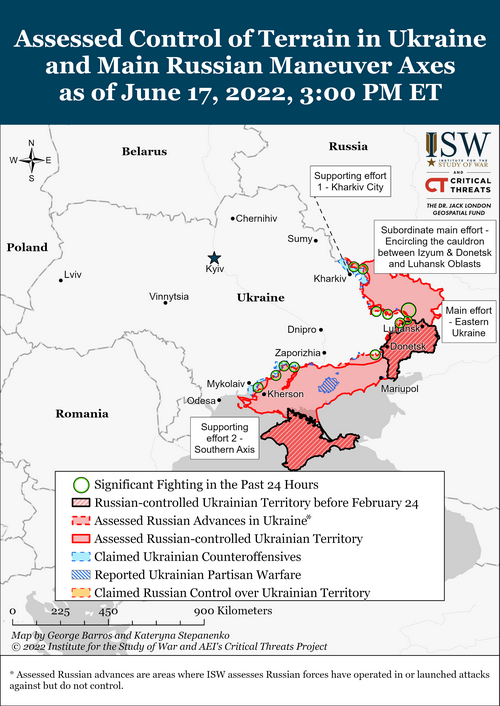
From The Institute For The Study of War:
Kateryna Stepanenko, Mason Clark, George Barros, and Grace Mappes
June 17, 7:00 pm ET
Click here to see ISW’s interactive map of the Russian invasion of Ukraine. This map is updated daily alongside the static maps present in this report.
Russian forces are continuing to deploy additional forces to support offensive operations in the Severodonetsk-Lysychansk area, and Ukrainian defenses remain strong. Ukrainian Defense Ministry Spokesperson Oleksandr Motuzyanyk reported that Russian forces are transferring tanks, armored personnel carriers, engineering equipment, and vehicles from Svatove, along the Russian ground lines of communication (GLOCs) in Luhansk Oblast, to Starobilsk, just 40 km east of Severodonetsk.[1] Social media users reported that Russian forces are likely redeploying equipment from northern Kharkiv Oblast to Donbas and published footage of Russian heavy artillery arriving by rail in Stary Osokol, Belgorod Oblast on June 17.[2] UK Chief of Defense Tony Radakin stated that Russian forces are “diminishing” in power by committing large quantities of personnel and equipment for incremental gains in one area.[3] The Russian military has concentrated the vast majority of its available combat power to capture Severodonetsk and Lysychansk at the expense of other axes of advance and is suffering heavy casualties to do so.
Russian President Vladimir Putin declared that Russian forces will attack Ukrainian positions near Donetsk City but reiterated that the new tactic will require additional time during his address at the St. Petersburg Economic Forum on June 17.[4] Putin stated that Russian forces will stop what he claimed is Ukrainian shelling of Donetsk City by attacking Ukrainian fortifications from the rear. Putin may have amplified reports of shelling of civilian areas of Donetsk City, which Ukrainian officials have denied, to discourage Western officials from supplying weapons to Ukraine.[5] Putin also declared that Russian forces will fully complete the “special military operation” in Ukraine, and noted that Russian and proxy forces will intensify counter-battery combat.[6] Putin urged Russian forces to refrain from entirely destroying cities that they aim to “liberate,” ignoring the destruction Russian forces have inflicted on Ukrainian cities and the artillery-heavy tactics Russian forces are currently employing in Severodonetsk.”[7]
Unconfirmed Ukrainian sources report that the Kremlin fired the Commander of the Russian Airborne Forces, Colonel-General Andrey Serdyukov, due to mass casualties among Russian paratroopers. Odesa Oblast Military-Civil Administration Spokesperson Serhiy Bratchuk reported that the Kremlin appointed the current chief of staff of the Central Military District, Colonel-General Mikhail Teplinsky, as Serdyukov’s replacement and named the Deputy Commander of the Russian Airborne Forces, Lieutenant General Anatoly Kontsevoi, as the First Deputy Chief of Staff of the Russian Airborne Forces.[8][9] ISW cannot independently confirm these claims or Serdyukov’s exact role in the invasion of Ukraine, but they, if true, would indicate that Serdyukov is being held responsible for the poor performance of and high casualties among Russian VDV units, particularly in early operations around Kyiv. Continued dismissals and possible internal purges of senior Russian officers will likely further degrade poor Russian command and control capabilities and the confidence of Russian officers.
Key Takeaways
- Russian forces continued to launch unsuccessful ground assaults against Severodonetsk and its southeastern outskirts on June 17.
- Russian forces continued efforts to sever Ukrainian lines of communication to Lysychansk, both from the north toward Slovyansk and in the south near Bakhmut.
- Ukrainian forces are likely conducting a counteroffensive northwest of Izyum intended to draw Russian forces away from offensive operations toward Slovyansk and disrupt Russian supply lines and are making minor gains.
- Ukrainian forces and aviation continued to strike Russian logistics and fortifications in occupied settlements along the Southern Axis, with localized fighting ongoing.
- Russian forces continued to regroup and transfer personnel within Zaporizhia Oblast to maintain defensive positions along the frontline.
- Russian President Putin reaffirmed his commitment to “completing” the Russian operation in Ukraine but acknowledged that unspecified new Russian tactics (which are likely simply explanations for poor Russian performance) will take time.
- Unconfirmed Ukrainian sources reported that the Kremlin fired the commander of the Russian Airborne Forces, Colonel-General Andrey Serdyukov, due to poor performance.
Go here to read the rest. Putin’s war to conquer Ukraine now seems to be a war to capture the remainder of two provinces in Eastern Ukraine.


Australian blogger “Perun”, one with an accounting and logistics background, produced a lengthy YouTube video about 6 days ago on the logistics and manpower problems of the Russian army entitled, “All Metal, No Manpower: Russian Infantry Shortages…” Among the many in-depth details he covers are points made by at least 2 pro-Russian military leaders active in the Ukrainian war, Alexander Khodakovsky, who leads the “Vostok Battalion,” a committed Chechnyan military unit fighting in the south part of Ukraine, and “Igor GIrkin,” a former Russian (KGB?) agent who likes to go by the call name of “Strelkov” (“shooter”): Both of them bitterly decry the lack of proper equipping and training of the Donetz and Luhansk People’s Battalion I”DPR,” “LPR”) recruits that are being used, they say, sometimes as “draw-fire” units—pure cannon fodder sacrificed to make the Ukrainian infantry and artillery reveal their positions, so that the Russians can plaster the latter with heavy artillery fire. It is these battalions also that are equipped with WW2 (or prior)-issue Mosin-Nagant bolt-action rifles, instead of AK-47’s, and obsolete mechanized equipment. They also accuse the Russian command of distributing vodka regularly to the troops, and not just the DPR/LPR, especially before an assault, to “build up courage.” A number of Ukrainian drone videos have surfaced showing Russian troops obviously drinking and being inebriated—often before they are crushed by drone-dropped bombs or drone-guided artillery fire.
The use of these Donetz and Luhansk “soldiers” also permits the Russian High Command to deny taking casualties, saying instead that these proxy cannon-fodder elements are independent nations fighting Nazis in Ukraine. Of course, forced levies of men from these two Oblasts makes a joke of the Russian claim that the Russians are liberating the population, when in fact they are depopulating and liquidating them.
Perun also analyzes the unit deaths that are publicly announced, often from local newspaper obituary sources, and it confirms that a large number of the Russian army recruit deaths are from the poorest, often Siberian, republics, such as Buryatia and Tuva (sometimes transliterated “Tyva”) — and it is saying something to be the poorest among the 85 or so federal “subjects” and republics in the Russian Federation, which generally has the lowest per capita income among so-called “developed nations” (excepting S. Petersburg and Moscow). These impoverished young conscripts are promised an equivalent year’s salary — the average annual income in Buryatia for example is about $5400—and are poorly trained, poorly equipped, and sent into battle with the typical WW2 coldly cynical Russian idea that “those who survive will train the others.”
Perun goes into much more detail on the mobilization failures of the Russian Army, and that despite Ukrainian losses, it is getting worse day by day, week by week. The Ukrainians seem to know this based on their intel services, and this is why they have refused to withdraw from Severodonetsk, and instead want to wreak a 5-1 or even 10-1 loss ratio on the Russians until they hope they are exhausted: and the Ukrainians seem to think that point is not far off.