
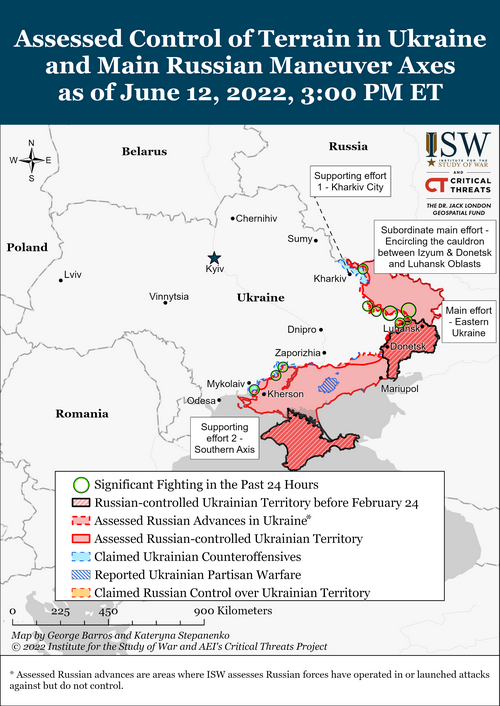
From The Institute For The Study of War:
Karolina Hird, Frederick W. Kagan, George Barros, and Grace Mappes
June 12, 6:30 pm ET
Click here to see ISW’s interactive map of the Russian invasion of Ukraine. This map is updated daily alongside the static maps present in this report.
Russian forces continue to struggle with generating additional combat-capable units. The UK Ministry of Defense reported on June 12 that Russian forces have been trying to produce more combat units by preparing to deploy third battalion tactical groups (BTGs) from some units over the last few weeks.[1] The UK MoD noted that Russian brigades and regiments normally can generate two BTGs, but doing so leaves the parent units largely hollow shells. The UK MOD concluded that these third BTGs will likely be understaffed and rely on recruits and mobilized reservists. Their deployment will likely adversely impact the capacity of their parent units to regenerate their combat power for quite some time. BTGs generated in this fashion will not have the combat power of regular BTGs. It will be important not to overestimate Russian reserves produced in this way by counting these third BTGs as if they were normal BTGs.
Pro-Russian sources are continuing to spread disinformation to sow anxiety and resentment among the Ukrainian population. Russian Telegram channels reportedly began spreading a fake mobilization order on June 12 that they falsely attributed to the Ukrainian General Staff. The fake order called for the mobilization of all eligible Ukrainian women to report for duty by “June 31” (sic).
Key Takeaways
- Russian forces continued ground assaults in Severodonetsk and blew up bridges that connect Severodonetsk to Lysychansk across the Siverskyi Donets River in a likely attempt to cut Ukrainian ground lines of communication (GLOCs) that run from Bakhmut to Lysychansk and Severodonetsk.
- Russian forces made incremental gains to the southeast of Izyum and will likely continue attempts to advance on Slovyansk from the northwest.
- Russian forces continued efforts to push Ukrainian troops back from contested frontlines northeast of Kharkiv City.
- Russian forces focused on maintaining defensive lines along the Southern Axis.
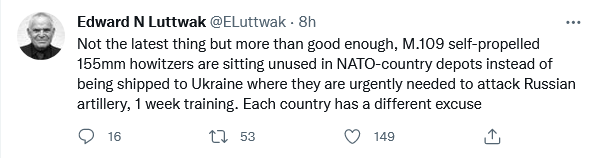
Go here to read the rest. As I already stated, this is becoming a war of materiel. NATO needs to have a central command to supply munitions and weapon systems to Ukraine.


Previously there have been reports of a large meatpacking facility, owned by ARON-M. LLC, in Melitopol that was taken over by Russian military units and pressed into use as a morgue (SOFREP.com, 6/11/22, a site specializing in military info especially special operations). The Russians demanded use of the facility and refused to pay for the cost of electricity for the refrigeration. Now it appears that the facility is too full and overflowing with Russian dead, even as they send back dead Russian servicemen (especially if they’re of higher rank) by train for funeral services in Moscow.
SOFREP believes the estimates of at least 30,000 Russian military killed to be accurate, since US & UK sources think their casualties are about 20%, and the initial invasion force was 150,000 military. SOFREP goes with the oft-quoted estimate that for every soldier killed, 2x’s to 3x’s as many are seriously wounded and out of action— And because the Russian military has terrible field medical facilities—if any—the casualty rates and seriously injured rates are probably even higher. Also, because the men of the Russian force are now almost all conscripts that were only rudimentarily trained, it is thought they didn’t even have the medical first aid training to save many wounded in the field, even if they could be evac’ed to a field hospital. Things like Quick Clot emergency field bandages, or military-grade emergency field compression bandages that you can buy on Amazon are unknown to the Russian organizational disaster formerly called the Red Army. Additionally, there have been reports by a Ukrainian civilians around Melitopol and elsewhere of field cremation facilities burning/working 24/7, likely to try to attempt to resolve the problem. It is true the Ukrainians are suffering a terrible toll, but they have the advantage of being on their own soil and are said to have far superior medical facilities, even in the field.
One other thought, drawing on my personal experience having for some years worked in the funeral industry: Even if a human body is refrigerated, usually at 38 to 40°F, because it is 90% water, it will still begin to rapidly deteriorate and fluid will eventually separate and drain out of the body after a short period, perhaps days, more likely perhaps within hours (since the Russian dead are brought in from the field and such bodies weren’t able to be kept immediately cold after death); but certainly by 2-14 days—it varies by the person and their biochemical makeup. (It was often why we had to explain to people who didn’t want embalming of their loved one that the person would have to be put in a closed casket swiftly after leaving refrigeration and buried usually as soon as possible. Many mausoleums, being above-ground structures, have a rule that casket burials must have embalmed bodies only.) I can only imagine the ungodly, unearthly smell of death at this Russian “morgue” facility. In the fact in the entire neighborhood for miles.