Donald R. McClarey
Cradle Catholic. Active in the pro-life movement since 1973. Father of three, one in Heaven, and happily married for 43 years. Small town lawyer and amateur historian. Former president of the board of directors of the local crisis pregnancy center for a decade.
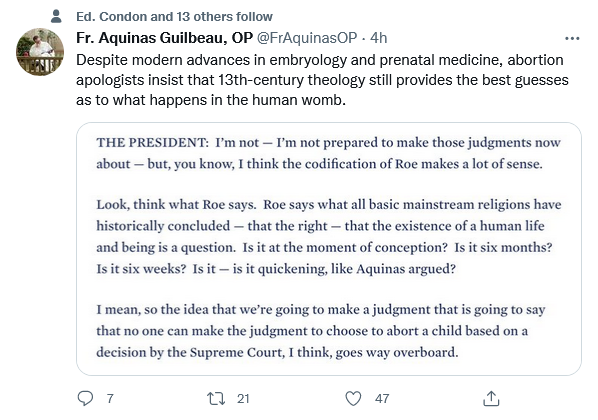



There is no good faith on the Left. Even Brandon’s worm eaten brain doesn’t believe that Aquinas’ phrase has any relevance to the reality of when human beings come into existence. I would call him a hypocrite for going back to the 13th century to support his argument, but he’s not. He’s simply making an argument someone gave him that no one is supposed to believe. Truly, what are the chances Brandon is actually a fan of the Angelic Doctor? Rather, Brandon has power, he’s going to use it and he wants you to know that’s what’s going on. Simply put, the Left is way past trying to convince through logical persuasion.
To make it worse, they’re not even honestly representing what the Summa was talking about.
I’ll copy-paste my response to a reasonably polite fellow who is, IIRC, an agnostic at best:
You might be interested in what he wrote in context– not just the written context, but the cultural and scientific, and even what he meant by “soul.”
It wasn’t, “is this a person.”
Short version, vegetative soul sounds very much like our understanding of an organism being alive, but not able to feel. An animal soul matches with the ability to respond to stimulus, as determined by moving. And a rational soul is believed to be present when the embryo is recognizable as male or female human.
It’s a description of the bare minimum that must be true, based on the evidence available.
Basically like when philosophers today try to figure out if Neanderthals were people, starting from before we found out about how common it is to have their DNA.
He was very wonderfully polite about it, too. 😀
Aquinas figured that the embryo was alive at conception, and that Jesus was fully in His human body from that point. But that wouldn’t get the same “haha cat-licks stoooopid” points.
This is no different than when they misrepresent the Venerable Bede’s theorizing on extinct theology based on word roots as “Easter is named for a pagan goddess.”
Correct Foxfier. Theorizing about quickening was done to determine whether the sin involved was homicide to aid priests hearing confessions. That abortion at all times was a grave sin has always been held by the Church.
The earliest source is an anonymous church manual of the late first century called The Didache. It commands, “Thou shall not murder a child by abortion nor kill that which is begotten.”
The Epistle of Barnabas contains a similar guide to Christian morality. It was composed sometime between AD 70 and 132, and was included in some early versions of the New Testament. In the midst of several chapters of instructions on ethics, it states: “Thou shall not slay the child by procuring abortion; nor, again, shalt thou destroy it after it is born.” The latter phrase refers to the ancient Greek and Roman practice of abandoning newborns to die in unpopulated areas if the baby was the “wrong” sex or suspected of health problems. To the author of Barnabas, this practice and abortion were equal in sinfulness.
https://christiansforsocialaction.org/resource/abortion-and-the-early-church/
I think we tend to anachronize our conception (pun intended) of Aquinas’ (and other ancient writers) notion of quickening, as we generally filter it through a latent Cartesian dualism that sees the body and soul as two hermetically sealed substances. For Aquinas, the person (among other things) is an individual substance of a rational nature (following Boethius), which in his view is constitutive of body and soul as a whole. Thus, in Aquinas’ view it’s not like there’s an inert shell of a human being sitting in the womb waiting to be ensouled; rather, the physical substance undergoes developmental change in substance (in the philosophical sense) through the hierarchy of being in living things. This developmental process concludes when the rational soul is embodied, for the body then has the capacity, so to speak, to be a rational substance. The reason they had the notion of quickening wasn’t just theological, as this tweet implies, but was Aristotelian biology that understood the semen as having some sort of ‘soul’ that was the extrinsic active principle of the organization of the menstrual blood. Thus, the fetus is alive, but is not yet a rational substance because its organizing principle is from without until it is sufficiently formed. At “quickening,” though, the organizational principle is then intrinsic, as the rational soul is the form of the body.
However, even given Aquinas’ faulty biology, the principles he works off of would, I think, lead him to easily conclude that human life begins at conception if he had a more accurate understanding of biology, as we now know that the “capacity” for a rational soul is present from the moment of conception, as the developmental architecture is complete and intrinsic from this moment.
That being said, Aquinas’ speculation here isn’t meant to be dogmatic; he’s taking the current biological understandings of his day and synthesizing them within a theological framework. That abortion was against church teaching has been clear from the earliest days, as can be easily and explicitly seen in the Didache, and Aquinas doesn’t depart from this.
science–embryology–shows that there is no sharp demarcation point between human and non-human. Accordingly “termination” (killing the human in the womb) is a decision made arbitrarily and to be logically consistent, in or out of the womb, -5 months or _+2 years are equivalent. See “Abortion and Science: Life Begins at Conception.”
https://catholicstand.com/abortion-science-catholic-teaching-life-begins-at-conception/
BOB KURLAND: I read and liked your article. You can add general anesthesia to your list of things that limit self-awareness. A person undergoing surgery under general anesthesia is no more self-aware than an unborn child.