
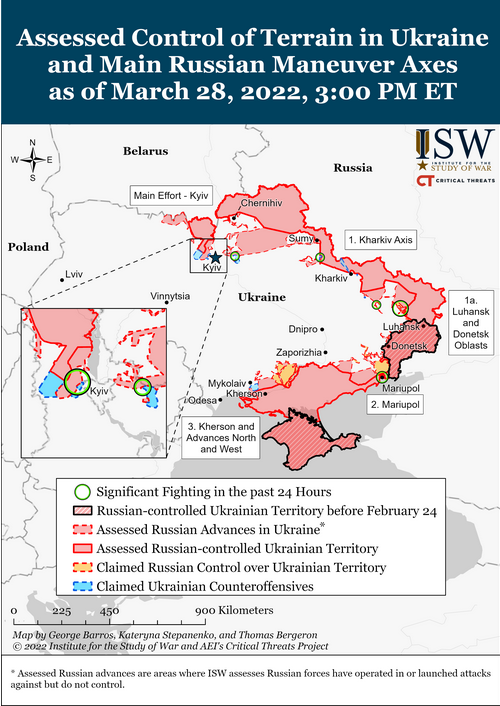
From The Institute For The Study of War:
Mason Clark and George Barros
March 28, 4:30pm ET
Ukrainian forces recaptured Irpin, northwest of Kyiv, on March 28. Ongoing Ukrainian counterattacks around Kyiv will likely disrupt ongoing Russian efforts to reconstitute forces and resume major offensive operations to encircle Kyiv. Ukrainian forces additionally repelled Russian attacks toward Brovary, east of Kyiv, in the past 24 hours. Russian forces in northeastern Ukraine remain stalled and did not conduct offensive operations against Chernihiv, Sumy, or Kharkiv in the past 24 hours. Russian forces continue to make grinding progress in Mariupol but were unable to secure territory in either Donbas or toward Mykolayiv.
Key Takeaways
- Russian forces have not abandoned their objective to encircle and capture Kyiv, despite Kremlin claims that Russian forces will concentrate on eastern Ukraine.
- Ukrainian forces recaptured the Kyiv suburb of Irpin on March 28. Ukrainian forces will likely seek to take advantage of ongoing Russian force rotations to retake further territory northwest of Kyiv in the coming days.
- Russian forces conducted unsuccessful attacks toward Brovary and did not conduct offensive operations toward Chernihiv, Sumy, and Kharkiv. Russian operations in northeastern Ukraine remain stalled.
- The Ukrainian General Staff stated that a battalion tactical group (BTG) of the 1st Guards Tank Army fully withdrew from Ukrainian territory near Sumy back to Russia for possible redeployment – the first Ukrainian report of a Russian unit fully withdrawing into Russia for redeployment to another axis of advance in this conflict.
- Russian forces continued to steadily take territory in Mariupol.
- Ukrainian resistance around Kherson continues to tie down Russian forces in the area. Russian forces did not conduct any offensive operations in the southern direction.
Russian conscription efforts, which Ukrainian intelligence expects to begin on April 1, are unlikely to provide Russian forces around Ukraine with sufficient combat power to restart major offensive operations in the near term. Russia’s pool of available well-trained replacements remains low and new conscripts will require months to reach even a minimum standard of readiness. Ukraine’s Main Intelligence Directorate (GUR) reported on March 28 that Russia will begin conscription through the BARS-2021 (Combat Army Reserve of the Country) program on April 1 alongside the normal semi-annual conscription cycle on April 1 to “conceal mass mobilization measures.”[1] The GUR reported that BARS-2021 reservists will replenish units operating in Ukraine and will be supported by convicted criminals recruited through the BARS program in return for full amnesty.
ISW published an explainer on BARS-2021 and other Russian conscription efforts on March 5.[2] The Russian military launched the BARS-2021 program in 2021 in order to establish an active reserve by recruiting volunteer reservists for three-year contract service. BARS-2021 operated on the same principle as US and NATO reserves, where reservists actively train and are compensated while maintaining their civilian jobs. The Russian Armed Forces sought to create exclusively reservist units but likely did not accomplish its goals due to low engagement from Russian citizens. The Russian Defense Ministry hoped to recruit more than 100,000 reservists starting in August 2021, but it is unlikely the Kremlin was able to achieve its goals on such a short timeline.
The Russian military is likely close to exhausting its available reserves of units capable of deploying to Ukraine. The Ukrainian General Staff reported on March 28 that Russia continues to train and deploy additional units to Ukraine, including the Pacific Fleet’s 155th Naval Infantry Brigade and an unspecified element of the 14th Separate Guards Special Purpose Brigade.[3] The Ukrainian General Staff additionally reported on March 27 that unspecified Western Military District and Pacific Fleet units continued to deploy toward Ukraine, but that Ukraine has observed a “significant decrease in the intensity of traffic from the depths of the Russian Federation”—indicating Russia has likely already deployed most of its reserves to Ukraine.[4] The Ukrainian General Staff additionally stated that Russia is covertly mobilizing the population of the Russian-backed, Georgian breakaway region of South Ossetia to support the war in Ukraine and has already transferred 150 South Ossetian fighters to Crimea.[5]
Go here to read the rest. From Strategy Page:
March 28, 2022: The 2022 Russian invasion of Ukraine turned into an embarrassing (for Russian leaders) failure because the Russians were unable to supply their forces while the Ukrainian internal transport system survived Russian attacks. Russia did block access, by water, to Ukrainian Black Sea ports, but Ukraine had numerous land routes across borders with Poland, Hungary, Slovakia and Romania. While supplies can no longer be flown into Ukraine, they can be flown to neighboring countries and then enter Ukraine via railroads and highways.
Like most nations that once belonged to the former Soviet Union, Ukraine depends more on railways than highways for moving people and freight. Russia tried to shut down the Ukrainian railways with air and long-range missile attacks, but the internal railway system is so dense, and track repair capabilities so expanded, that track damage is rapidly fixed and there are usually ways to reroute traffic until repairs are completed. Ukraine has 22,300 kilometers of railway and employs over 400,000 people to operate nearly 2,000 locomotives, 85,000 freight and 4,000 passenger cars.
There are not many railroad border crossings, even as long-closed rail crossings with friendly nations are being refurbished and reopened. Meanwhile most military supplies and personnel come in via roads. Not just the major roads that pass-through border control posts, but many additional rural paved and unpaved roads as well as some traversable cross-country routes. Russia has tried to locate the concentration points inside Ukraine where military supplies are stored until needed. A few have been bombed so the concentration sites are frequently changed or trucks continue going until they are close enough to the fighting to unload. Ukraine provides refueling on the way in and out.
Russian supplies and military equipment also move up to and sometimes across the border by rail. Russia tried to run its trains into Ukraine but found their locomotives and rail cars were frequent targets of attack by the many small groups of well-armed Ukrainians waging an effective war on Russian road or railway traffic. This made it difficult to remove disabled locomotives and train cars, or repair damaged tracks. The Russians were soon restricted to using the roads where Russian trucks and combat vehicles were constantly under attacks from Ukrainian ground forces. The Russians did not have sufficient troops to go out and attack, or even find, the Ukrainian forces. The Ukrainians were operating in small groups and usually in uniform. The Ukrainian fighters traveled on roads or via known cross-country routes with the assistance of locals.
The Russians concentrated on maintaining control of the roads, which was costly in terms of casualties and troops required. The Russians had trouble communicating while the Ukrainian forces did not. Russian military patrols on the roads attracted attacks and reduced but did not eliminate, the attacks on supply convoys, and themselves attracted more Ukrainian attacks. This limited how deep into Ukraine Russian troops could advance and is the main reason Russian troops stalled after two weeks of fighting. Russia has several hundred transport helicopters but these are vulnerable to Ukrainians armed with American Stinger anti-aircraft missiles that have been updated to get past missile defenses Russian helicopters are now equipped with.
Until early March Russia had an easier time using railroad crossings from Belarus, where six rail lines cross into Ukraine. In early March Belarussian railway employees were found to be cooperating with their Ukrainian counterparts to sabotage Russian rail traffic from Belarus to Ukraine. Belarus had refused to send troops into Ukraine but has been forced to allow Russian troops to operate in Belarus and cross into Ukraine. The pro-Russia Belarus government was forced to divert some of its few reliable military units to guard the rail crossings. This has not stopped the sabotage but has slowed it down. Most Belarussians oppose the Russian invasion of Ukraine as well as their own pro-Russia ruler, who was recently helped by Russian troops moved into Belarus to help suppress the growing number of demonstrations against the unpopular Belarussian ruler and Russia in general.
The Ukrainian army still has about a dozen combat brigades and over a hundred thousand troops. This is augmented by more than twice as many reservists and armed civilians who are organized into hundreds of smaller units and have inflicted most of the vehicle losses and personnel casualties on the Russians. The Ukrainian army brigades have to be used carefully because Russia has more combat aircraft and long-range missiles and guided rockets that could attack them. The Ukrainian brigades act as a threat to Russian units and tie down many Russian troops. The brigades are employed whenever the Russians get an advance going, as they have in east and south. But most of the damage is done by the irregulars, which includes many of the army special forces troops.
Go here to read the rest.
Yonder are the Hessians! They were bought for seven pounds and ten pence a man. Are you worth more? Prove it!
General John Stark to his men prior to the Battle of Bennington
Russian manpower problems remind me of the British during the Revolutionary War. The British Army was relatively small and service fighting in America was unpopular. The British solution was to hire 30,000 troops from German states, collectively known as the Hessians. Although the Hessians gave some good service, American conditions were foreign to them, and Americans quickly lost their fear of them as they found them quite beatable. In the modern world there are no large sources of troops that may be leased out. Considering the collapse of the ruble, the Soviets couldn’t pay for them in any case. Additionally mercenaries, at least in modern times, have a poor record fighting against troops defending their country against a foreign invader.


Von Clausewitz says the overriding imperative is to press the attack and roll up the enemy when your enemy is retreating, no matter the challenges of doing so.
Easily said, because the Ukrainians are likely nearly exhausted as well, and lack a lot of the mobility as well as air support needed to be able to do this.
Western analysts who appear reliable have said that Putin is ordering his commanders to prepare and launch an imminent chemical warfare attack, which is consistent with the Russian forces withdrawing approximately 30 km outside of Kyiv. If so, the safest option for Ukrainian forces would be to be engaged close within the penumbra of the static Russian positions—-although it wouldn’t be a surprise for the Russian High Command to launch a chemical attack that might even poison some of their own forces. “All for the cause.”
The last 48 hours it’s been raining off and on with winds around 10 miles an hour in the area of Kyiv. Rain is expected to continue for the most part for the next five days. Those conditions presently are not favorable for a chemical attack.
Also the typical Eastern European spring rains will bog down Russian armored vehicles.
Let us pray for rain for the next two months as Ukrainians attempt to rearm.
It’s also a mystery to me why Ukrainians are allowing their beleaguered but extraordinary forces in the key port of Mariupol to be wiped out. I would’ve thought they would want to concentrate a siege-lifting attack to try to break the encirclement, if only to let a number of their forces escape. It also would prevent the Russians from linking up between Berdansk and the Crimea. I really don’t understand this.
Sun Tzu had some comments about invading forces losing their will when losing momentum and defending forces encouraged by halting the enemy. A bit more backbone on the part of the EU would have prevented much of this situation and still can be of some benefit if the present some form of a united front.