
The Christian evidence for Christ begins with the letters ascribed to Saint Paul. Some of these are of uncertain authorship; several, antedating A.D. 64, are almost universally accounted as substantially genuine. No one has questioned the existence of Paul, or his repeated meetings with Peter, James, and John; and Paul enviously admits that these men had known Christ in his flesh. The accepted epistles frequently refer to the Last Supper and the Crucifixion…. The contradictions are of minutiae, not substance; in essentials the synoptic gospels agree remarkably well, and form a consistent portrait of Christ. In the enthusiasm of its discoveries the Higher Criticism has applied to the New Testament tests of authenticity so severe that by them a hundred ancient worthies, for example Hammurabi, David, Socrates would fade into legend. Despite the prejudices and theological preconceptions of the evangelists, they record many incidents that mere inventors would have concealed: the competition of the apostles for high places in the Kingdom, their flight after Jesus’ arrest, Peter’s denial, the failure of Christ to work miracles in Galilee, the references of some auditors to his possible insanity, his early uncertainty as to his mission, his confessions of ignorance as to the future, his moments of bitterness, his despairing cry on the cross; no one reading these scenes can doubt the reality of the figure behind them. That a few simple men should in one generation have invented so powerful and appealing a personality, so lofty an ethic and so inspiring a vision of human brotherhood, would be a miracle far more incredible than any recorded in the Gospel. After two centuries of Higher Criticism the outlines of the life, character, and teaching of Christ, remain reasonably clear, and constitute the most fascinating feature of the history of Western man.
Will Durant, from Caesar and Christ, Volume III, Story of Civilization
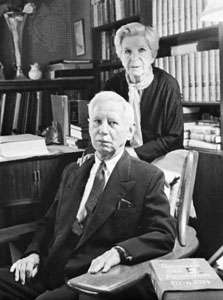
American historians Will and Ariel Durant wrote over forty years (1935-1975) the eleven volume Story of Civilization. In limpid prose they told the story of the civilizations of man up through the time of Napoleon. The volumes have a prized place in my library. The work, which in its day sold an astounding two million sets, has of late fallen out of favor, as contemporary history too often is barely literate politicized junk, and the patience to read lengthy works is growing scarcer among moderns. As I hope and long for better times, I enjoy re-reading these volumes.
Some kind soul has placed audio selections from this magnificent work on You Tube. I will post them from time to time. Here is Why Rome Fell. Enjoy!


Thanks for this posting Donald. This is a vision our future unless we return to God.
That’s great Will. Jesus of Nazareth was a real person, not a myth. But was he who he said he was?
Durant lost his faith in Christ which makes his honesty as a historian even more admirable.
Durant was reconciled with the Church right before his death.
And it is noteworthy that his atheism had softened considerably by the time he was turning out the Civilization series. He was downright dismissive of scholasticism in “The Story of Philosophy” (which was published in 1926 and skips centuries after Aristotle, including Aquinas).
But his take on the same subject in “The Age of Faith” in 1950 was detailed, respectful and sympathetic.
I think he wrote himself back into the Faith, and crossed the finish line at the end.
https://www.shu.edu/news/historian-and-philosopher-will-durant.cfm
Beautiful Dale. He is one of my favorite authors. He was a true truth seeker, and such men and women generally come out right with God in the end.
Durant lost his faith in Christ which makes his honesty as a historian even more admirable.
I tend to like Durant too, but really, all he’s saying there is that the Higher Critics who argued that the Jesus of the Gospels was a myth, that the Apostles made it all up, were wrong. Even among the practitioners of the Higher Criticism, that was a minority view.
I’m glad to hear that he read himself back into the Faith.
Even among the practitioners of the Higher Criticism, that was a minority view.
True, but the temptation to shade facts to fit beliefs is always there. I have used this passage before to defend the historicity of Christ, and that Durant was writing at that time from a standard of non-belief makes it doubly effective.
The entire set is available for download online in a number of different formats.
Will Durant’s significantly younger wife Ariel died first, and it may be that a belief that she lived on drew him back to the Redeemer and His Church.