
For love of Him they ought to expose themselves to enemies both visible and invisible.
Saint Francis of Assisi
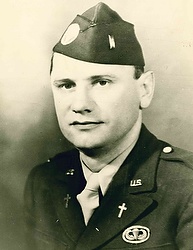
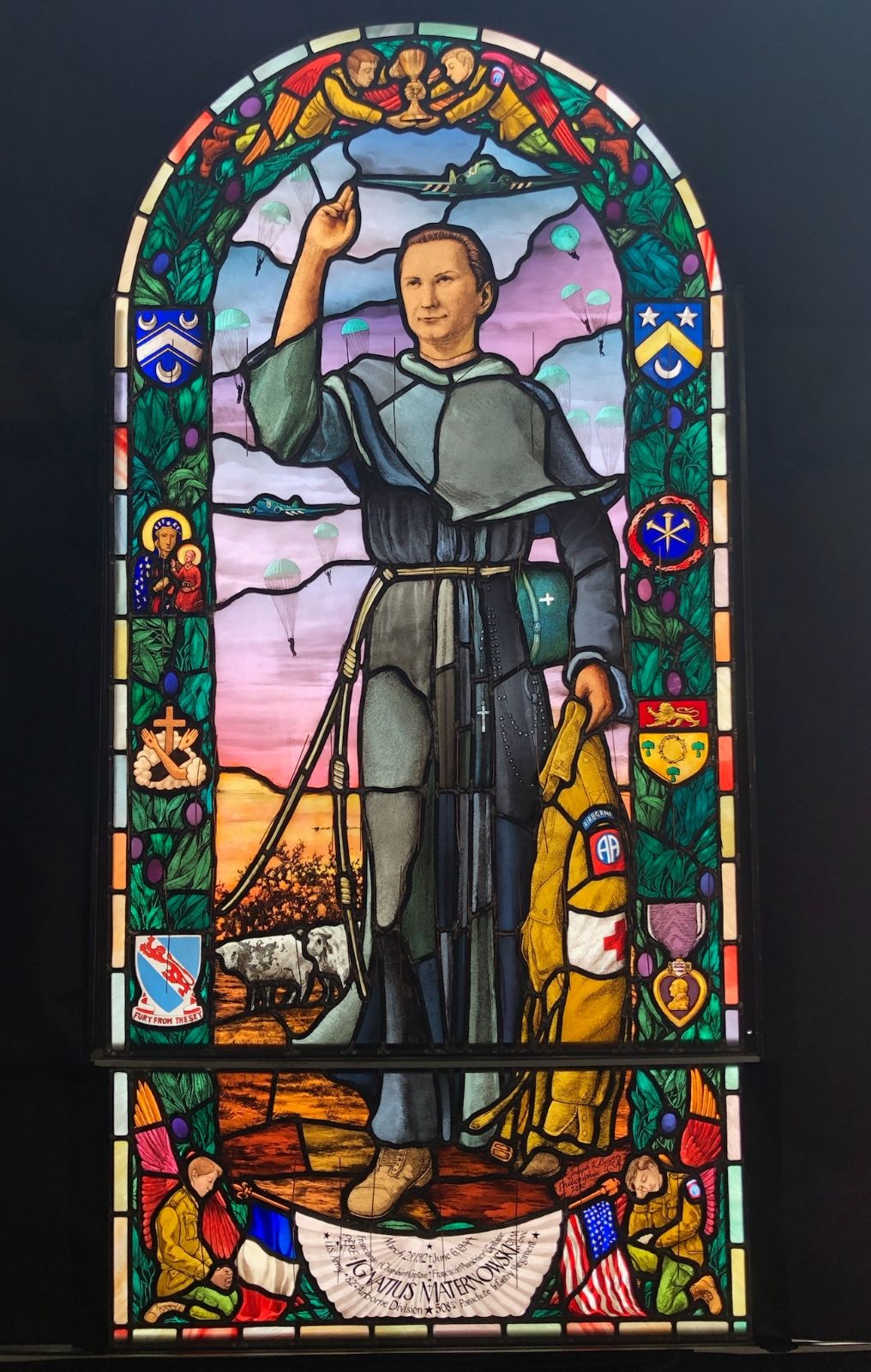
Ignatius Maternowski entered this Vale of Tears on March 28, 1912, in Holyoke, Massachusetts, the son of Polish immigrants He attended, appropriately enough, Saint Francis High School. Impressed by the Franciscans he encountered there, he decided to become a Franciscan priest. He was ordained to the priesthood on July 3, 1938. His gift for preaching manifesting itself, he was assigned as a missionary-preacher at the friary of Saint Anthony of Padua in Elicott City, Maryland.
From the time of Pearl Harbor he sought permission to serve as a chaplain and in July 1942 he enlisted in the Army. He served as a chaplain in the 508th regiment of the 82nd Airborne. In the aftermath of the chaotic combat drop into Normandy on the night before D-Day, Captain Maternowski busied himself in tending both American and German wounded.
Realizing that some sort of facility would be needed to treat all of the wounded, the chaplain walked into enemy lines and discussed setting up, with a no doubt bemused German Wehrmacht doctor, some sort of joint aid station to care for the wounded of both sides. Crossing back into American lines, he was shot in the back and killed by a German sniper. Being killed while seeking to aid the helpless is about the best way I can think of for a Franciscan to die. Father Maternowksi was the only Allied chaplain to die on D-Day.


I never heard this story before. Thank you.
He is new to me as well.
Great man. Great courage and love of neighbor. Thank you for the post.
[…] Michael Cook at Mercatornet Podcast: Dawn of the New Eve – Scott Hahn at The Road to Emmaus Franciscan Paratrooper – Donald R. McClarey, J.D., at The American Catholic Scandal In Wheeling-Charleston Diocese: […]
Shot in the back. The only thing the invading Germans were good for.
Another good example of a soldier-chaplain is Fr Simon Knapp, O.Carm., who served with Edmund Allenby’s cavalry regiment during the Boer War; Allenby, who didn’t hand out praise readily, called him “the best specimen of Army chaplain I’ve ever met.” Fr Knapp was killed during WWI while again serving as an army chaplain. See http://www.greatwarci.net/honour/jersey/database/knapp-ss.pdf
Thank you for this. I felt a well of anger when I read that he set up a common medical station to help wounded soldiers on both sides then ended up dying at the hands of a German sniper. What a waste. This life has no real justice and makes no sense.