
Congress finds that--
        (1) in August 1943, President Franklin D. Roosevelt and other
    Allied leaders proposed the creation of a ground unit of the Armed
    Forces that would engage in a ``long-range penetration mission'' in
    Japanese-occupied Burma to--
            (A) cut off Japanese communications and supply lines; and
            (B) capture the town of Myitkyina and the Myitkyina
        airstrip, both of which were held by the Japanese;
        (2) President Roosevelt issued a call for volunteers for ``a
    dangerous and hazardous mission'' and the call was answered by
    approximately 3,000 soldiers from the United States;
        (3) the Army unit composed of the soldiers described in
    paragraph (2)--
            (A) was officially designated as the ``5307th Composite
        Unit (Provisional)'' with the code name ``Galahad''; and
            (B) later became known as ``Merrill's Marauders'' (referred
        to in this section as the ``Marauders'') in reference to its
        leader, Brigadier General Frank Merrill;
        (4) in February 1944, the Marauders began their approximately
    1,000-mile trek through the dense Burmese jungle with no artillery
    support, carrying their supplies on their backs or the pack saddles
    of mules;
        (5) over the course of their 5-month trek to Myitkyina, the
    Marauders fought victoriously against larger Japanese forces
    through 5 major and 30 minor engagements;
        (6) during their march to Myitkyina, the Marauders faced hunger
    and disease that were exacerbated by inadequate aerial resupply
    drops;
        (7) malaria, typhus, and dysentery inflicted more casualties on
    the Marauders than the Japanese;
        (8) by August 1944, the Marauders had accomplished their
    mission, successfully disrupting Japanese supply and communication
    lines and taking the town of Myitkyina and the Myitkyina airstrip,
    the only all-weather airstrip in Northern Burma;
        (9) after taking Myitkyina, only 130 Marauders out of the
    original 2,750 were fit for duty and all remaining Marauders still
    in action were evacuated to hospitals due to tropical diseases,
    exhaustion, and malnutrition;
        (10) for their bravery and accomplishments, the Marauders were
    awarded the ``Distinguished Unit Citation'', later redesignated as
    the ``Presidential Unit Citation'', and a Bronze Star; and
        (11) though the Marauders were operational for only a few
    months, the legacy of their bravery is honored by the Army through
    the modern day 75th Ranger Regiment, which traces its lineage
    directly to the 5307th Composite Unit.
From the Act of Congress in 2019 which awarded Merrill’s Marauders a unit Congressional Gold Medal
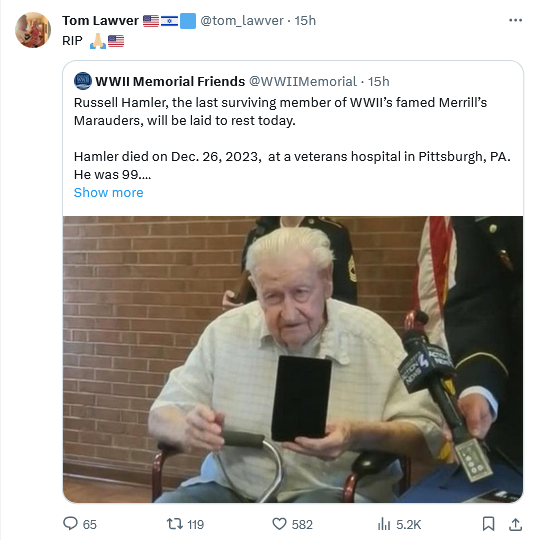
A sad reminder above of the ticking clock as the last survivor of Merrill’s Marauders departs this Vale of Tears.
Released in 1945, The Stilwell Road, narrated by Ronald Reagan while he was a Captain in the Army Air Corps, tells the story of the forgotten theater of the War, the China-Burma-India theater where the Allies, fighting over some of the most rugged terrain on Earth, wrested victory from the Japanese. The Stilwell Road refers to a section of the Burma Road by which Nationalist China was supplied by the United States and Great Britain during the War.
The unit known as Merrill’s Marauders is mentioned in the film. Officially designated by the uninspiring title of 5307th Composite Unit (Provisional), the press tagged them as Merrill’s Marauders and thus they have come down through history. Three thousand volunteers, most of them veterans of the fighting in the Pacific, including some veterans who volunteered from military stockades and who were known as The Dead End Kids, the Marauders were organized to fight behind Japanese lines. Led from the front by Brigadier General Frank Merrill, the Marauders were trained in the deep penetration tactics, supported by air drops, pioneered by British General Orde Wingate, with Merrill throwing in some American touches, for example the importance of marksmanship, as old as Roger’s Rangers, wilderness fighters of the French and Indian War, famed for their long distance raids.
The Marauders went into action in northern Burma in February 1944. Between February and May they marched 750 miles over some of the most rugged, and disease infested, terrain on Earth. Always outnumbered, they were never defeated and invariably inflicted many more casualties on the Japanese than they sustained. They engaged in combat with the Japanese on thirty two separate occasions including five major engagements. At the end they took Myitkyina airfield, a military objective that in retrospect still looks impossible for them to have taken. The unit was disbanded in August 1944 with only 130 men and officers still on their feet. As a tribute to their heroism, the Marauders had the unprecedented honor of every man in their ranks awarded a Bronze Star, along with a Presidential Unit Citation for the Marauders as a whole. The Marauders are looked upon as an ancestral unit by American Ranger, Special Ops and LERP (Long Range Reconnaissance and Patrol) units. Colonel George A. McGee (1992), who took over command of the Marauders after Frank Merrill had to be evacuated on March 29, 1944 due to a heart attack, and three Nisei interpreters, Roy H. Matsumoto (1993), Henry Gosho (1997), and Grant Hirabayashi, are inductees into the Ranger Hall of Fame.


I often wondered why the allied strategy favored the bloody Pacific Island hopping campaign rather then supporting China with an attrition land war in China and using air fields from China to get at Japan.
With more reading it seems that the China strategy was a primary consideration but the logistic challenges were too great. It seems that Marrill’s success may indicate that if logistics had allowed for more military resources invested in China the Pacific War may have been shorter and less bloody for the allies. Perhaps Asia would have had a different history if Chiang Kia-Shek had more help with his struggle fighting the Japanese and the Chinese Communist at the same time.
Objective, Burma!