
A fascinating video detailing the paths of Japanese and US merchant shipping during World War II. Beginning in 1943 the US is increasingly dominant with the Japanese shipping clinging to the Asian coast down to the oil in the Dutch East Indies. 1944 shows the obliteration of those Japanese routes and by the surrender in 1945 Japanese merchant shipping is virtually non-existent. A stark reminder of just what madness it was for Japan to start a war it could not win with the US.
At the end of the epic movie Tora, Tora, Tora, Admiral Isoroku Yamamoto, the head of the combined Japanese fleet, after the successful attack on Pearl Harbor, refuses to join in the elation of his staff, and makes this haunting observation: “I fear all we have done is to awaken a sleeping giant and fill him with a terrible resolve.” The line is almost certainly apocryphal. The director of the film, Elmo Williams, claimed that Larry Forester, the film’s screenwriter, had found the line in a 1943 letter written by Yamamoto. However, he has been unable to produce the letter, and there is no other evidence that such a letter exists.
https://www.youtube.com/watch?v=dn98oqd1E8w
However, there is no doubt that Yamamoto would fully have endorsed the sentiment that the line contained. He had studied at Harvard in 1919-1921, and served two tours as a naval attache at the Japanese embassy in Washington DC. He spoke fluent English, and his stays in the US had convinced him of that nation’s vast wealth and industrial power. He had also developed a fondness for both America and Americans.
In the 1930’s Yamamoto spoke out against Japan allying with Nazi Germany and Fascist Italy, fearing that such an alliance would lead inevitably to a war with the US that Japan would lose. He received frequent death threats as a result from fanatical Japanese nationalists. These were not idle threats, as such nationalists did assassinate a fair number of Japanese politicians and military men during the Thirties who were against war with the US. Yamamoto ignored the threats with studied contempt, viewing it as his duty to the Emperor and Japan to speak out against a disastrous course. Yamamoto wrote in a letter to one nationalist:
Should hostilities once break out between Japan and the United States, it would not be enough that we take Guam and the Philippines, nor even Hawaii and San Francisco. To make victory certain, we would have to march into Washington and dictate the terms of peace in the White House. I wonder if our politicians (who speak so lightly of a Japanese-American war) have confidence as to the final outcome and are prepared to make the necessary sacrifices.
After war came, and his warnings were ignored, Yamamoto fought to win it for Japan, until he died at the hands of an American P-38 Lightning raid, specifically targeting the plane he was flying in, the US eager to have their brilliant adversary no longer at the helm of the Japanese navy. In the aftermath of the Pearl Harbor raid, on January 9, 1942, when Japan was riding high on a wave of rapid conquest throughout the Pacific, Yamamoto made the following comment which indicated both his moral qualms as to the Pearl Harbor raid, and his fears as to the ultimate outcome:
“A military man can scarcely pride himself on having ‘smitten a sleeping enemy’; it is more a matter of shame, simply, for the one smitten. I would rather you made your appraisal after seeing what the enemy does, since it is certain that, angered and outraged, he will soon launch a determined counterattack.”
https://www.youtube.com/watch?v=SEvFj74Dg38


If you look carefully you can see the U.S. merchant ships that sailed right past the Japanese held Kuril islands during the war. How could they do that? Simple: they just flew the flag of the USSR. The Japanese dared not touch them.
In a 1991 article, “Pearl Harbor: Military Inconvenience, Political (and Strategic) Disaster”, John Mueller contended that the damage done was not extensive. The equipment was old and some of it obsolete. The US could readily repair and replace. The damage was made relatively trivial by US massive industrial capacity and replacement war machines were new, powerful, and in huge numbers.
The US was not prepared to take the offensive. So, the attack did little to stop America. Until 1945, the US would send 90% of its war effort to Europe, anyhow.
The political/strategic ramifications were tragic for Japan, the US and East Asia. Japan was destroyed. The US was forced into a long and ghastly war when (Mueller argues) containment/harassment strategies may have rolled back Japanese aggression. And, Japan was replaced by, arguably, worse local tyrannies, e.g., China, NK, and USSR.
John Toland’s excellent book, The Rising Sun, has a depiction of a Japanese officer POW (from a movement in a train in the US) recognizing US industrial might and concluding the empire didn’t stand a chance.
It is not nice to start a war of aggression.
Japan coveted the Hawaiian Islands forever as a strategic base. When Hitler began his move to conquer the world, Japan had to stake its claim to world dominance. Japan needed the Hawaiian Islands. Driving the Americans out was the first step. “”To make victory certain, we would have to march into Washington and dictate the terms of peace in the White House.”” and before Hitler, for it was Hitler’s plan to roll over England into America. Notice that Russia stopped both Germany and Japan. I believe that Hitler and Hirohito, who denied any part in WWII, would have shared the spoils. They did prepared the path for the USSR, and communism to overlord the world.
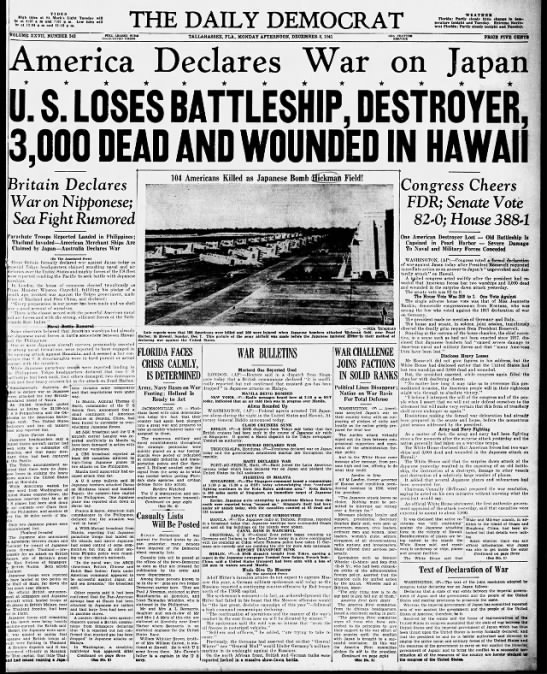
Interesting that the news headline “The Daily Democrat” mentions only “[one] battleship, destroyer lost.” My father, a commissioned US Army officer, stationed first at San Francisco, then, in the Pacific theater, commented once that the extent of the loss at Pearl Harbor was kept from both the American people, even the military, and fr the news media, to confuse and obstruct Imperial Japanese naval planning from accurate assessment. But he deduced as he watched Guam, Wake, and the Philippines fall that the blow at Pearl Harbor must have been grievous.
Although I am sure John Harwell makes a number of valid points in his book, to say generally that the assets “lost” at Pearl Harbor were “old and obsolete” is hardly correct, especially since in a epochal action, the Battle of the Surigao Straits (23-26 October 1944), 5 of the Pearl Harbor-raised-and-refitted battleships, <Pennsylvania, Tennessee, California, West Virginia, and Pennsylvania> inflicted massive destruction on the Force 3 of Operation Sho Go, the 3rd prong of the IJN attack in the Battle of Leyte Gulf. Both Pennsylvania and Maryland had 8 x 16” guns which were the state of the naval art for the time (only the IJN battleships Yamato & Musashi had larger bores: the US and Royal Navies wisely settled on that size as the maximum safely tested large naval gun bore size (Even the Kriegsmarine Bismarck “only” had 15” guns), so they were effective though slower platforms.
The British naval historian who uses the nom de plume “Drachinifel” (“Dragon-in-the-mountain”) has a number of wonderful YouTube documentaries on the massive undertaking involved in the salvage operation at Pearl Harbor of the US Pacific Fleet. It really bears watching the three videos he’s put together to realize the enormous extent of the undertaking and the amazing achievement of those naval salvage experts..
Steve Phoenix has it nailed: the Pearl battleships were refitted (as were most ships at the time) with better AA and radar, along with other things. Surigao Strait was their hour of vengeance, but each of them was also invaluable in throwing explosives in support of the repeated amphibious assaults. A shell from even a 14-inch main gun was devastating. The iron hail from offshore was essential to success.
Pearl was a disaster, but all of the ships save the Arizona and Oklahoma were salvageable precisely because they had been sunk in shallow water and could be raised comparatively easily. The Japanese did capitalize on their victories at Pearl (and the Philippines) and ran riot for a while. But their advantage died at Midway and doom crept ever closer, guns ablaze, from that point onward.
Dale:
A 14-in shell weighed in at 1750 lb, and a 16-inch at 2000 even. The 18-in shell was reported to weigh 2800. From evidence in Korea and Vietnam, those make holes the size of tennis courts.
There is a (perhaps legendary) story that the Emperor was being briefed in January 1942 of all the magnificent sallies of the war, and asked “And where do we stop?” Reportedly, he got no answer.
Also, as Tom Byrne points out, as naval gun ordnance payload increases with gun bore size, range also increases with naval gun bore size (range: 14” – about 14-16 statute [as opposed to nautical] miles; 16” – about 20-24 statute miles; 18” – about 25-27 or more statute miles) (the reason for the variation depends on the historical year we might be talking about and the different gun and shell design [or type: high-explosive v. armor-piercing] of different navies). But unless we are talking about a World War I type Battle of Jutland engagement, as is well known by everyone here, aircraft and aircraft carriers made those naval gun ranges largely irrelevant.
But then again, as Dale Price points out, the use of even a 14” naval gun battery in shore bombardment is an awesome display of power. In any event, the old WWI “battle wagons” were a highly useful asset throughout WW2 both in the Atlantic and Pacific theaters.
What kind of accuracy did those big guns offer?
The Japanese emporer-god Hirohito and Hitler neglected to read The Declaration of Independence. Hirohito and Hitler both believed that when they walked into Washington, D.C. the people would bow down and worship.
CAG: By World War II, the accuracy of naval gunnery had greatly improved, to the point that the British battleship HMS Warspite landed a hit on the Italian BB Giulio Cesare during the Battle of Calabria (9 July 1940) at a distance of 24 km (15 statute miles), one of the longest recorded hits in naval gunnery history.
The art of naval gunnery was however still largely “informed guesswork,” requiring data inputs of the range, speed, and bearing of one’s own ship, and that of the target ship. Obviously, those six variables allow for a great deal of inaccuracy. By World War II all the major navies used range finders based on a parallax imagery system: two images would be displayed at either end of the rangefinder, and when they coincided, that would compute the distance or range. However, obviously one’s naval target would also be moving and likely taking evasive action. One had to estimate the enemy target’s speed and bearing based on observation of its masts and hull orientation. These numbers with them fed into an early analog computer, a device with cogs and wheels, which took a few seconds to spit out a so-called firing solution that was then communicated to the turrets, telling them the correct bearing and gun elevation. Using a visual range finder could be easily obscured by smoke, mists, gathering darkness, or fog. So early radar systems were also used to verify distance. The Japanese were said to have the poorest radar returns, and accuracy suffered. They were known to used different color-coded shells for each ship, so that they could determine from the splashes of the near-misses how far off they were from the target—in other words, a very crude trial-and-error system. (This sometimes led to an evasion system, where a target, particularly if they were outranged by their opponent’s guns, would “chase splashes,” so that as the attacker corrected their range and bearing calculations, the target would immediately move to the last “miss.” Lt Cmdr. Earnest Evans commanding the USS Johnston did this in the actual battle of Leyte Gulf when he launched an attack on the IJN battleship line threatening the escort carriers of Taffy-3, so avoiding hits by the much larger enemy gunnery—for a time.)
The Imperial Japanese Navy also didn’t use gyroscopes, as did the Americans to keep their guns trained at the proper elevation and bearing once a firing solution had been calculated. Also the US Navy Mk 36-38 radar system was far superior as the war progressed, giving much more accurate range-finding results.
Still, naval gunnery accuracy could be badly affected by many factors—-the training and skill of the crew, weather, conditions, and early radar, especially in the German KriegsMarine, could be knocked out by the concussions of one’s own guns. At one of the night battles at Guadalcanal (“2nd Battle of Guadalcanal,” 14-15 Nov 1952), the recently completed USS South Dakota suffered a near-catastrophic electrical failure as a result of the concussive effect of its own 16” guns, literally shaking loose the electrical connections of its entire radar and rangefinding system and blinding the ship’s targeting capacity. Fortunately the opposing IJN ships failed to locate the crippled ship even though they were all well within range.
Edit: “2nd battle of Guadalcanal,” 14–15, November 1942.”
Super interesting! Thanks Steve!
One person who had a major influence on the Navy was Georgia Congressman Carl Vinson. He pushed through spending bills that created the Two Ocean Navy. He was called “The Father of the Two-Ocean Navy.” He recognized the importance of the aircraft carrier. The nuclear aircraft carrier USS Carl Vinson is named after him. The Two-Ocean Navy Act was enacted on July 19, 1940. The USA had a head start in ship building before the attack on Pearl Harbor. You can see a short video about him on “The History Guy: History Deserves to Be Remembered.” It is titled “Carl Vinson and the Two-Ocean Navy.” :
*
https://www.youtube.com/watch?v=EpqtsvHMk_E
*
TOM D : The USSR flagged ships sounds like they were part of the Soviet Lend Lease program. The YouTube channel Military History Visualized has a long interesting interview of D.M. Giangreco on the Invasion of Japan, Lend Lease and many more topics. It is titled “D.M. Giangreco on the Invasion of Japan, Lend Lease & much more”
*
https://www.youtube.com/watch?v=_4uDfg38gyk
*
At timestamp 01:02:27 D.M. Giangreco discusses Lend Lease. He said that because the supply lines in the Pacific Theater were vulnerable to disruption by the Japanese that Pacific Theater Lend Lease to the Soviets had to be covert.
GregB: Wholeheartedly agree: the YouTube channel Military History Visualized is a fascinatingly informative site.