
[youtube]http://www.youtube.com/watch?v=LzZOp-nPho8[/youtube]
For the Union on the first day of Gettysburg, the standout performance was delivered by Brigadier General John Buford and his two brigades of cavalry. They delayed the advancing Confederates just long enough so that the Army of Northern Virginia had to fight arriving Union infantry corps from the Army of the Potomac before they could take Gettysburg. As a result, the vital high ground south of Gettysburg, that allowed the Union to fight and win a defensive battle on immensely favorable terrain, was seized without a fight by the Union troops. Buford, a native Kentuckian raised in Illinois, did not long enjoy the fame he earned at Gettysburg. He died of typhoid fever in Washington DC on December 16, 1863, his well earned promotion to Major General of Volunteers being given to him on his death bed. Here is his report on the activities of his division on the crucial first day:
Lieut. Col. C. Ross SMITH,
Chief of Staff, Cavalry Corps.
Colonel: I have the honor to make the following report of the operations of the First Cavalry Division, from its crossing the Potomac at Edwards Ferry, on June 27, to its crossing of the Rappahannock on August 1: After passing the Potomac on the upper pontoon bridge, the division marched over almost impassable roads, crossing the Monocacy near its mouth by a wretched ford, and bivouacked on the east side of the mountains, 3 miles from Jefferson, being halted there by the whole train of General Stahel’s division blockading the road through the mountains.
June 28, the division moved through Jefferson, and went into camp near Middletown, for the purpose of shoeing and refitting. June 29, the Reserve Brigade was detached and moved to Mechanicstown. The First and Second Brigades moved through Boonsborough, Cavetown, and Monterey Springs, and encamped near Fairfield, within a short distance of a considerable force of the enemy’s infantry. The inhabitants knew of my arrival and the position of the enemy’s camp, yet not one of them gave me a particle of information, nor even mentioned the fact of the enemy’s presence. The whole community seemed stampeded, and afraid to speak or to act, often offering as excuses for not showing some little enterprise, “The rebels will destroy our houses if we tell anything.” Had any one given me timely information, and acted as guide that night, I could have surprised and captured or destroyed this force, which proved next day to be two Mississippi regiments of infantry and two guns. June 30, the two brigades moved out very early to go to Gettysburg, via Fairfield. At the latter place my advance ran upon the force referred to. I determined to feel it and drive it, if possible, but, after a little skirmishing, found that artillery would have to be necessarily used Resolved not to disturb them, for fear cannonading from that quarter might disarrange the plans of the general commanding. Fairfield was 4 or 5 miles west of the route assigned me, and I did not wish to bring on an engagement so far from the road I was expected to be following. I immediately turned my column toward Emmitsburg without serious molestation, and was soon on my proper road and moving on Gettysburg, where I had reason to suppose I should find some of General Stahel’s [Kilpatrick’s] cavalry. We entered Gettysburg in the afternoon, just in time to meet the enemy entering the town, and in good season to drive him back before his getting a foothold. He withdrew toward Cashtown, leaving his pickets about 4½ miles from Gettysburg.
The night of the 30th was a busy night for the division. No reliable information of value could be obtained from the inhabitants, and but for the untiring exertions of many different scouting parties, information of the enemy’s whereabouts and movements could not have been gained in time to prevent him from getting the town before our army could get up. By daylight on July 1, I had gained positive information of the enemy’s position and movements, and my arrangements were made for entertaining him until General Reynolds could reach the scene.
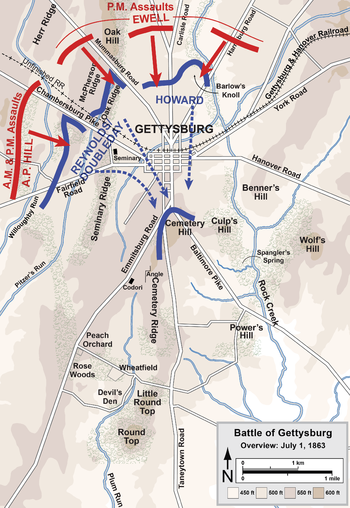
On July 1, between 8 and 9 a.m., reports came in from the First Brigade (Colonel Gamble’s) that the enemy was coming down from toward Cashtown in force. Colonel Gamble made an admirable line of battle, and moved off proudly to meet him. The two lines soon became hotly engaged, we having the advantage of position, he of numbers. The First Brigade held its own for more than two hours, and had to be literally dragged back a few hundred yards to a position more secure and better sheltered. Tidball s battery, commanded by Lieutenant Calef, Second U.S. Artillery, fought on this occasion as is seldom witnessed. At one time the enemy had a concentric fire upon this battery from twelve guns, all at short range. Calef held his own gloriously, worked his guns deliberately with great judgment and skill, and with wonderful effect upon the enemy. The First Brigade maintained this unequal contest until the leading division of General Reynolds’ corps came up to its assistance, and then most reluctantly did it give up the front. A portion of the Third Indiana found horse-holders, borrowed muskets, and fought with the Wisconsin regiment that came to relieve them. While this left of my line was engaged, Devin’s brigade, on the right, had its hands full The enemy advanced upon Devin by four roads, and on each was checked and held until the leading division of the Eleventh Corps came to his relief.
After the fall of General Reynolds, whose advance troops partially drove back the enemy and made heavy captures of prisoners, the enemy brought up fresh troops, and engaged General Doubleday’s command, which fought bravely, but was greatly outnumbered and forced to fall back. Seeing our troops retiring, and their need of assistance, I immediately rushed Gamble’s brigade to Doubleday’s left, and dismounted it in time to render great assistance to our infantry, and to check and break the enemy’s line. My troops at this place had partial shelter behind a low stone fence, and were in short carbine range. Their fire was perfectly terrific, causing the enemy to break and rally on their second line, which made no farther advance toward my position.
Shortly after this, I placed my command on our extreme left, to watch and fight the enemy should he make another attack, and went to Cemetery Hill for observation. While there, General Hancock arrived, and in a few moments he made superb disposition to resist any attack that might be made.
My division bivouacked that night on the left of our position, with pickets extending almost to Fairfield. The zeal, bravery, and good behavior of the officers and men on the night of June 30, and during July 1, was commendable in the extreme. A heavy task was before us; we were equal to it, and shall all remember with pride that at Gettysburg we did our country much service.
[youtube]http://www.youtube.com/watch?v=OE-BKmlr3OI[/youtube]


Donald;
Thank you for this post. It is nice to see my home State of Wisconsin gets a mention. I was with a unit that was originally part of the 2nd Wisconsin but it was renamed to the 127th Inf. Reg. When I took a tour of Gettysburg, the guide showed us where a Wisconsin unit that took part in the battle were positioned but never mentioned who they were or if they were part of the action. It was (now it is in doubt) my understanding the Wisconsin units were on the far left and did not take part in the direct fighting. Here is more information on WI unitshttp://www.gettysburg.stonesentinels.com/WI.php. Thank you again!
On Confederate arrogance; British military observer Coldstream Guards L/C Fremantle wrote, “. . . the universal feeling in the army was one of profound contempt for an enemy whom they have beaten so constantly.”See Sears.
Prior to Brandy Station, the Union cavalry was second-rate. That reversed at Gettysburg.
Buford’s cav was doing for Meade what Stuart’s was not doing for Lee. What’s more, Buford fixed the Confederate Army at Gettysburg. His stalling, in-depth (fighting like mounted infantry) defense held the ground for infantry reinforcement and confused the Confederates.
SEars states the “gods of war” smiled on the Rebs that afternoon. Had A. P. Hill and Ewell (Jackson’s replacement) sufficiently assumed the offensive, they’d likely have destroyed the two Union Corps (once again the XI covered itself in other than glory).
Then again, Meade had planned to fight it out on the Pipe Creek line. A delay in the conflagration may have given back to Lee his “eyes”, J. E. B. Stuart.
To my thinking, this is the day the battle was decided. An army couldn’t hope for a better field than the Union’s fallback position on the hills. The rest of the battle was unwinnable for the Confederates.