
(The above video was posted by the White House yesterday.)
Here once the embattled farmers stood,
And fired the shot heard round the world.
Ralph Waldo Emerson
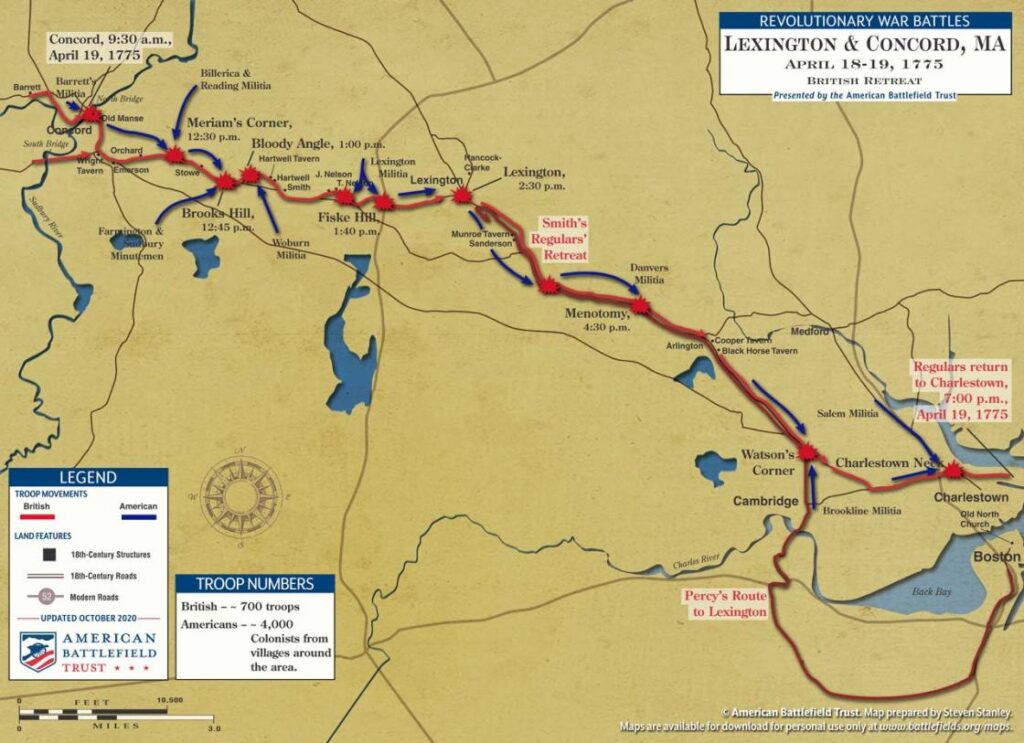
On the eve of the Revolution the 13 colonies had no Army but they were not defenseless. Their militias constituted a military force of uncertain power but they had a history as old as their colonies and they allowed the colonists to assume that, as a last resort, they would not be helpless against the British Army. General Thomas Gage, the commander of the British garrison in Boston and the military governor of Massachusetts, viewed the militia as a constant threat to his forces, and it was his sending of a detachment of 700 troops to seize the militia arsenal at Concord that precipitated the American Revolution.
The battles of Lexington and Concord on April 19, 1775 demonstrated both the strengths and the weaknesses of the American militia system. The initial clash at Lexington involved a standard militia unit of 77 men, not a picked minute man company. The militia was under the command of Captain John Parker, a veteran of the French and Indian War. Parker was in ill-health, suffering from tuberculosis, and some accounts indicate he was difficult to hear. 77 men of course stood no chance against 700 British regulars, and Parker seemed to regard his militia as making a political statement rather than actually attempting to stop the British. Shots were exchanged, who fired first is unknown. The British swiftly brushed aside the fleeing militia and continued their march on Concord. So far, so ineffective, as far as the American militia was concerned.
But the British did not simply have to deal with one company of militia at Lexington. The entire country around Boston was up in arms, the word of the British foray spread by Paul Revere, William Dawes and other messengers, and the militia companies were assembling and marching to fight, convinced after the news of Lexington filtered out that the long-expected war had begun.
By the time the British reached Concord some 250 militia had assembled. Realizing that he was outnumbered by the British, Colonel James Barret withdrew from Concord across the North Bridge and posted his men on a hill a mile north of the village where they could keep an eye on the Redcoats, and they were swiftly joined by reinforcing militia.
Smoke began rising from Concord as the British troops destroyed munitions. The militia became restive, asking their officers if they were to stand idle while Concord was burned to the ground by the “lobsterbacks”. (Fire had spread to the Concord meetinghouse, but the British had joined in the bucket brigade that put out the fire.) Seeing only approximately 95 British soldiers, Colonel Barret order his men to advance with muskets loaded, but not to fire unless fired upon.
As the militia advanced, the British fired upon them and the militia fired back. The heavily outnumbered British fled to a reinforcing column of Grenadiers coming from the center of Concord. The Americans were astonished by all this, most of the men still surprised that an actual war had started. Most of them withdrew back to the hill while others ran home, a real war being more than they had bargained for.
Now the British began their long retreat to Boston, their march shadowed on each side by enraged American militia who constantly, from concealment, peppered the British column with shots. Eventually some 3800 American militia would participate in the bloody harassment of the British as they desperately continued their march. Probably none of the 700 British would have made it back to Boston but for a reinforcing column of 1000 regulars which awaited them at Lexington. The combined force of approximately 1700 men then marched back to Boston, still under heavy harassing fire. By the end of the day some 73 regulars had been killed, 174 wounded and 53 missing. The American casualties numbered 49 dead, 39 wounded and 5 missing. If there had existed a central command capable of directing all of the militia units involved, it is doubtful if the British would have been able to escape. However, each unit of the militia, virtually each member of each militia unit, was left to conduct the fight as they saw fit. Even so, the results of the day had been absolutely stunning, with the British retreating from a militia which they had hitherto widely mocked. Boston was now besieged by an American militia army of 20,000 raised seemingly by magic to the astonished British. No one could doubt after that red April day that the war had well and truly begun.


Interesting. There is a theory that the New World Order is something engineered by the UK developing from Winston Churchill at the end of World War II to preserve British hegemony and part of the reason why you see BBC intentionally editing Trump’s speeches and the labor party in England doing things like sending people to campaign for Kamala Harris in this country is because Trump threatens them. Those advancing this Theory say that Trump is the existential threat. So maybe this is the final end of the American Revolution. I must admit that I started to think differently about England after I heard about the “naughty document.”
Churchill was often called “the Yankee” by his political opponents because his mother was an American and his political style was “un-British”. In his four volume History of the English Speaking Peoples, written before World War II, but not published until the 50’s, he demonstrated a great fondness for, in his phrase,”The Great Republic”. (In his third volume, Age of Revolution, the paperback version, the cover has a depiction of the Americans at the Battle of Bunker Hill.) Churchill wanted to preserve the British Empire, but when Labour gave up India after the War he knew that was not possible. After he led the Tories back to power in 1951, he realized that the only way the UK could remain a great power was to allow no daylight between the UK and their vastly more powerful “cousins”. He hoped that the English could be the Greeks, offering counsel and traditional wisdom to the American Romans. In all this Churchill was an anomaly, much of the British upper crust always having little love for America or Americans.